Digital Transformation
Digital integration: connecting systems without creating new problems
Digital integration connects the systems a business runs on, such as ERP, point of sale, CRM and operational platforms, so that data and work move between them without someone copying them by hand. It succeeds when ownership, data contracts and security are settled before the first connection is built.

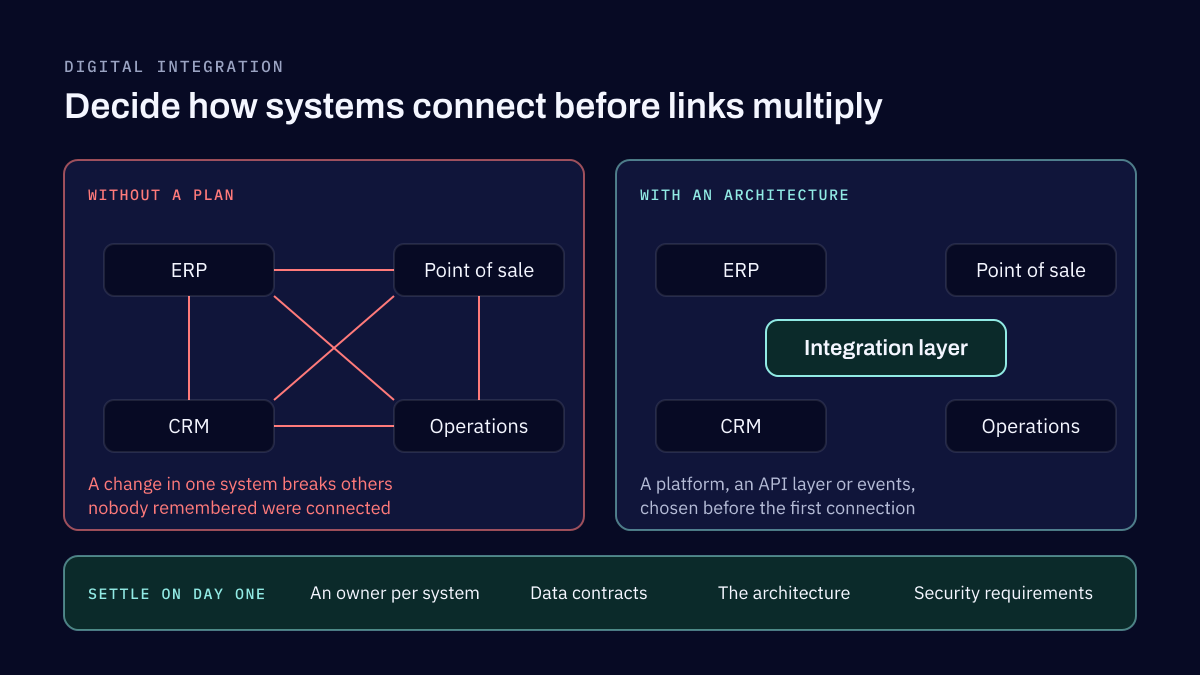
Digital integration means connecting the systems your business runs on, such as the ERP, point of sale, CRM and operational platforms, so that data and work move between them on their own. Done well, an order entered once reaches finance, stock and customer service without anyone retyping it. Done badly, it adds a new set of fragile connections that nobody owns. The difference is mostly decided before the first connection is built.
The problem integration solves
Most businesses run on more systems than they can keep in step. MuleSoft's 2026 Connectivity Benchmark Report, a survey of 1,050 enterprise IT leaders carried out in late 2025, found that the number of applications in an enterprise grew from 897 to 957 in a year, and that only 27% of them were integrated with each other. The same survey found that 96% of organisations face barriers to using their data for AI. Those are a vendor's figures from large enterprises, but the pattern holds in smaller companies too: every system added without a plan for how it shares data becomes one more place where information has to be copied, checked and reconciled by hand.
What integration looks like in practice
In the projects I have led, integration has meant connecting ERP, point of sale, CRM and operational platforms through three kinds of link:
- APIs, so one system can ask another for data or send it a change as it happens, such as a sale at the till updating stock.
- Data pipelines, which move and reshape larger volumes on a schedule, such as the day's transactions loaded into reporting.
- Automated workflows, which replace a manual handoff between teams with a sequence the systems carry out, such as a new customer in the CRM opening an account in the ERP.
The aim each time is the same: keep business data in step across systems, remove the manual steps that slow work down and introduce errors, and let people work from one version of the facts.
Where integration projects go wrong
The failures repeat from one project to the next, and few of them are technical at the start.
No one owns the data. When a customer record lives in three systems, someone has to decide which one is right. Without an owner for each kind of data, every conflict becomes a meeting, and the integration copies errors as faithfully as it copies facts.
Point-to-point connections multiply. Each new link is quick to build on its own, and together they become a web where a change in one system breaks others nobody remembered were connected.
Data models don't match. "Customer", "order" or "product" means something slightly different in each system. Mapping those differences once, in writing, is cheaper than discovering them one failed transaction at a time.
Vendor lock-in. Business logic built deep inside one product's connectors is hard to move when the product, the price or the contract changes.
Security comes last. Integrations are accounts with broad access to business data, and they are often given more permissions than they need because that is quicker during testing. Verizon's 2026 Data Breach Investigations Report found that breaches involving a third party made up 48% of all breaches, and every integration with an outside service is a third-party connection.
What to set up before the first connection
If I started an integration project again tomorrow, four things would be settled from day one:
- System ownership. Each system, and each kind of data, has a named owner who decides what is correct and approves changes.
- Data contracts. For every flow, a written agreement between the system that sends the data and the systems that receive it: the fields, their meaning, their format and how a change is announced. The Open Data Contract Standard, a Linux Foundation project, offers a common format, now at version 3.2.
- An integration architecture. A decision about how systems connect, whether through an integration platform, an API layer or events, made before the connections multiply rather than after. APIs are described in a standard format such as OpenAPI 3.2, so another team can build against them. Our architecture design service produces that design and the decisions behind it.
- Security requirements. Written down with the architecture, not added after go-live.
Building security into every connection
Security has to be part of the architecture, not a review at the end. In practice that means:
- Least-privilege access. Each integration gets its own account with only the permissions its flow needs, never a shared administrator login.
- Encryption. Data is encrypted in transit, with TLS 1.3 (now specified in RFC 9846), and at rest wherever it is stored along the way.
- API security. Every API checks who is calling and what that caller may see. The OWASP API Security Top 10, whose current edition is from 2023, puts broken object level authorisation first: an API that returns any record it is asked for, whoever asks. Where APIs use OAuth, the IETF's RFC 9700 of 2025 sets out current good practice.
- Audit logging. Every connection records what it read and changed, so a problem can be traced to its source.
- Continuous monitoring. Failed calls, unusual volumes and access outside normal patterns are watched, so a broken or abused connection is noticed in hours, not at month end.
Postman's 2025 State of the API Report, a survey of more than 5,700 developers and API professionals, found that 82% of organisations have adopted an API-first approach to some degree. As APIs become the way systems talk, the controls above become part of running the business, not an extra.
Where to start
Start with one flow that hurts today, such as orders retyped from one system into another, and map it from end to end: which systems it touches, who owns each piece of data and what has to be true for it to work. Write the data contract and the security requirements for that flow, build it on the architecture you intend to keep, and use what you learn to plan the next one.
If you are deciding where integration fits in a wider change, our digital transformation advisory sets the order of work with your leadership. When the design is settled, our software development team builds integrations and APIs, and our application and cloud security reviews check them before they go live. See all of our digital transformation services.
Frequently asked questions
What is the difference between digital integration and digital transformation?
Digital transformation is the broader change in how a business works with technology, from strategy to the systems themselves. Integration is one part of it, often the part that decides whether the rest works, because new systems that cannot exchange data with the old ones leave people copying information between screens.
Should we use point-to-point connections or an integration platform?
A handful of point-to-point connections is fine while the number of systems is small and stable. Once several systems need the same data, a shared layer, such as an integration platform, an API gateway or an event broker, keeps each system connected once instead of to every other system. The choice matters less than deciding it on purpose, before the connections multiply.
What is a data contract?
A data contract is a written agreement between the system that produces data and the systems that use it. It states the fields, their meaning and format, who owns them, how quality is checked and how changes are announced. The Open Data Contract Standard gives teams a common format for writing one.
When should security be part of an integration project?
From the first design session. Each connection is an account with access to business data, so its permissions, how its credentials are stored, how traffic is encrypted and what is logged need to be decided with the architecture. Security added after go-live usually means reworking connections that are already in use.
Sources
- 2026 Connectivity Benchmark Report, MuleSoft, 2026
- 2025 State of the API Report, Postman, 2025
- 2026 Data Breach Investigations Report, Verizon, 2026
- OWASP API Security Top 10, 2023 edition, OWASP Foundation, 2023
- RFC 9700: Best Current Practice for OAuth 2.0 Security, IETF, 2025
- Open Data Contract Standard, Bitol, a Linux Foundation AI & Data project, 2026
Digital transformation strategy consulting
We find out where your business stands today, decide with your leadership what to change and in what order, and write it down as a roadmap with costs and measures. If you want, we stay on to oversee the programme while it is carried out.
Related reading
Digital Transformation
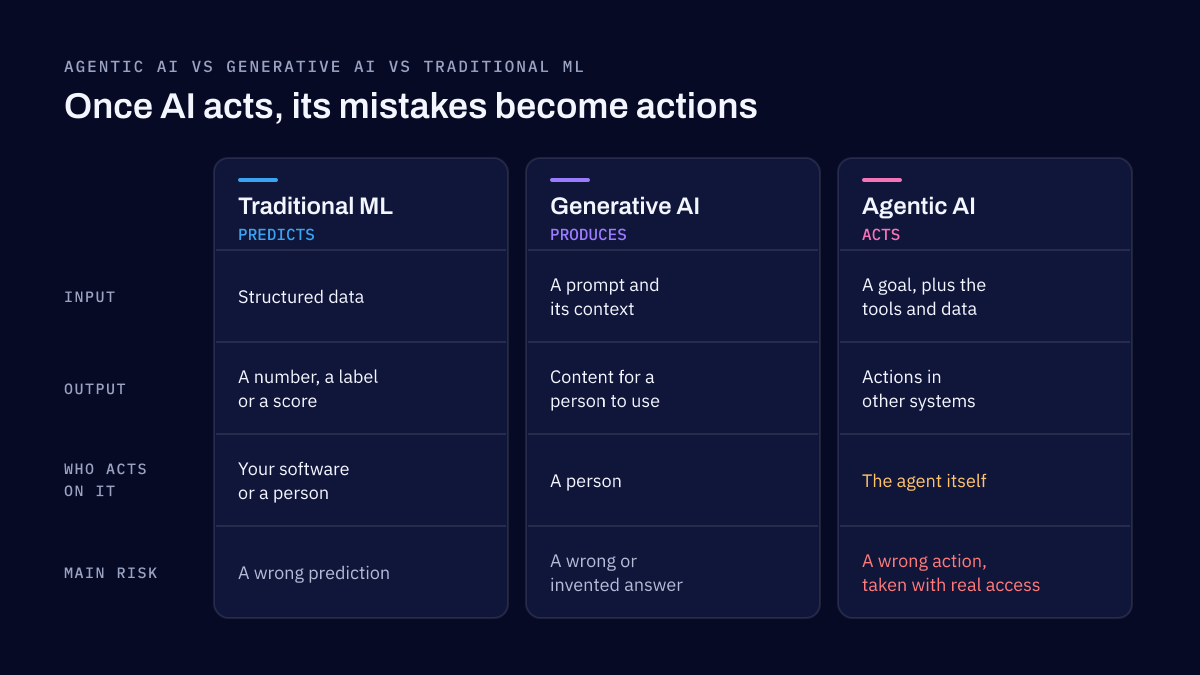
Agentic AI vs generative AI vs traditional ML: what changes when AI starts taking action
Traditional machine learning predicts, generative AI writes, and agentic AI acts. The difference decides what a project costs, what can go wrong and how much control it needs. Here is how to tell the three apart, with examples of each, and how to choose the one your project actually needs.
Digital Transformation
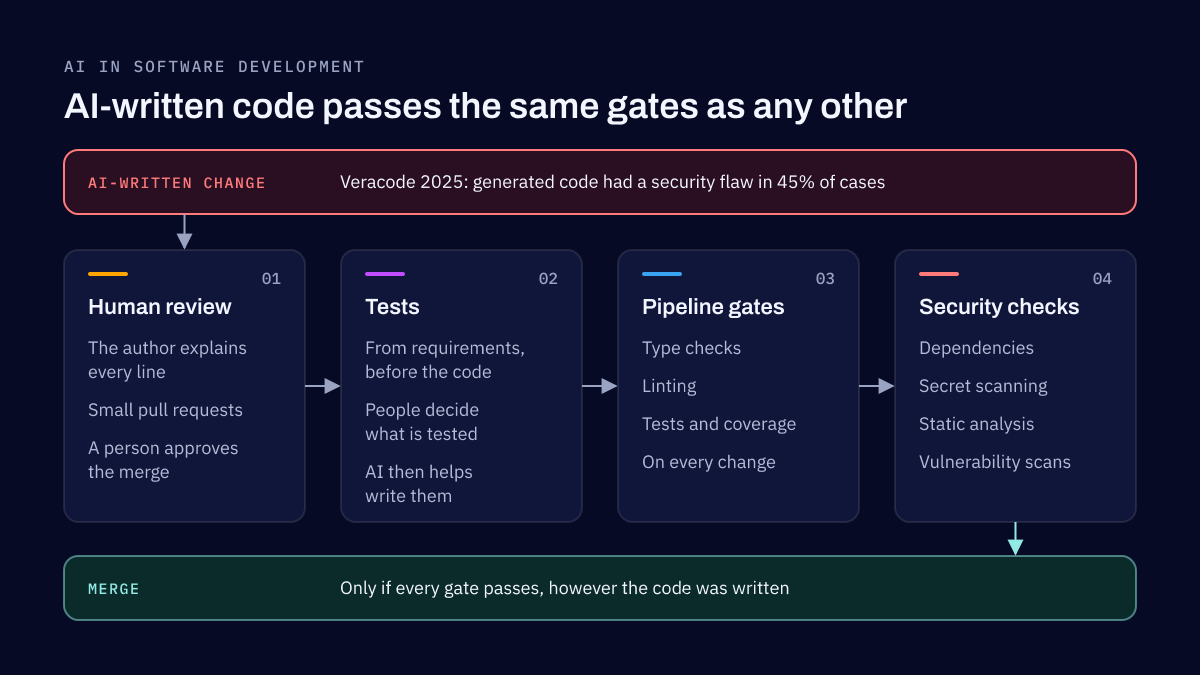
AI in software development: how QA changes in the age of vibe coding
AI assistants and agents now write, review and test code. They make code faster to write, not safer to ship. Four public incidents show what goes wrong, and what review, testing, security checks and governance have to look like when much of the code is written by AI.
Tell us what you want to change
What is holding the business back, and any date that is driving it. We reply within two business days.