Teams and Outsourcing
What is IT staff augmentation, and when does it fit?
IT staff augmentation adds a specialist to your technical team without adding them to your payroll. This article compares it with a permanent hire and a project, explains who directs the work and how an engagement starts and ends, and says when it is the wrong choice.

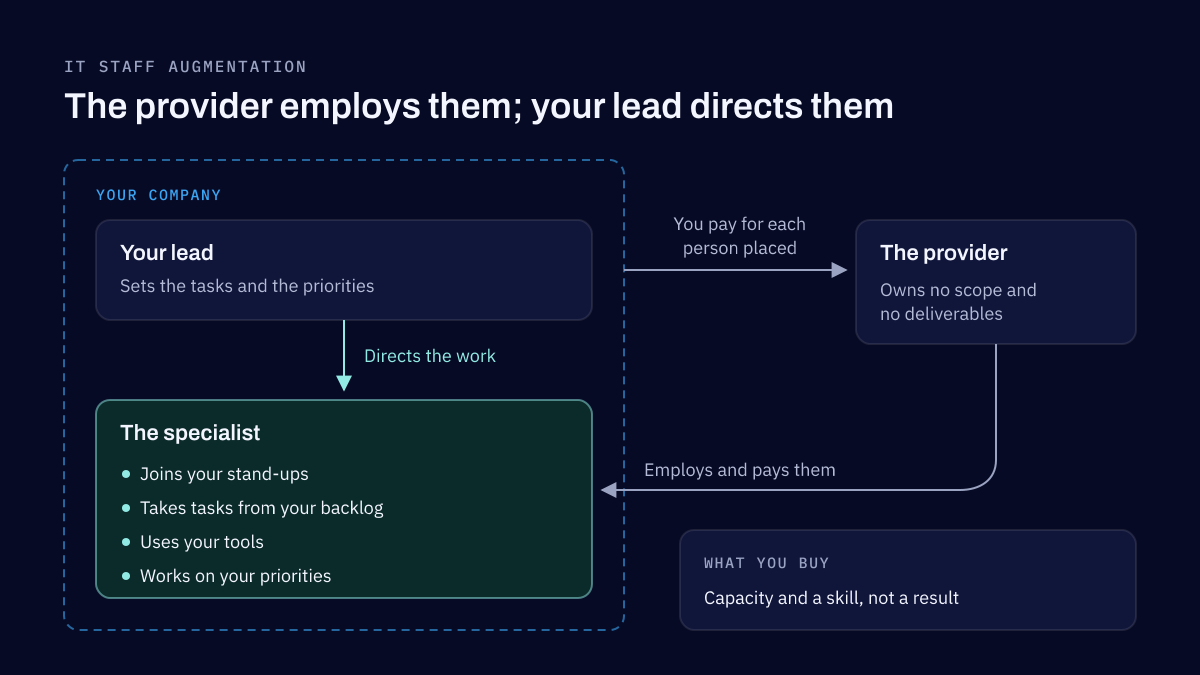
IT staff augmentation adds a specialist to your technical team without adding them to your payroll. A provider places one of its own engineers or developers in your team, your lead directs their work, and you pay the provider for as long as you need the person. It differs from a permanent hire, who becomes your employee, and from a project, where the provider owns a scope and is responsible for the result.
Below: how the arrangement works, how it compares with a hire and a project, what makes a placement work, and when it does not fit.
How staff augmentation works
Three parties are involved: your company, the provider and the specialist. The provider employs or contracts the specialist and pays them. You pay the provider for each person placed. The specialist works in your team, with your tools and on your priorities, the way a new member of staff would.
What you are buying is capacity and a skill, not a result. A security engineer, a cloud engineer or a software developer joins the team, and the team decides what they do. When the need ends, the engagement ends, and nobody has to be let go from your payroll.
Staff augmentation, a permanent hire or a project
The three options differ on who employs the person, who directs the work and what you are paying for.
| Permanent hire | Project | Staff augmentation | |
|---|---|---|---|
| Who employs the person | You | The provider | The provider |
| Who directs the work | You | The provider, against a written scope | You, through your own lead |
| What you pay for | A salary and benefits | A defined result | A person's time, for as long as you need it |
| How it ends | Resignation or dismissal | When the result is delivered | With notice, when the need ends |
Clients do not always ask for the option they need. When a request comes in, a few signs tell me which one fits. If the client describes an outcome, a finished migration or a penetration test report, rather than a role, it is a project, and the provider should own a scope. If nobody on the client's side can direct the work or knows what to ask the specialist for, it is a project too, because someone has to own the plan.
It also runs the other way. A client asks for a project, but the work changes every week and they want to steer it themselves. Or the need has no end date: pipelines that have to keep running, a backlog of vulnerabilities to work through month after month. A scope written today would be wrong in a month, and a person in the team fits better.
Who directs the work
In staff augmentation, the client's lead directs the specialist, as they would anyone else on the team. The specialist joins stand-ups, takes tasks from the backlog and answers to the person the client names. The provider owns no scope and no deliverables, and it does not stand between the lead and the specialist on the day-to-day work.
That is the point of the arrangement, and it asks something of the client: a named owner. A specialist with no one to direct them waits for tasks or gets pulled in several directions, and neither helps the team.
How an engagement starts and ends
Terms differ between providers, so read the contract. At GUILDA, a US engagement starts with a description of the role: the skills, the start date and whether the work is remote or on-site. We propose one of our own people with a profile, you interview them as you would a candidate for your own team, and nobody starts without your approval. Then the contract is signed and the specialist starts.
The engagement runs month to month, with no minimum term, and either side ends it with 30 days' notice. If the specialist leaves or turns out not to be the right fit, we propose another of our people and arrange a handover, at no extra charge. The Outsourcing page sets out the full terms.
The first weeks
Most placements that struggle do so early, and for the same few reasons. Access is not ready: accounts, VPN, repositories or cloud permissions are still being requested on the first day, and the first week is lost waiting. Nobody is named to direct the specialist. The specialist is left out of the team's stand-ups, chats and decisions, so they work without context. Or no first goal or backlog is ready, and the first weeks go on finding out what the team wants.
Each has a simple fix before the start date: request access early, name the lead, add the specialist to the team's channels and meetings, and write down the first goal.
What makes it last
The placements that work for a long time look like ordinary employment from the inside. The client's lead checks in regularly, gives feedback and resets priorities, as with their own staff; placements that end early often end after weeks of silence. The specialist is treated as a member of the team, included in reviews and decisions rather than handed isolated tickets.
When something is not working, the client says so early, while it can still be corrected, or the specialist replaced, before the placement fails. And the need stays clear. Placements end early when the reason for them disappears, or when it was never well defined in the first place.
When it does not fit
Staff augmentation is the wrong choice when nobody on your side can direct the work, or when what you want is a defined result. In both cases, a project with a written scope serves you better, such as Software Development or Cloud Transformation run by a provider's own team.
A permanent hire is the better answer when the skill is central to your business and needed indefinitely, when the role builds knowledge the company must keep, such as its architecture or its key systems, or when the role leads people or sets direction for the team. A placed specialist should not hold any of those. Staff augmentation can still cover the work while you recruit, and the permanent hire takes over when they arrive.
If the gap is a skill your own staff could learn, Cybersecurity Training leaves it with them, and the two often go together: a placed specialist covers the work while the team learns.
Frequently asked questions
How is staff augmentation different from outsourcing?
In outsourcing, you hand a provider a piece of work, such as a project or a function, and the provider decides how to deliver it. In staff augmentation, the provider places a person in your team, and your own lead decides what they work on and how. You keep control of the work; the provider keeps the employment.
Who manages the specialist day to day?
You do. The specialist takes direction from the lead you name, joins your team's routines and works from your backlog, like a member of your own staff. The provider employs them and handles the contract, and steps in if the placement is not working, but it does not set their tasks.
How long does a staff augmentation engagement last, and how does it end?
As long as the need lasts. Terms differ between providers. At GUILDA, US engagements run month to month with no minimum term, and either side ends them with 30 days' notice. If a specialist leaves or is not the right fit, we propose another of our people, with a handover, at no extra charge.
When should we make a permanent hire instead?
When the skill is central to your business and needed indefinitely, when the role builds knowledge the company must keep, such as its architecture or key systems, or when the role leads people or sets direction for the team. Staff augmentation can still cover the work while you recruit.
IT staff augmentation with security, cloud and software engineers
When your team is short of a skill or of hands, we place one of our own security engineers, cloud and DevOps engineers or software developers in it. You interview them before they start, your lead directs their work, and the arrangement runs by the month with 30 days' notice and no minimum term.
Related reading
Business Continuity
Microsoft 365 went down and Microsoft tenants were breached: can your business keep running?
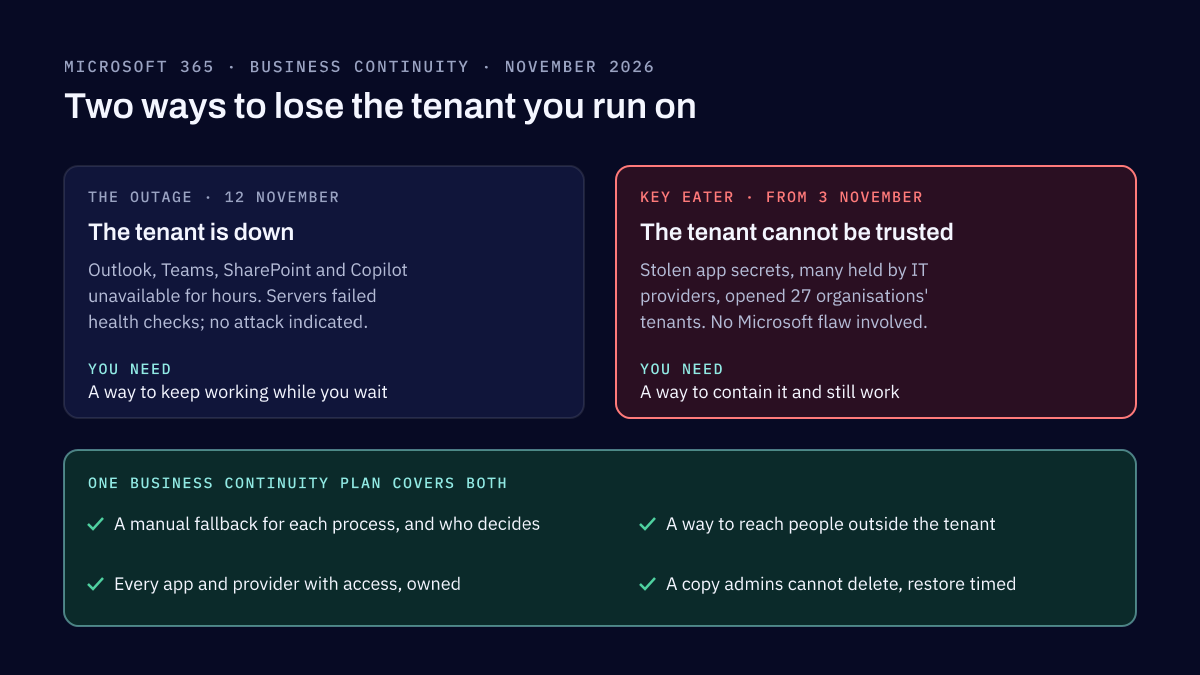
On 12 November 2026 a Microsoft 365 outage cut companies off from Outlook, Teams and Copilot for hours. The same month, stolen app credentials opened 27 organisations' Microsoft tenants, many through their IT providers. Neither was a Microsoft hack, and both test the same business continuity plan.
Digital Transformation
Agentic AI vs generative AI vs traditional ML: what changes when AI starts taking action
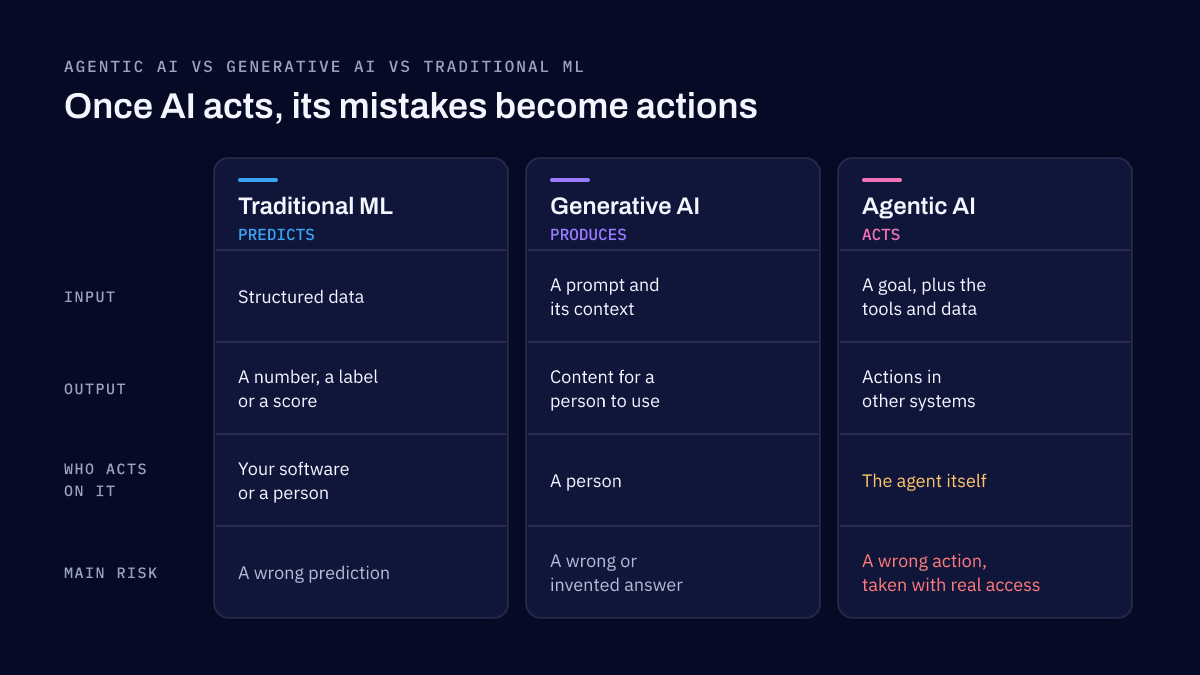
Traditional machine learning predicts, generative AI writes, and agentic AI acts. The difference decides what a project costs, what can go wrong and how much control it needs. Here is how to tell the three apart, with examples of each, and how to choose the one your project actually needs.
Tell us the role you need to fill
The role, the skills and the start date in a few lines. We reply within two business days.