Identity and Access
Identity-based attacks: how they work and what stops them
An identity-based attack uses a real account, with stolen, guessed or abused credentials, instead of breaking through a firewall. It is stopped by phishing-resistant multifactor authentication, least-privilege accounts and removing the dormant and shared accounts attackers rely on, in that order.

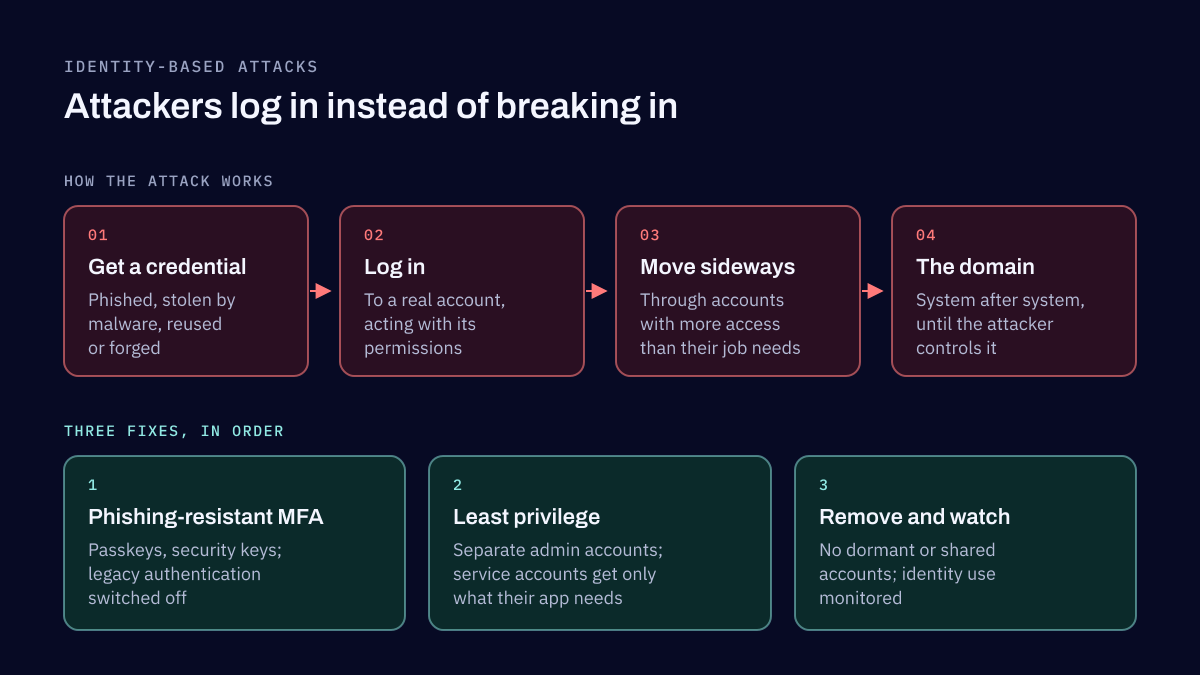
An identity-based attack is one where the attacker logs in instead of breaking in. They use a real account, with credentials that were phished, stolen by malware, reused from another breach or forged, and then act with that account's permissions. The defences that work are phishing-resistant multifactor authentication, accounts that hold only the access they need, and the removal of old and shared accounts, backed by monitoring of how identities are used.
What the IBM X-Force 2024 index found
The live version of this article was written in February 2024 around IBM's X-Force Threat Intelligence Index 2024. Looking at incidents X-Force responded to in 2023, IBM found that the use of stolen credentials to access valid accounts had risen 71% in a year and made up 30% of incidents, tied with phishing as the most common way in. It also recorded a 100% increase in Kerberoasting, an attack on service accounts described below.
The next edition, the X-Force Threat Intelligence Index 2025, found the same for 2024: abuse of user identities was the preferred entry point, in 30% of cases.
What has changed since
The way in has changed since. In IBM's 2026 index, exploitation of vulnerabilities became the leading cause of attacks, at 40% of the incidents X-Force saw in 2025. Verizon's 2026 Data Breach Investigations Report shows the same change in breaches: exploitation rose to 31% of initial access, while credential abuse, the previous leader, fell to 13%, with phishing at 16%.
That does not make identity less important. Credentials are still one of the main ways in, and once an attacker is inside, through a vulnerable server or a phished laptop, accounts are how they move from one system to the next. Microsoft's Digital Defense Report 2025 reported that identity-based attacks rose 32% in the first half of 2025 and that more than 97% of them were password attacks. The question for most companies is no longer whether an attacker will hold a valid account at some point, but how far that account will take them.
How identity-based attacks work
The techniques are well documented in MITRE ATT&CK, the public catalogue of attacker behaviour, where the use of real accounts is technique T1078, Valid Accounts. The paths that work most often in our red team and penetration tests are:
- Credential theft. Passwords and session tokens captured by phishing pages or by infostealer malware on a user's device, then used or sold.
- Password reuse. A password exposed in one breach tried against the company's own sign-in pages, often through password spraying: a few common passwords tried across many accounts.
- Kerberos abuse. Requesting Kerberos tickets for service accounts in Active Directory and cracking their passwords offline (Kerberoasting), or forging tickets once enough access is gained.
- Misconfigured certificate services. Active Directory Certificate Services (AD CS) templates that let an ordinary user request a certificate for someone else, including an administrator.
- Lateral movement through overprivileged accounts. An account with more access than its job needs, used to reach the next system, and the next, until the attacker controls the domain.
The weaknesses that make them work
The same weaknesses appear in most identity assessments we carry out:
- Accounts without multifactor authentication, or with methods that can be phished.
- Service accounts with too much access, passwords that never change and nobody reviewing what they do.
- Dormant accounts of people who left, projects that ended and test users nobody removed.
- Legacy authentication protocols, which accept a password alone and bypass multifactor authentication even where it is switched on.
- Shared administrator accounts, where several people use one login, so no action can be traced to a person.
Each one raises the risk that a stolen credential is accepted, or that an ordinary account becomes a privileged one.
Three fixes, in order
If a company could fix only three identity problems this quarter, these are the three, in this order:
- Enforce phishing-resistant multifactor authentication and disable legacy authentication. Passkeys and security keys built on FIDO standards, or smart cards, resist phishing in a way that codes and push approvals do not. NIST's SP 800-63B-4, final since July 2025, requires services at its second assurance level to offer a phishing-resistant option and requires one at the highest level, and CISA's guidance on phishing-resistant MFA explains how to roll it out. Start with administrators and remote access. At the same time, block legacy protocols, for example with Microsoft Entra Conditional Access, so the new methods cannot be bypassed.
- Apply least privilege to administrative and service accounts. Separate administrator accounts from everyday ones, give each service account only the permissions its application needs, use long random or managed passwords for them, and review privileged access on a schedule.
- Remove dormant and shared accounts, and watch how identities are used. Disable accounts that have not signed in for a set period, give every administrator a named account, and monitor identity activity continuously: impossible travel, sign-ins from new devices, a service account used interactively, a sudden request for many Kerberos tickets.
None of these needs a new product to begin. Most identity platforms already include the controls; what is missing is usually the decision, the inventory and the follow-through.
Where to go from here
Our identity and access management service sets up identity platforms, designs who can reach what, controls privileged access and runs access reviews. To find out which of the paths above work against your own environment, our penetration testing and red team service tests Active Directory and identity systems the way an attacker would. For the monitoring in the third fix, our threat detection and SIEM service connects your identity provider to a SIEM with detection rules your team then runs, and our cybersecurity training helps staff recognise the phishing that starts many of these attacks.
Frequently asked questions
What is an identity-based attack?
It is an attack that uses a legitimate account to get in or to move around, instead of exploiting a flaw in software. The attacker steals, guesses, buys or forges the credentials of a real user or service account, then acts with that account's permissions. Because the activity looks like normal sign-ins, it is harder to spot than malware.
Is any multifactor authentication enough?
No. Codes sent by text message, one-time passwords and push approvals can all be phished or abused, for example by flooding a user with push requests until one is accepted. NIST SP 800-63B-4 and CISA both recommend phishing-resistant methods, such as passkeys and security keys built on FIDO standards, or smart cards, especially for administrators.
What is legacy authentication and why disable it?
Legacy authentication covers older sign-in protocols, such as basic authentication for mail, that send a user name and password and cannot ask for a second factor. An account protected by multifactor authentication can still be reached through them with the password alone, which is why they need to be switched off once nothing depends on them.
How do attackers abuse service accounts?
Service accounts run applications and integrations, often with broad permissions, passwords that never change and nobody watching their sign-ins. Attackers look for them because one of them can open many systems. Techniques such as Kerberoasting let an attacker request a Kerberos ticket for a service account and crack its password offline.
Sources
- X-Force Threat Intelligence Index 2024, IBM, 2024
- X-Force Threat Intelligence Index 2025, IBM, 2025
- X-Force Threat Intelligence Index 2026, IBM, 2026
- 2026 Data Breach Investigations Report, executive summary, Verizon, 2026
- Microsoft Digital Defense Report 2025, Microsoft, 2025
- SP 800-63B-4: Digital Identity Guidelines, Authentication and Authenticator Management, NIST, 2025
- Implementing Phishing-Resistant MFA, CISA, 2022
- Valid Accounts, T1078, MITRE ATT&CK, 2026
Identity and access management services
We set up the identity platform your staff and customers sign in through, design who can reach what, put controls around administrator access and run the access reviews that keep it right. The work runs on Okta, Auth0, Microsoft Entra ID or Google Workspace.
Related reading
Identity and Access
Identity governance and administration for AI agents: reviews, lifecycle, least privilege
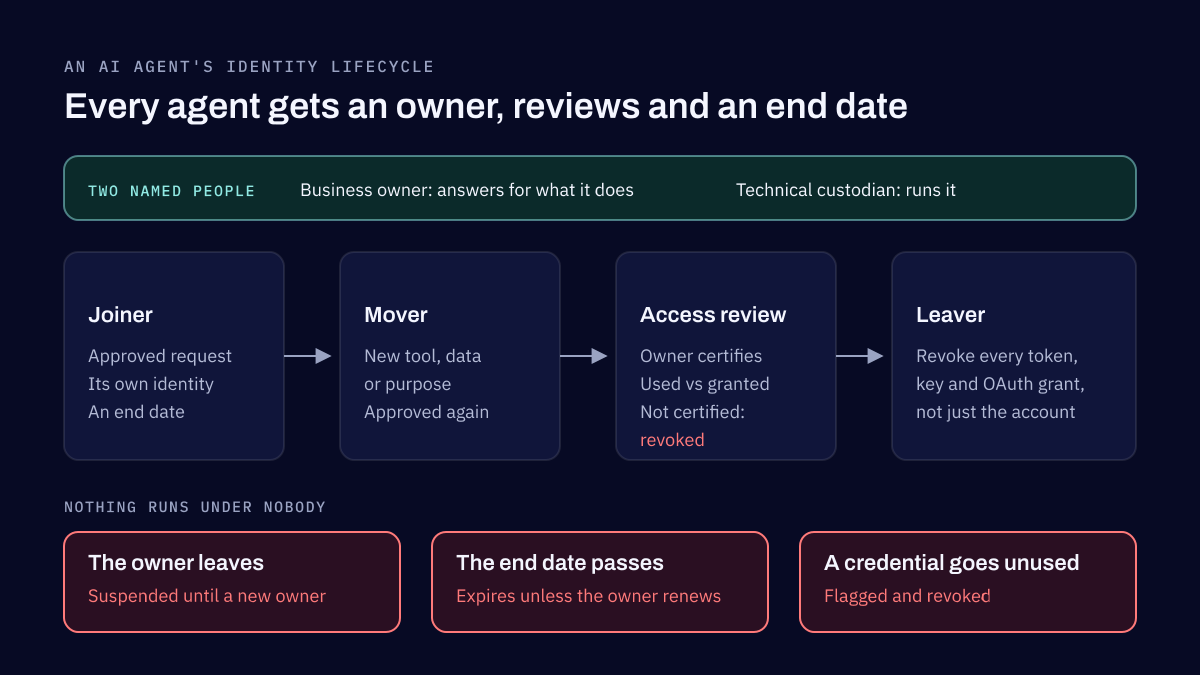
Identity governance and administration decides who should have access to what, keeps that access right as people join, move and leave, and proves it with reviews. AI agents are the newest identities it has to govern. Each needs an owner, a joiner, mover and leaver process, access reviews and an end date, like any other account.
Business Continuity
Microsoft 365 went down and Microsoft tenants were breached: can your business keep running?
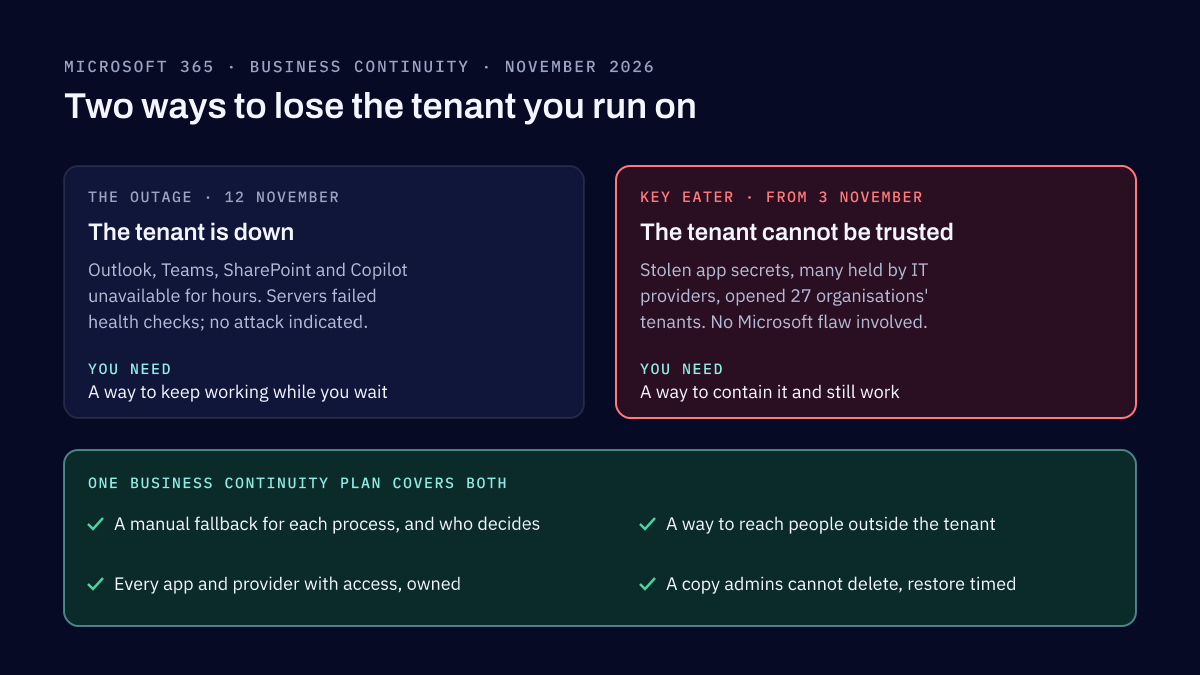
On 12 November 2026 a Microsoft 365 outage cut companies off from Outlook, Teams and Copilot for hours. The same month, stolen app credentials opened 27 organisations' Microsoft tenants, many through their IT providers. Neither was a Microsoft hack, and both test the same business continuity plan.
Tell us how your people and customers sign in today
Name the platforms you use, roughly how many people and applications are involved, and what prompted the question. We reply within two business days.