Security Testing
Red team vs penetration testing: which test answers your question
A penetration test finds as many weaknesses as it can in a defined scope, with your team aware of it. A red team pursues one goal the way a real attacker would, to test whether your people and processes detect and stop it. Purple teaming sits between them.

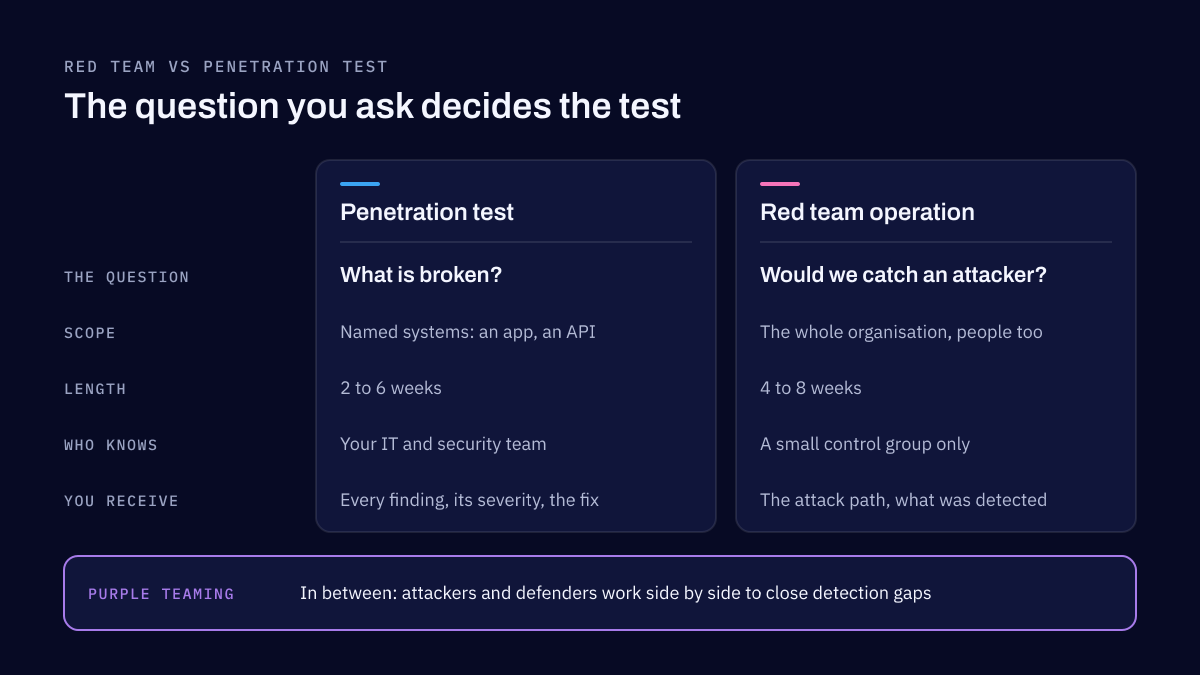
A penetration test finds as many exploitable weaknesses as it can in a defined scope, over a few weeks, with your team aware of it, and ends with a list of what to fix. A red team operation pursues one goal, such as reaching a payment system, the way a real attacker would, to test whether your people and processes notice and stop it. Purple teaming sits between them: attackers and defenders work side by side to close the gaps in detection. Which one you need depends on the question you are asking.
The two tests side by side
| Penetration test | Red team operation | |
|---|---|---|
| Goal | Find and rank the weaknesses in a defined scope | Reach one objective, and test detection and response on the way |
| Scope | Named systems: an application, an API, a network, a cloud account | The whole organisation, its people included, aimed at one goal |
| Length (our engagements) | 2 to 6 weeks, fixed price | 4 to 8 weeks, fixed price or time and materials |
| Who knows | Your IT and security team, who often help the testers | A small control group only; the defenders do not know |
| What you receive | Every finding with evidence, its severity and how to fix it, then a retest | The attack path, what was and was not detected, and how the response went, then a retest |
NIST's testing guide, SP 800-115, describes penetration testing as testers mimicking real-world attacks to find ways around the security features of an application, system or network. NIST's glossary defines a red team as a group authorised to emulate a potential adversary's capabilities against an organisation's security posture. The first is about the system. The second is about the organisation that defends it.
When a penetration test is the better first step
Many requests for a red team are better served by a penetration test first. These are the signs:
- There has never been a penetration test, or the last one's findings are still open. A red team would spend its weeks rediscovering basics a penetration test lists faster and for less.
- No one is watching. If there is no monitoring and no team whose job is to detect and respond, a red team has nothing to test except the weaknesses themselves.
- A compliance requirement asked for it. An auditor, a customer or the payment card industry's data security standard asks for a penetration test (SOC 2 and ISO/IEC 27001 auditors often expect one), and a red team report does not satisfy it. Our compliance work starts from what the auditor needs.
- The question is what is broken, not whether you would catch an attacker. The question decides the test.
What each finds that the other misses
The two tests are not stronger and weaker versions of each other. Each finds things the other cannot.
A red team shows whether alerts fire and whether anyone acts on them. A penetration test rarely tests that, because the team knows it is coming. A red team also chains small issues into one route: a phished password, a forgotten service account, a misconfigured certificate template, each minor on its own. A scoped penetration test would report them as separate low findings. The identity paths attackers use are often where these chains run.
A penetration test, for its part, covers its scope systematically and finds many weaknesses a red team never touches, because the red team stops once it reaches its goal. It also finds application and API flaws, such as broken access control and business logic errors, that a red team skips when an easier path exists.
Detection is the part a penetration test cannot measure. Mandiant's M-Trends 2026 reported that the median time an attacker stayed in a network before being found rose from 11 to 14 days, and that organisations found intrusions themselves in 52% of cases in 2025, up from 43% in 2024. CrowdStrike's annual threat findings for 2025, published in 2026, put the average time for criminal attackers to move from their first foothold to other systems at 29 minutes. Whether your team would be in the 52% is what a red team finds out.
Who knows about a red team
A red team only works if the defenders do not know it is happening, and it is only safe if the right few do. In practice:
- A small control group knows. A sponsor, usually the CISO, and one or two others who can confirm that an alert is the exercise and stop the test if needed.
- Rules of engagement are written and signed. They state the goal, what is off limits, the testing window and who to call to stop. Nothing is tested without written authorisation.
Both mistakes are costly. When too many people know, the defenders behave differently and the test no longer shows how they would respond to a real attack. When too few know, a real incident response can begin: lawyers, the police or a vendor get involved, or a production system is shut down. The European Central Bank's TIBER-EU framework, which governs red teaming of large EU financial entities, keeps knowledge to a small trusted group on a need-to-know basis for the same reason.
Purple teaming, between the two
In a purple team exercise the attackers run their techniques while the defenders watch, and both work out together why each one was or was not seen. We recommend it in two places:
- Before a red team, when detection is new or untested. Work through the techniques together first, then test the result blind with a red team.
- After a red team, to replay the techniques that went unseen with the defenders present and fix each gap.
The team leaves with more than a report: detection rules written or tuned and mapped to MITRE ATT&CK, now at version 20, a list of what is still not seen, and defenders who know how each technique looks in their own logs. If those rules need a platform to run on, our threat detection and SIEM service builds it and hands it to your team. TIBER-EU's 2025 update made a purple teaming phase part of every test it governs.
Choosing
Start from the question. If you need to know what is broken in a system, or an auditor asked, buy a penetration test. If your weaknesses are known and fixed, and you need to know whether your team would catch an attacker, buy a red team. If you are not sure your defenders could see the attack at all, start with purple teaming. Our red teaming and penetration testing service runs all three, each ending with a report and a retest.
Frequently asked questions
Is a red team better than a penetration test?
Neither is better; they answer different questions. A penetration test tells you what is broken in a defined scope and how to fix it. A red team tells you whether your defenders would notice and stop a real attack. Most companies need the first before the second is worth paying for.
Do we need a security operations team before a red team?
You need someone whose job is to detect and respond, in house or a provider, and the logs they would use. Without them, a red team has nothing to test beyond the weaknesses a penetration test finds faster and for less. A purple team exercise is often the better way to build that capability first.
Does a compliance requirement call for a red team?
Usually not. The payment card industry's data security standard requires penetration testing, and SOC 2 and ISO/IEC 27001 auditors and customers often expect it; a red team report does not replace it. Threat-led red teaming is required in some regulated sectors, such as large EU financial entities under TIBER-EU and the EU's Digital Operational Resilience Act, but not for most companies in the United States or Mexico.
How long does each engagement take?
Our penetration tests and purple team exercises take 2 to 6 weeks at a fixed price. Red team operations take 4 to 8 weeks, at a fixed price or on time and materials depending on the project, because the attack follows the goal rather than a checklist.
Sources
- SP 800-115, Technical Guide to Information Security Testing and Assessment, NIST, 2008
- Glossary: red team (CNSSI 4009-2022), NIST, 2022
- M-Trends 2026, Mandiant (Google Cloud), 2026
- Annual threat findings for 2025, press release, CrowdStrike, 2026
- MITRE ATT&CK, version 20, MITRE, 2026
- TIBER-EU Framework, 2025 update, European Central Bank, 2025
Penetration testing services and red team operations
We test your applications, networks, cloud and identity systems the way an attacker would, and red team operations go after a goal you set. Every engagement ends with a findings report and a retest of what your team has fixed.
Related reading
Business Continuity
Microsoft 365 went down and Microsoft tenants were breached: can your business keep running?
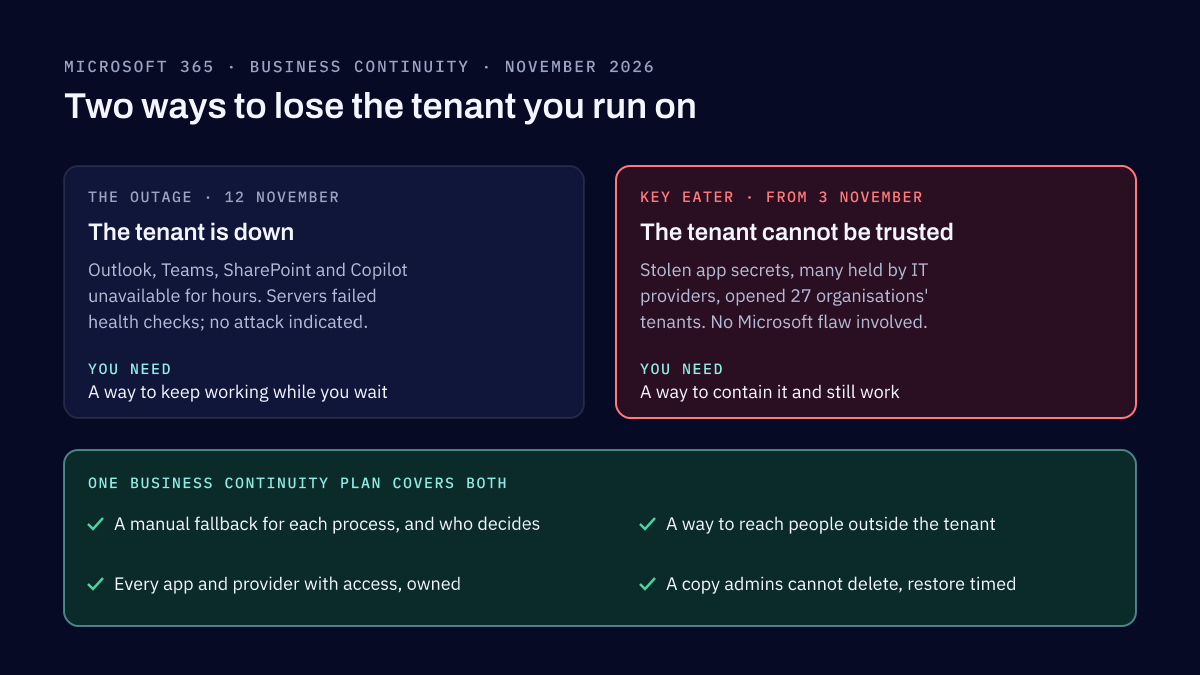
On 12 November 2026 a Microsoft 365 outage cut companies off from Outlook, Teams and Copilot for hours. The same month, stolen app credentials opened 27 organisations' Microsoft tenants, many through their IT providers. Neither was a Microsoft hack, and both test the same business continuity plan.
Digital Transformation
Agentic AI vs generative AI vs traditional ML: what changes when AI starts taking action
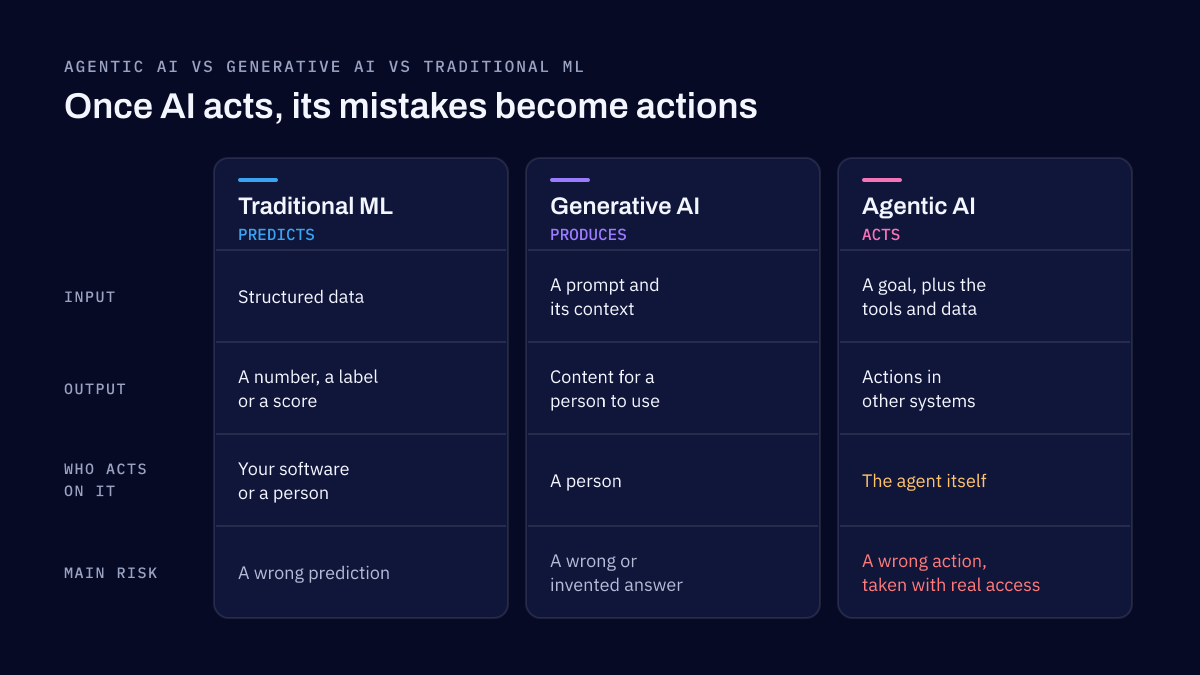
Traditional machine learning predicts, generative AI writes, and agentic AI acts. The difference decides what a project costs, what can go wrong and how much control it needs. Here is how to tell the three apart, with examples of each, and how to choose the one your project actually needs.
Tell us what you want tested
Name the applications, networks or cloud accounts, and any deadline. We reply within two business days.