Business Continuity
GCP Disaster Recovery and Business Continuity
Disaster recovery on Google Cloud starts with two numbers, how long a system may be down and how much data it may lose, and ends with a test that proves you can meet them. Between the two sit the choice of zone, region or multi-region, backups kept apart from the workload, and every dependency the application needs to run.

Disaster recovery on Google Cloud means deciding how long each system may be down and how much data it may lose, then building and testing a way to meet those limits. Google's disaster recovery planning guide calls the two limits the recovery time objective (RTO) and the recovery point objective (RPO). The choices that meet them are where each workload runs (one zone, one region or several), where its backups live, and whether the whole application, not only its servers, comes back when you need it.
The stakes are not small. In the Uptime Institute's 2026 outage analysis, 57% of the operators it surveyed in 2025 said their most recent major outage cost more than $100,000, and one in five put the cost above $1 million.
Start with the business, not the architecture
Recovery objectives come from a business impact assessment: for each system, how much downtime and data loss the business can accept, and what else depends on it. An order system and an internal wiki do not deserve the same answer, and a single objective for everything usually means the important systems are underprotected and the rest overpaid for.
Where I see companies struggle is not in setting the numbers but in validating them. A plan says four hours; nobody has ever measured how long a recovery takes. The objectives are only as real as the last test that met them.
What each Google Cloud location survives
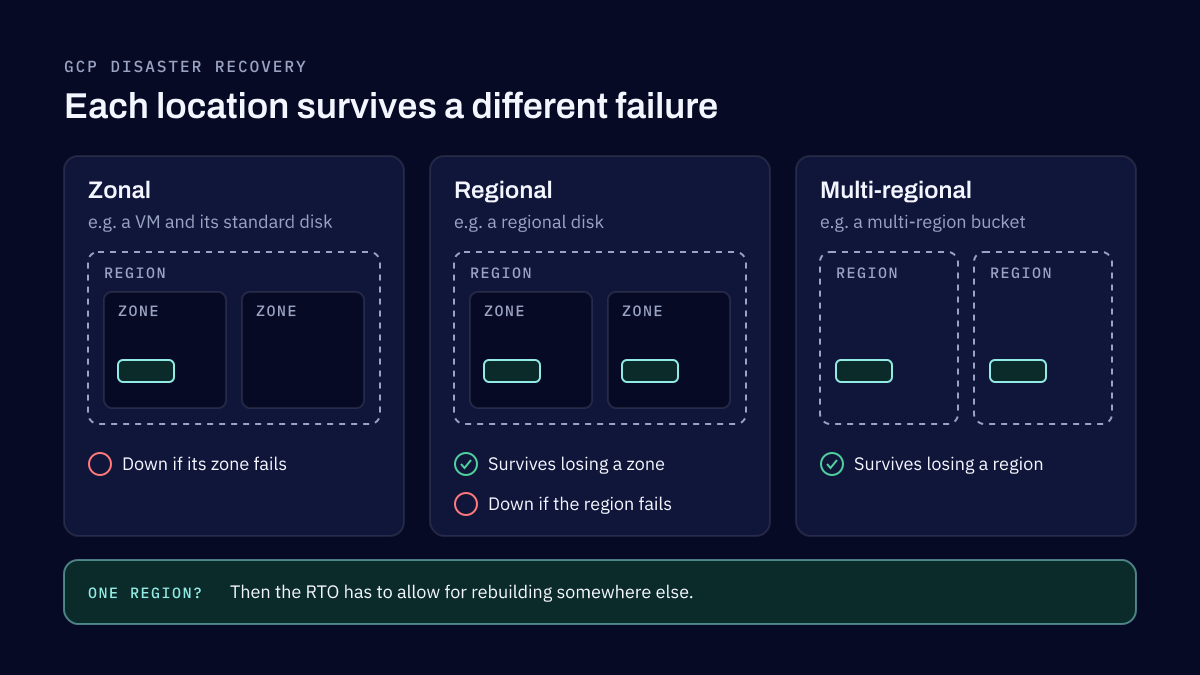
Google Cloud resources are zonal, regional or multi-regional, and the disaster recovery architecture guide is explicit about what each survives:
- Zonal resources, such as a Compute Engine VM and its standard persistent disk, can be affected by an outage in that zone.
- Regional resources are spread across zones and are designed to resist the loss of one zone, but not of the whole region.
- Multi-regional resources, such as a multi-region Cloud Storage bucket, are designed to resist the loss of a region.
Running in one region is a reasonable choice for many systems. It is a choice, though, and the RTO has to allow for rebuilding somewhere else if that region is unavailable.
Copies that survive the failure you plan for
Google describes three patterns, cold, warm and hot, from no standby at all to a second environment running and ready. Most companies mix them by system. The building blocks for each:
- Virtual machines and disks. Disk snapshots are stored by default in the multi-region closest to the source disk. Regional disks replicate synchronously between two zones. Asynchronous Replication copies a disk to a second region on the same continent, with a target RPO of about one minute.
- Backups kept apart. Backup and DR Service protects Compute Engine, Persistent Disk, Filestore, Cloud SQL, AlloyDB and several self-managed databases. Its backup vaults can enforce a minimum retention, during which no one can delete a backup, which also matters for ransomware protection.
- Databases. Cloud SQL disaster recovery relies on a cross-region read replica you can promote. On Enterprise Plus edition, advanced DR adds a designated DR replica with switchover and replica failover. Failover can lose data if the replica is lagging; plan for that in your RPO.
- Object storage. Dual-region and multi-region buckets keep data in two or more places. By default the RPO for objects is up to 12 hours; turbo replication brings it to 15 minutes for dual-region buckets. Soft delete keeps deleted objects for 7 days by default, configurable up to 90.
- Kubernetes. Backup for GKE backs up a cluster's resources and its Persistent Disk volumes and can restore them into a cluster in another region, which must already exist.
The gap I find most often is not a missing backup. It is a backup that has never been restored, a second region that was never failed over to, or a backup environment that shares the same project and the same administrators as the workload it protects.
The application has to come back, not only the servers
The lesson I come back to most is that restoring infrastructure does not mean the application is available. A database can be restored and VMs started, and customers still see an error, because DNS points to the old region, a firewall rule or a private connection was never recreated, a secret lives somewhere else, or a service outside Google Cloud only accepts calls from the old address.
A recovery plan has to list those dependencies and recover them in order. Cloud DNS routing policies can fail traffic over to a backup set of addresses when health checks fail, though if every endpoint is unhealthy, Cloud DNS serves them all as if they were healthy. Networking, identity and configuration should be defined as code, so the second environment matches the first and can be built in hours rather than rediscovered under pressure. Defining that foundation is part of our cloud transformation work, and the recovery design itself is an architecture decision worth writing down before it is needed.
Test the plan, then measure it
Google's reliability guidance says to run tests periodically that include regional failovers, release rollbacks and restoring data from backups, and to check the results against your RTO and RPO. I would go further in three ways:
- Test end to end. Fail over the whole application and have someone use it, rather than confirming that each component started.
- Automate the recovery. Every manual step is a step someone will get wrong at three in the morning. Scripts and infrastructure as code turn a recovery into something you can run, time and repeat.
- Measure against the objective. Record how long the recovery took and how much data was lost, and compare both with the objectives the business set. If they do not match, either the architecture or the objective has to change.
A test also shows whether the backups themselves are sound, whether they hold the data you expected and whether they are protected. A cloud security review looks at the same question from the other side: who could delete or change those copies.
Where to begin
If you have no tested plan today, start small: pick the system the business would miss first, agree its RTO and RPO, restore it from backup into a separate project, and time the result. That single test usually teaches more than the plan document, and it shows where to invest next. When that system runs on your own premises or in a hybrid setup, our backup and recovery setup agrees its targets with you, builds the backups to meet them and tests a restore before the hand-over.
Frequently asked questions
What is the difference between RTO and RPO on Google Cloud?
The recovery time objective (RTO) is how long an application may be offline after a major incident. The recovery point objective (RPO) is how much data, measured in time, it may lose. Google Cloud uses the same definitions in its disaster recovery planning guide. Both are business decisions first; the architecture follows from them.
Does Google Cloud back up my workloads automatically?
Not in the sense most people mean. Google keeps its own infrastructure available, but backups of your virtual machines, databases and clusters, where they are stored, how long they are kept and whether they can be restored are yours to set up. Backup and DR Service, Cloud SQL backups and Backup for GKE give you the tools; you decide how they are used.
Is a regional deployment enough for disaster recovery?
A regional resource is built to survive the loss of a zone, not of a whole region. If the business cannot accept the time it would take to rebuild in another region, you need copies or replicas in a second region, or a multi-regional service, and a tested way to switch to them.
How often should a disaster recovery plan be tested?
Often enough that the result still describes the system you run today. A useful rule is to test after every significant change to the architecture and at least once a year end to end. Google's reliability guidance asks for periodic tests that include regional failover and restoring data from backups.
Sources
- Disaster recovery planning guide, Google Cloud, 2024
- Architecting disaster recovery for cloud infrastructure outages, Google Cloud, 2024
- Backup and DR overview, Google Cloud, 2026
- About disaster recovery (DR) in Cloud SQL, Google Cloud, 2026
- About Asynchronous Replication, Google Cloud, 2026
- Data availability and durability, Google Cloud, 2026
- DNS routing policies and health checks, Google Cloud, 2026
- Backup for GKE overview, Google Cloud, 2026
- Perform testing for recovery from failures, Google Cloud, 2026
- Annual outage analysis 2026, Uptime Institute, 2026
Software architecture consulting and design
We design how a system should be built before anyone builds it, or review one that already exists. You receive the architecture, the decisions behind it and a specification another team can build from, in two to six weeks at a fixed price, or two to four months when the hardware is designed too.
Related reading
Business Continuity
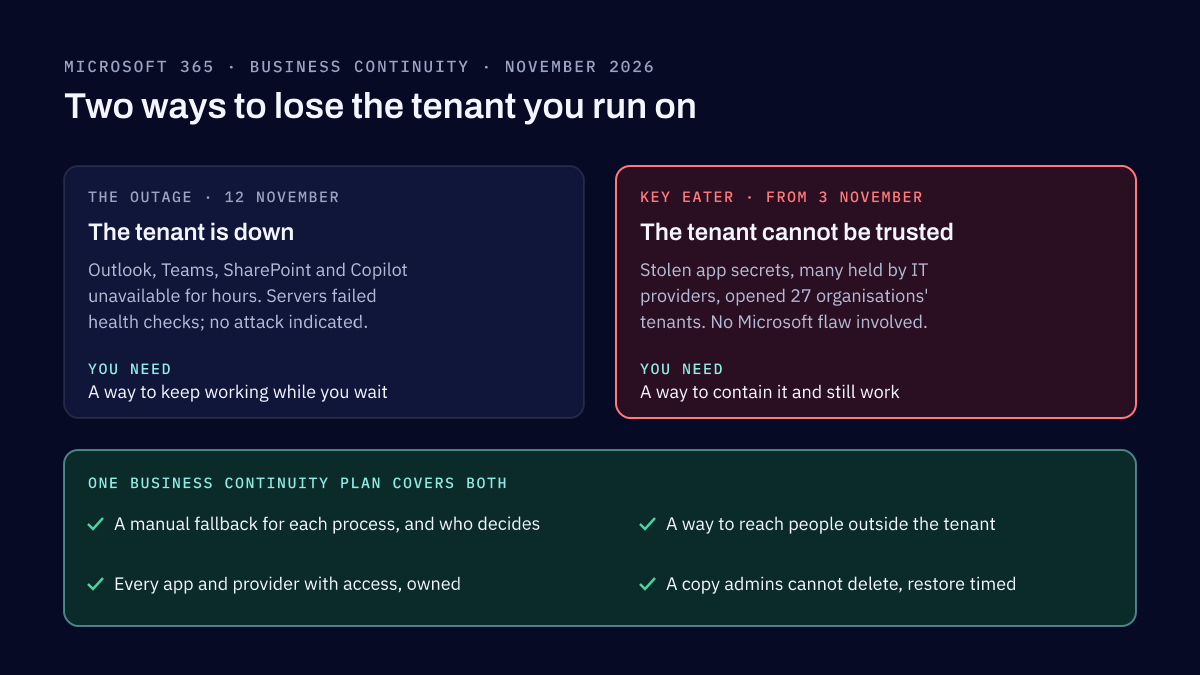
Microsoft 365 went down and Microsoft tenants were breached: can your business keep running?
On 12 November 2026 a Microsoft 365 outage cut companies off from Outlook, Teams and Copilot for hours. The same month, stolen app credentials opened 27 organisations' Microsoft tenants, many through their IT providers. Neither was a Microsoft hack, and both test the same business continuity plan.
Digital Transformation
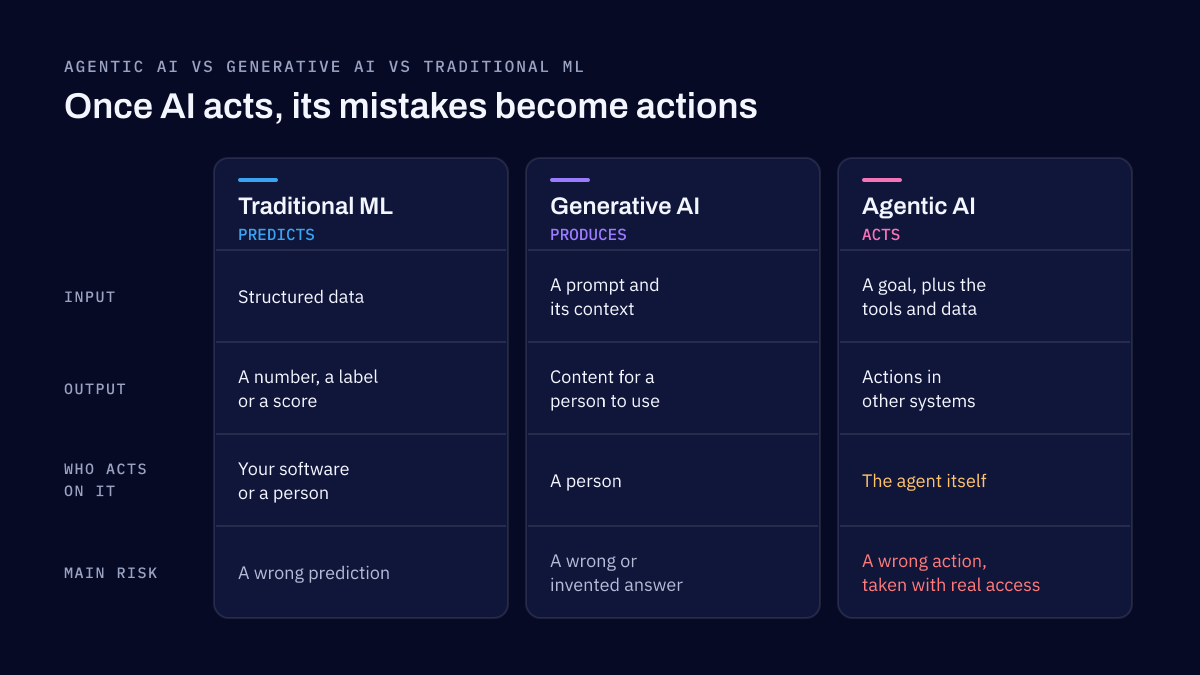
Agentic AI vs generative AI vs traditional ML: what changes when AI starts taking action
Traditional machine learning predicts, generative AI writes, and agentic AI acts. The difference decides what a project costs, what can go wrong and how much control it needs. Here is how to tell the three apart, with examples of each, and how to choose the one your project actually needs.
Tell us what you need to design or review
A few lines on the system, the decision ahead of you and any deadline are enough. We reply within two business days.