AI Security
10 ways your AI can be turned against you: OWASP Top 10 for LLMs vs MITRE ATLAS
A chatbot that invents a refund policy, an assistant that leaks mail without a click, a coding tool shipped with planted code. The OWASP Top 10 for LLM Applications names these risks for builders; MITRE ATLAS records how attackers carry them out. Here is how the two fit together.

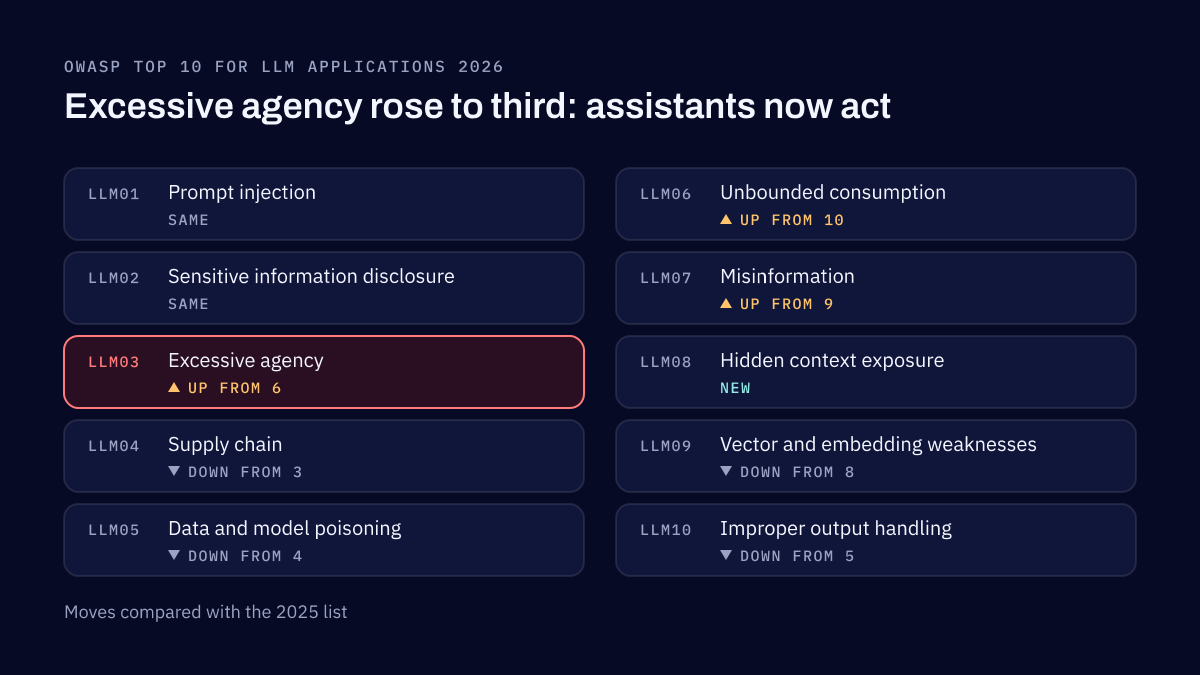
The OWASP Top 10 for LLM Applications is the OWASP GenAI Security Project's ranked list of the ten most critical security risks in software built on large language models, from prompt injection at number one to improper output handling at number ten. The current edition is 2026, published in August 2026. MITRE ATLAS answers a different question: it is MITRE's knowledge base of the tactics and techniques attackers use against AI systems, with real case studies. Use OWASP to decide what to build and test, and ATLAS to describe and detect the attack when it comes.
Three times AI was turned against its owner
These risks are easy to read past until they cost someone money. Three public cases show what the list is about.
The chatbot that wrote its own refund policy. In 2022 a traveller asked Air Canada's website chatbot about bereavement fares after a death in the family. The chatbot told him he could apply for the discount after flying. The airline's actual policy said otherwise, and it refused. In February 2024 British Columbia's Civil Resolution Tribunal ruled against the airline in Moffatt v. Air Canada, rejecting its argument that the chatbot was responsible for its own words, and ordered it to pay. In OWASP's terms that is misinformation, number seven in 2026. Your chatbot speaks for your company, and a tribunal will treat it that way.
The email that read your mailbox for the attacker. In June 2025 Microsoft published CVE-2025-32711, an AI command injection in Microsoft 365 Copilot that let an unauthorised attacker disclose information over a network, rated 9.3 out of 10. The researchers at Aim Security who reported it named it EchoLeak and described a zero-click attack: an email carried hidden instructions that Copilot later followed when the user asked it an ordinary question, with no click from anyone. Microsoft fixed it in the service itself. This is prompt injection, number one, leading straight to sensitive information disclosure, number two.
The coding assistant that shipped with someone else's code. In July 2025 AWS reported in security bulletin AWS-2025-015 that a token with too much access, found in the build configuration of its Amazon Q Developer extension for Visual Studio Code, let an attacker commit malicious code that went out in version 1.84.0. AWS found that the code did not run because of a syntax error, and replaced the release. A tool developers trust with their code and their terminal was the delivery route. That is supply chain risk, number four in the LLM list and ASI04 in the agentic one.
None of the three needed an exotic attack on a model. Each one went through something the system read, said or shipped.
The OWASP Top 10 for LLM Applications 2026
The 2026 edition replaced the 2025 list in August 2026. OWASP says it draws on research from real AI security incidents and maps each risk to NIST, MITRE ATLAS, CWE and the agentic list.
| Rank | Risk | What it looks like | Move from 2025 |
|---|---|---|---|
| LLM01 | Prompt injection | Text in a message, document, email or web page makes the model ignore its instructions | Same |
| LLM02 | Sensitive information disclosure | The model reveals customer data, internal documents or secrets it can reach | Same |
| LLM03 | Excessive agency | The assistant or agent can do more than its task needs: send, delete, pay, deploy | Up from 6 |
| LLM04 | Supply chain | A model, dataset, plugin or tool from a third party is compromised | Down from 3 |
| LLM05 | Data and model poisoning | Training or fine-tuning data is altered to change how the model behaves | Down from 4 |
| LLM06 | Unbounded consumption | Requests run up compute and cost, or drain service for everyone else | Up from 10 |
| LLM07 | Misinformation | Confident, wrong answers that people or systems act on | Up from 9 |
| LLM08 | Hidden context exposure | The system prompt, retrieved policy text, tool definitions or configuration are drawn out of the model | New; takes the place of system prompt leakage |
| LLM09 | Vector and embedding weaknesses | The search store behind a retrieval system leaks or accepts planted content | Down from 8 |
| LLM10 | Improper output handling | Model output goes into a browser, database or shell without checks | Down from 5 |
Two changes matter most. Excessive agency rose because assistants now act, not only answer. And the new hidden context entry tells builders to assume that anything placed in the prompt can be discovered, so no secret or access decision should depend on it staying hidden. What to do about each risk in a product of your own is the subject of our guide to LLM security.
Beyond the LLM list: the rest of the OWASP GenAI Security Project
The LLM Top 10 is one deliverable of the OWASP GenAI Security Project, a volunteer community under the OWASP Foundation. Three others matter for a security lead.
- The OWASP Top 10 for Agentic Applications for 2026, released in December 2025 and written by more than 100 contributors, covers systems that plan and act. Its risks run from ASI01, agent goal hijack, through tool misuse, identity and privilege abuse, agentic supply chain, unexpected code execution, memory and context poisoning, insecure communication between agents, cascading failures and the exploitation of human trust, to ASI10, rogue agents.
- The Agent Control Standard, contributed to the project in September 2026, moves from listing agent risks to enforcing limits on agents while they run. It is new and still early.
- The OWASP AI Testing Guide, a separate OWASP project whose first version came out in November 2025, sets out a method for testing the trustworthiness of AI systems. It is the closest thing to a test plan the lists have.
MITRE ATLAS in one page
MITRE ATLAS, the Adversarial Threat Landscape for Artificial-Intelligence Systems, is maintained by MITRE, the not-for-profit that also maintains ATT&CK. It is built the same way: tactics are the attacker's goals, techniques are how each goal is reached, and every entry has an ID a tool or a report can cite. The ATLAS data release 2026.10 of 28 October 2026 holds 16 tactics, 129 techniques, 92 sub-techniques, 44 mitigations and 77 case studies of attacks on real AI systems. Since August 2026 a new release has come every few weeks.
Where OWASP ranks risks for the people building an application, ATLAS describes the attack from the attacker's side, step by step, from reconnaissance to impact. That is what a defender needs to recognise one in progress. Our MITRE ATLAS guide covers the techniques and the logs that catch them.
OWASP vs MITRE ATLAS, side by side
| OWASP Top 10 for LLM Applications (and the agentic list) | MITRE ATLAS | |
|---|---|---|
| What it is | A ranked list of the most critical risks, with examples and mitigations | A knowledge base of attacker tactics, techniques and case studies |
| Who maintains it | The OWASP GenAI Security Project, a volunteer community | MITRE |
| Point of view | The builder: what can go wrong in what we make | The attacker: how they get from first contact to impact |
| Unit | Ten risks per list (LLM01 to LLM10, ASI01 to ASI10) | Tactic and technique IDs (AML.T…), like ATT&CK |
| Current version | LLM list 2026; agentic list 2026 | Data release 2026.10 |
| Updated | About once a year | Every few weeks |
| Best for | Design reviews, test scope, developer training, report language | Threat modelling, detection rules, red team planning, showing real cases |
How we use them together
On our AI system security reviews the OWASP lists set the scope: each risk, from the LLM list and, where the system can act, the agentic list, becomes a set of test cases, and the report uses OWASP's names so developers recognise the finding. ATLAS comes in on the detection side. Its techniques sit alongside ATT&CK in the rules we write for the SIEM your team already runs, through our threat detection and SIEM work, and in threat models for the system.
The two meet in the findings. We tag each one with its OWASP risk and its ATLAS technique, so the developer who fixes it and the analyst who watches for it are talking about the same thing. And when leadership asks whether any of this really happens, ATLAS case studies answer faster than any risk score.
Testing the system the way an attacker would is the part most teams skip. It follows the same logic as any red team or penetration test: a list tells you where to look, and only a test shows what is actually exposed. Our red teaming and penetration testing work covers the application and infrastructure around the model.
What teams get wrong
When a client tells us they have covered the OWASP Top 10 for LLMs, we usually find four things.
- A checklist, not a test. The list was read and policies were written, but nobody tried to break the system. The first real test tends to find prompt injection.
- Only the chat box was tested. The team tried what a user might type, but not the documents, emails and web pages the AI reads on its own. That is where indirect prompt injection comes in, as the Copilot case showed.
- The agent has more access than its task. The model's answers are filtered, but the tools and keys it holds can reach far more than it needs. That is excessive agency, now third on the list.
- No record of what the AI did. Prompts, tool calls and outputs are not logged, so an attack would leave nothing for anyone to find.
Beyond those, teams often work from an older edition of the list; read only the LLM list while building agents; treat the Top 10 as a compliance standard, when governance belongs to the NIST AI Risk Management Framework or ISO/IEC 42001; and write ATLAS off as academic, when a security operations team can use it exactly as it uses ATT&CK.
Start with the inventory of the AI you run, take the 2026 lists to scope a test of the system that matters most, and give your detection team ATLAS so that what the test finds is something they can watch for.
Frequently asked questions
Is the OWASP Top 10 for LLM Applications a standard we can certify against?
No. It is an awareness list of the most critical risks, written by a volunteer community, and nobody audits or certifies against it. When a customer or regulator wants a management system for AI, the references are the NIST AI Risk Management Framework and ISO/IEC 42001. The Top 10 is still the right starting point for what to build and test.
What changed in the 2026 edition of the OWASP Top 10 for LLM Applications?
Prompt injection and sensitive information disclosure stay first and second. Excessive agency rises from sixth to third, misinformation from ninth to seventh, and unbounded consumption from tenth to sixth, while improper output handling falls to tenth. System prompt leakage gives way to hidden context exposure, which covers everything the application feeds the model that the user never sees.
Do we need the agentic list if we already use the LLM list?
If your AI can call tools, take actions, remember past sessions or talk to other agents, yes. The OWASP Top 10 for Agentic Applications covers risks the LLM list only touches, such as an agent's goal being hijacked, tools misused, privileges abused and memory poisoned. Most assistants built in 2026 have at least one tool, so most teams need both lists.
Is MITRE ATLAS only for researchers?
No. It is built the same way as MITRE ATT&CK, so a security operations team that writes detection rules against ATT&CK can tag rules for AI attacks with ATLAS technique IDs in the same way. Its case studies are also the quickest way to show leadership that attacks on AI have already happened.
Sources
- OWASP GenAI LLM Top 10 2026, OWASP GenAI Security Project, 2026
- GenAI LLM Top 10, 2026 release (source repository), OWASP GenAI Security Project, 2026
- OWASP Top 10 for LLM Applications 2025, OWASP GenAI Security Project, 2024
- OWASP Top 10 for Agentic Applications for 2026, OWASP GenAI Security Project, 2025
- OWASP GenAI Security Project unveils 2026 Top 10 for LLM Applications and Agent Control Standard, OWASP GenAI Security Project, 2026
- OWASP AI Testing Guide, OWASP Foundation, 2025
- ATLAS data, version 2026.10, MITRE, 2026
- MITRE ATLAS, MITRE, 2026
- Moffatt v. Air Canada, 2024 BCCRT 149, British Columbia Civil Resolution Tribunal, 2024
- CVE-2025-32711, Microsoft 365 Copilot information disclosure, Microsoft (CVE record), 2025
- AWS-2025-015: Security update for Amazon Q Developer extension for Visual Studio Code, Amazon Web Services, 2025
- EchoLeak: zero-click AI vulnerability in Microsoft 365 Copilot, Aim Security, 2025
AI governance consulting and AI security
We help you govern, secure and watch the AI systems your company builds or buys. That means a governance framework your leadership can stand behind, a security review that tests how each system can be misused, the hardening it needs, and detection your team can operate.
Related reading
AI Security
Agentic AI security: your newest employee has admin rights and no manager
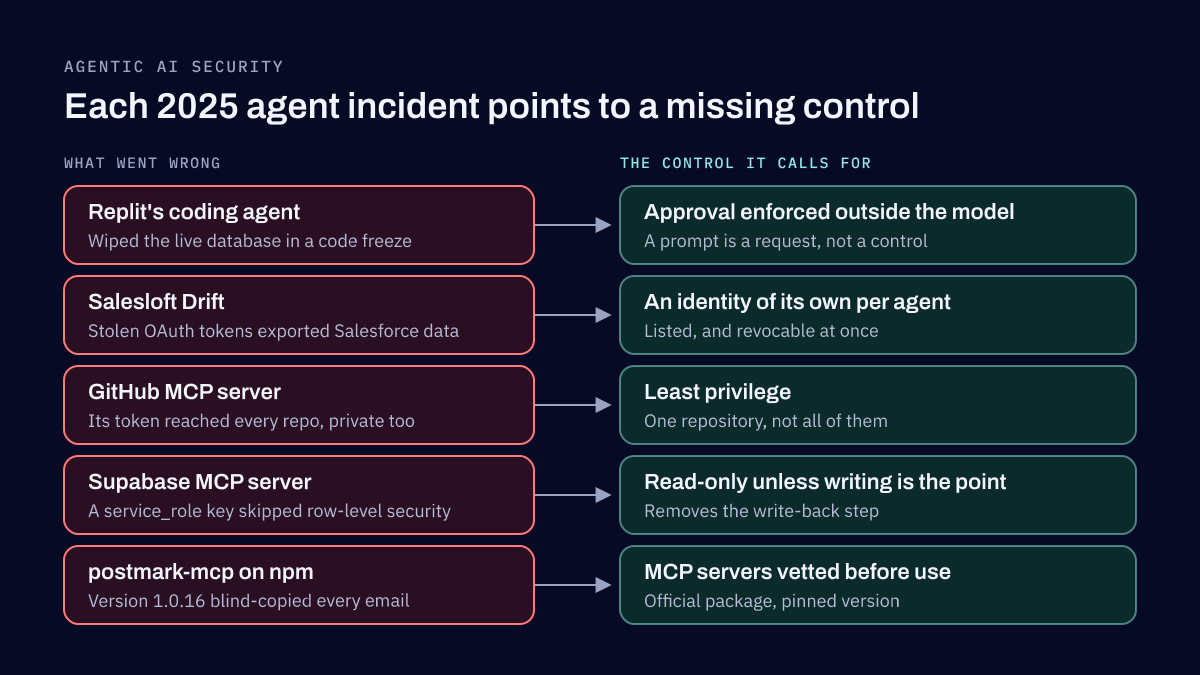
AI agents do more than answer. They call tools, read data and act in other systems, often with a person's keys. Five public incidents from 2025 show what goes wrong, and each points to a control, from an identity of the agent's own to a named owner who can stop it.
AI Security
AI governance framework: set the rules before your AI goes rogue
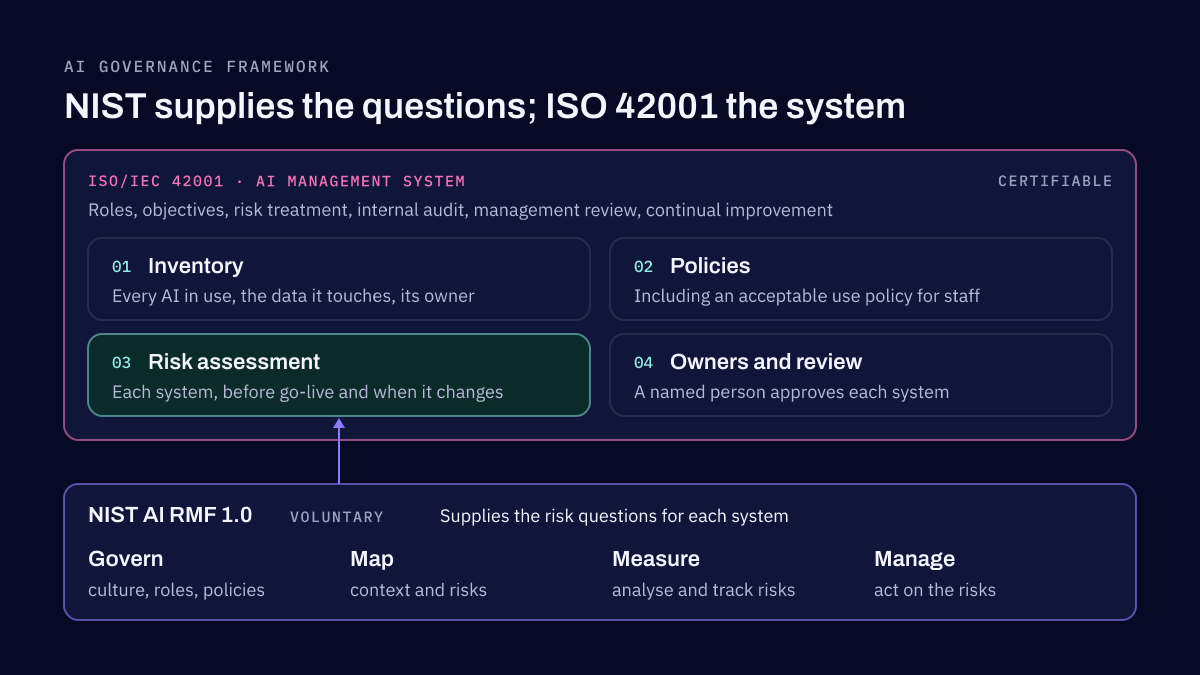
An AI governance framework decides which AI systems your company uses, what each may do, who approved it and how you notice when it goes wrong. NIST AI RMF supplies the risk questions, ISO/IEC 42001 the management system around them, and an acceptable use policy tells staff what they may do today.
Tell us which AI systems you need to govern
List the tools and systems you use, built or bought. We reply within two business days.