Threat Detection
UEBA: how to tell anomalous behavior from malicious activity
UEBA learns what is normal for each user, device, service account and application, and flags what departs from it. An anomaly is not an attack. Most are travel, a new role, an admin job or month-end. It becomes a finding when privilege, asset value, threat intelligence or a chain of actions says so.

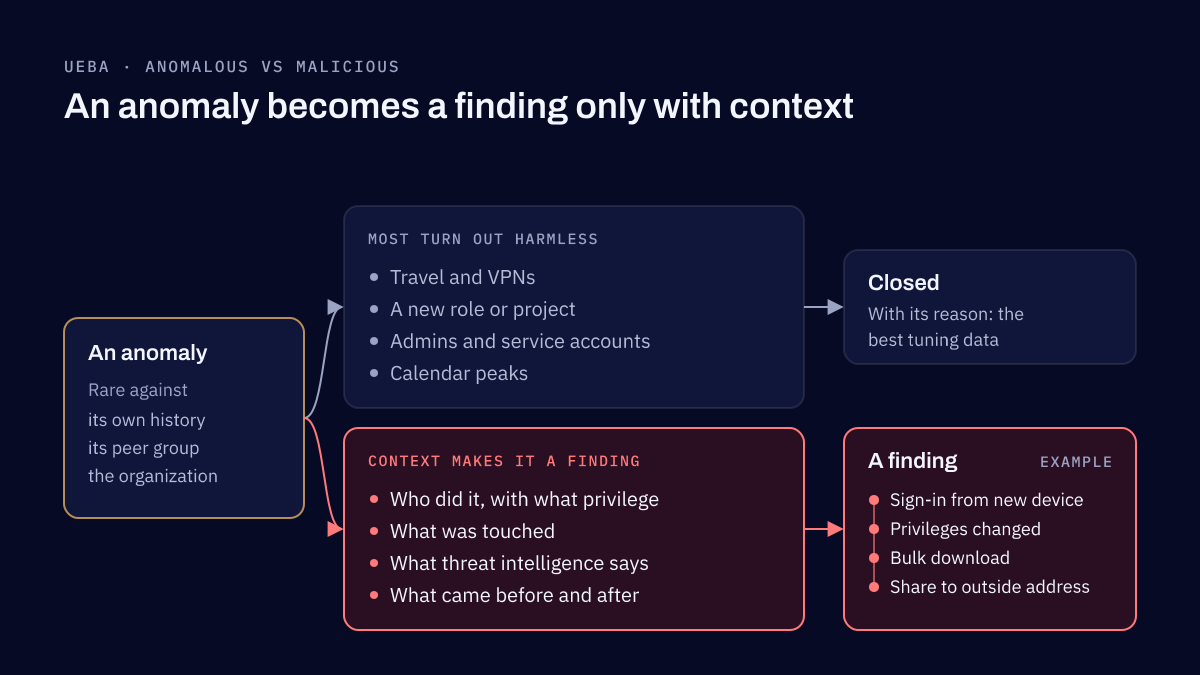
UEBA, or user and entity behavior analytics, learns what normal looks like for each user, device, service account and application in your environment, and flags what departs from it. That departure is an anomaly, and an anomaly is not an attack. Most turn out to be a trip abroad, a new role, an administrator's script or the month-end close. An anomaly becomes a finding worth opening when context says so: who did it and with what privilege, what they touched, whether threat intelligence knows the source, and whether the steps chain together the way an attack does.
What is UEBA?
User and entity behavior analytics builds a baseline for each user and for each entity: hosts, service accounts, applications and IP addresses. It compares today's activity with three references: the entity's own history, its peer group (people in the same team or with the same access), and the organization as a whole. When an action is rare against all three, its score goes up. Behavioral analytics is the wider term; UEBA is that idea applied to security logs.
Today UEBA is mostly a feature of the SIEM, not a separate product:
- Microsoft Sentinel includes UEBA at no extra licence cost. It builds profiles with machine learning, ranks each user's 20 closest peers, and gives every event an investigation priority score from 0 to 10.
- Splunk stopped selling its standalone User Behavior Analytics in December 2025, with support ending on 31 January 2027, and moved UEBA into Splunk Enterprise Security Premier.
- Elastic Security offers entity analytics: a risk score from 0 to 100 for each user and host, fed by detection alerts, asset criticality and prebuilt machine learning jobs.
- Wazuh has no UEBA module. Behavior baselines come from your own rules or from the OpenSearch anomaly detection plugin, which is turned off by default.
Why an anomaly is not an attack
Microsoft gives a plain example in its own documentation: the first time a user runs an Azure operation, the event scores high for rarity and low for risk, because first-time actions happen all the time. In the SIEMs we have built, four kinds of anomaly turn out to be harmless far more often than not:
- Travel and VPNs: impossible travel, a new country or a new network, explained by a VPN exit node, a business trip or a mobile carrier.
- A new role or project: someone joins a project and, overnight, touches systems and data they never touched before.
- Administrators and service accounts: scripts, maintenance windows and bulk jobs that look exactly like an attacker moving through the network.
- Calendar peaks: month-end close, audits, migrations and releases, which raise volume and bring work outside office hours.
Take a typical case, not a reported incident. A finance manager signs in from Miami at 9:00 and from Madrid at 9:40, and UEBA flags impossible travel. The Madrid address belongs to the company's VPN provider. Nothing happened, and an analyst spent twenty minutes proving it. Multiply that by a few hundred a week and you have alert fatigue.
The context that turns an anomaly into a finding
An anomaly earns a look when one or more of these is true:
- Who did it, and with what privilege. The same unusual action weighs more from a domain administrator, or from a finance user who can approve payments, than from an intern.
- What was touched. Customer data, production systems, payment platforms and identity infrastructure matter more than a shared folder of marketing drafts. Knowing which assets are critical is the output of a risk assessment, and UEBA is only as good as that list.
- What threat intelligence says. A source address, domain or file already known to be bad, or a technique currently used against your sector.
- What came before and after. Single anomalies are noise; a sequence is a story. A sign-in from a new device, then a change to the account's privileges, then a bulk download, then a share to an outside address follows the path MITRE ATT&CK describes from initial access to exfiltration. Each step alone might be explained. Together they need a person.
Non-human identities belong in UEBA for the same reason. Service accounts and AI agents are entities with baselines too, and a compromised one behaves like a compromised user.
Insider threat detection: three cases and the signal in each
Insider cases are where UEBA earns its place, because the person already has valid credentials and nothing they do looks like malware. CISA's Insider Threat Mitigation Guide, updated in 2026, covers intentional and unintentional insiders alike. Three public cases show three different signals.
Coinbase, 2025: support staff paid to look up customers
In May 2025, Coinbase disclosed that criminals had paid contractors or employees in support roles outside the United States for customer data, including names, addresses, masked account details and images of government IDs, and then tried to extort the company. Coinbase said its own security monitoring had detected the access in the previous months, and it estimated the cost at between $180 million and $400 million. The signal is access outside the role: support agents opening customer records with no ticket or business reason behind them.
Cash App, 2022: reports downloaded after the job ended
In April 2022, Block disclosed that a former employee had downloaded reports of Cash App Investing on 10 December 2021, after their employment had ended. The person had regular access to those reports in their past job. About 8.2 million current and former customers were contacted. The signal is access after it should end: an identity that kept working once the person behind it had left.
Tesla, 2023: two former employees and a newspaper
In August 2023, Tesla notified authorities that two former employees had taken the personal data of about 75,000 current and former employees and given it to the German newspaper Handelsblatt, which had told Tesla in May. The signal is leaving plus data: a large set of personal records moving out around a departure.
The fourth signal we look for is covering tracks: logging or an endpoint agent switched off, audit trails deleted, a new administrator account created. None of these proves anything alone, but each deserves a fast look.
Notice what these signals need. A departure only shows up if HR events reach the SIEM, and access outside the role only shows up if the system knows what the role is. Insider threat detection depends on identity and HR feeds as much as on logs, and on a written monitoring policy, which is part of security governance.
How to reduce alert fatigue
Alert fatigue sets in when analysts stop believing the alerts. Four changes do the most:
- Score the entity, not the event. Add risk to the user or host each time an anomaly appears, and raise one alert when the total crosses a threshold. Ten small oddities from one account in a day is a finding; one oddity from each of ten accounts usually is not.
- Suppress known-good activity, with a deadline. Allow-list documented admin jobs, service accounts and scanners, but give every entry an owner and an expiry date, so the list does not become a hiding place.
- Give the baseline time. Let behavior models learn for weeks before anyone is paged, and let them learn again after a reorganization or a migration.
- Write a runbook for every alert type. What to check first, how to close it, and why it was closed. The closing reasons are the best tuning data you will get.
Where to start
Connect identity first: your directory, sign-in logs and cloud accounts. Add the HR feed for joiners, movers and leavers. Mark the assets that matter most. Then run the models for a month, tune them, and only then route alerts to people. That is the order our SIEM implementation follows on Microsoft Sentinel, Splunk, Elastic Security or Wazuh: we connect the sources, write and tune the rules, and hand the platform over with runbooks. Your team, or a provider you choose, operates it afterwards.
Frequently asked questions
What is the difference between UEBA and a SIEM?
A SIEM collects security events from across your systems and raises alerts when they match a rule. UEBA learns normal behavior for each user and entity and scores what departs from it. Today UEBA is usually a feature inside the SIEM. Microsoft Sentinel includes it, Splunk moved it into Enterprise Security Premier in 2025, and Elastic Security has entity analytics. Rules catch what you already know to look for; UEBA catches what is unusual for that particular user.
Does UEBA use machine learning?
Partly. Single events are often scored with plain statistics, such as how rare a country, a device or an action is for that user. Machine learning builds the peer groups and finds patterns across many events over time. Microsoft Sentinel, for example, keeps a priority score for single events and a separate machine learning score for behavior across events. The models matter less than the data they learn from.
How long does UEBA take to learn normal behavior?
Weeks, not days. Microsoft documents its Sentinel anomaly models as trained on the previous 7 to 21 days of logs, and some compare activity against 30 days of history. In practice we wait several weeks before anyone is paged, and we let the models learn again after a reorganization, a merger or a large migration, because each of those changes what normal looks like.
Is it legal to monitor employee behavior?
In most places, yes, with conditions, and the rules differ by country and, in the United States, by state. Good practice is the same everywhere. Tell employees in writing what is monitored and why, collect only what the security purpose needs, keep it only as long as necessary, limit who can see it, and involve HR and legal before you switch it on. This is not legal advice, so check with counsel where you operate.
Sources
- Advanced threat detection with User and Entity Behavior Analytics (UEBA) in Microsoft Sentinel, Microsoft, 2025
- Anomalies detected by the Microsoft Sentinel machine learning engine, Microsoft, 2026
- End of sale and end of life for standalone Splunk User Behavior Analytics, Splunk, 2025
- Entity analytics overview, Elastic, 2026
- Enhancing IT security with anomaly detection in Wazuh, Wazuh, 2023
- Coinbase Global, Form 8-K, Coinbase (SEC filing), 2025
- Block, Inc., Form 8-K, Block (SEC filing), 2022
- Tesla data breach affects 75,735 people, state attorney general announces, Fox Business, 2023
- Insider Threat Mitigation Guide, 2026 edition, CISA, 2026
- MITRE ATT&CK, MITRE, 2026
SIEM implementation and threat detection
We deploy a SIEM, connect the log sources that matter, write detection rules mapped to MITRE ATT&CK and hand the platform over with runbooks. Your team operates it afterwards; we don't run a monitoring service.
Related reading
Threat Detection
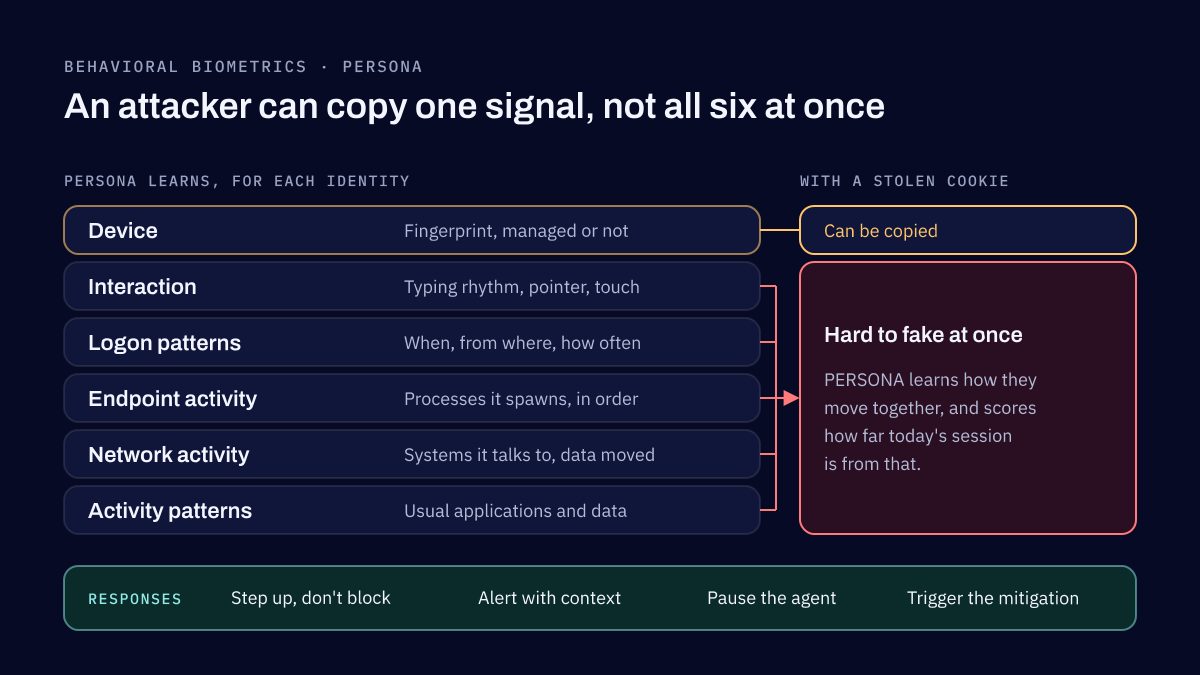
Behavioral biometrics with ML: PERSONA, a multimodal view of every user, device and AI agent
Behavioral biometrics identifies a user by how they act, not by what they know or carry. Combined with a device fingerprint and session context, and built with machine learning, it gives a profile that shows when an account, a device or an AI agent stops behaving like itself. PERSONA is our name for that profile.
Threat Detection
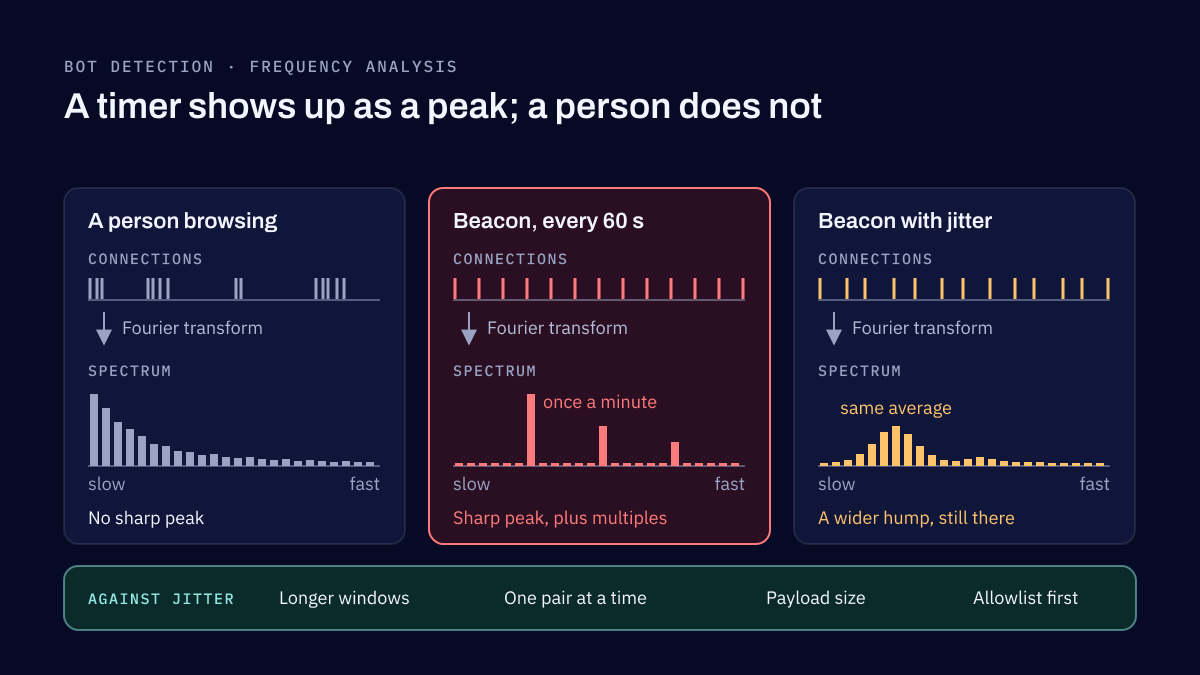
Bot detection by rhythm: how Fourier transforms and frequency analysis expose bots
Most bot detection judges each request on its own, so a patient bot gets through. Scripts and malware keep time, and people do not. This article explains how a Fourier transform turns that timing into a visible peak, how jitter tries to hide it, and where rhythm fits beside the other signals.
Tell us what you need to detect
Name your systems and the requirement behind the project. We reply within two business days.