Governance and Compliance
What Is FedRAMP and Why It Matters to Businesses
FedRAMP is the US government program that decides which cloud services federal agencies may use. It matters to companies that sell a cloud service to agencies and to contractors told to use FedRAMP cloud services. This guide explains how it works after the 2026 changes and when it is worth pursuing.

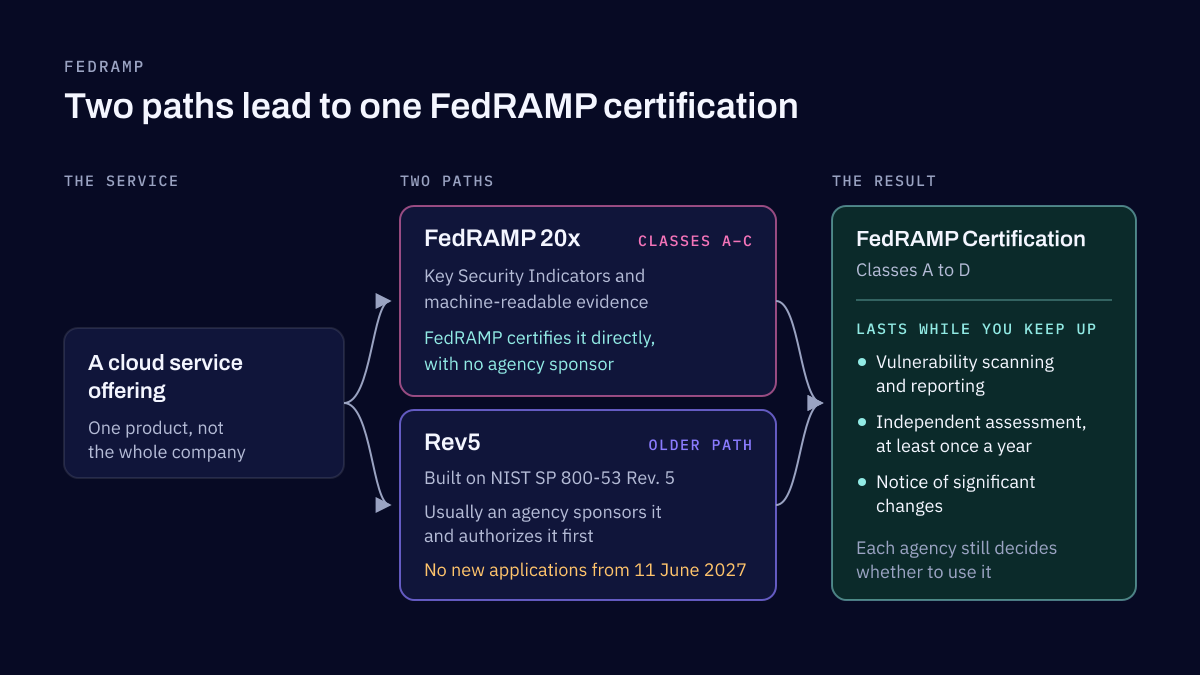
FedRAMP, the Federal Risk and Authorization Management Program, is the US government program that assesses cloud services before federal agencies use them. It is run by the General Services Administration and has been written into law since the FedRAMP Authorization Act of December 2022. FedRAMP looks at one specific cloud service offering, such as a software product or a platform, not at the company that sells it. Agencies are expected to accept that decision instead of each repeating the assessment. If you sell a cloud service to US federal agencies, you will need it. If you do not, you probably will not.
FedRAMP changed a great deal in 2025 and 2026, so much of what was written about it before then, including the earlier version of this article, is out of date. This guide reflects the program as it stands today.
When FedRAMP comes up
FedRAMP typically becomes relevant in two situations. The first is a cloud provider that wants to sell to US federal agencies: the agency cannot use the service until it has been through FedRAMP. The second is a government contractor whose contract requires it to use FedRAMP cloud services for the agency's data. In both cases the reasons are the same: a contract requires it, a regulation requires it, or the company wants access to the federal market.
What companies misunderstand about FedRAMP
The most common misunderstanding is treating FedRAMP as a seal of approval for a whole company. It is not. Since May 2026 FedRAMP calls its decision a certification, but it certifies a specific cloud service offering, one product with a defined boundary, and nothing else the company sells.
The second misunderstanding is assuming that running on a FedRAMP certified cloud makes your own application compliant. Google Cloud, for example, holds a FedRAMP High authorization for more than 150 of its services. If you build a product on those services, you can rely on many of Google's controls, following Google's customer responsibility matrix. Your application, your configuration and your data are still yours to secure and to show, and if you sell that application to agencies, it needs its own certification.
The third is treating it as a one-time project. A FedRAMP certification lasts only while the provider keeps up its obligations: regular vulnerability scanning and reporting, an independent assessment at least once a year for Classes B to D, and notice to FedRAMP and to agencies of significant changes, given in advance for the largest ones.
How FedRAMP works today
The legal basis
The FedRAMP Authorization Act, part of the defense authorization law for fiscal year 2023, wrote FedRAMP into law as a program within GSA and created the FedRAMP Board. In July 2024, the Office of Management and Budget memo M-24-15 set out how agencies use it: an agency must presume that a FedRAMP package is adequate for its needs and can set that aside only for a demonstrable reason. The memo also made clear that FedRAMP's decision does not replace the agency's own decision to operate a system under FISMA.
Certification classes
On 4 May 2026, FedRAMP renamed its authorizations certifications and replaced the Low, Moderate and High impact levels with Certification Classes A, B, C and D. The classes describe how much assurance FedRAMP has in a service, from Class A for pilots and very low risk uses to Class D, adequate for most agency systems whatever their impact level. FedRAMP says agencies should not read the classes as one-for-one replacements for the old levels, and agencies still categorize their own systems as Low, Moderate or High.
Two paths: 20x and Rev5
FedRAMP 20x, announced by GSA on 24 March 2025, is the new approach. Instead of long documents, providers show their security through Key Security Indicators and machine-readable evidence, and FedRAMP grants a Program Certification directly, with no agency sponsor. It is open for Classes A to C, and Class D is planned for 2027.
Rev5 is the older path, built on the NIST SP 800-53 Revision 5 controls. It generally needs a federal agency to sponsor the service and authorize it first. FedRAMP stops accepting new Rev5 applications on 11 June 2027, and existing Rev5 certifications stay valid until at least the end of 2028.
The 2026 rules
FedRAMP's Consolidated Rules for 2026 took effect on 4 July 2026, and FedRAMP begins enforcing them after 1 January 2027, following an early-adoption phase for Rev5. They rename and simplify much of the paperwork: the system security plan becomes a Certification Package Overview and Security Decision Record, plans of action and milestones are replaced by a list of accepted weaknesses, and continuous monitoring becomes ongoing certification, with agencies reviewing each service's reports together. Independent assessors still have to be accredited through A2LA.
When FedRAMP is not worth it
We tell companies that pursuing FedRAMP is not worth it when federal contracts are not a realistic business goal, or when the cost of getting and keeping a certification is greater than the revenue it would bring. The cost is not only the assessment: it is the engineering, the evidence and the ongoing obligations for as long as you sell to agencies.
In that case, the better investment is the security work underneath FedRAMP, done for its own sake: controls aligned with NIST SP 800-53, regular risk assessments, vulnerability management and continuous monitoring. That work protects the business today, satisfies most commercial customers, and leaves you far better prepared if a federal opportunity does arrive.
How GUILDA can help
GUILDA is not a FedRAMP assessor and cannot grant or promise a FedRAMP certification. What we do is the readiness work that makes a certification, or a strong security program without one, achievable:
- A NIST SP 800-53 gap assessment that shows where your controls stand and what to close, and help closing the gaps.
- A cloud security assessment of the AWS, Microsoft Azure or Google Cloud environment your service runs in.
- A vulnerability assessment of your systems and the risks they carry.
- Penetration testing that tests your defenses the way an attacker would.
If your service runs on Google Cloud, our guide to governance and the legal questions on Google Cloud covers the controls to put in place first.
Frequently asked questions
Is FedRAMP a certification?
Since May 2026, FedRAMP calls its decision a FedRAMP Certification; before that it was an authorization, and the law still uses that word. Either way it covers one cloud service offering, not a company, and each agency still decides for itself whether to use the service. It also lasts only while the provider keeps up its ongoing obligations.
If I build on a FedRAMP certified cloud, is my application certified?
No. A service built on a certified platform such as Google Cloud can reuse many of the platform's controls, following the platform's customer responsibility matrix, but your application needs its own certification if you sell it to agencies as a cloud service. The controls you configure and operate are yours to show.
Do I need an agency sponsor?
Not always. FedRAMP 20x offers a Program Certification for Classes A to C that FedRAMP grants directly, with no sponsoring agency. The older Rev5 path generally needs an agency to authorize the service first, and FedRAMP stops accepting new Rev5 applications on 11 June 2027.
Does FedRAMP apply to defense contractors?
Indirectly. The DFARS clause known as 7012, Safeguarding Covered Defense Information and Cyber Incident Reporting, requires a defense contractor that stores covered defense information in a cloud service to ensure the provider meets requirements equivalent to the FedRAMP Moderate baseline. The contractor does not need its own FedRAMP certification for that, but it has to choose its cloud providers accordingly.
Sources
- FedRAMP changelog, FedRAMP, US General Services Administration, 2026
- Certification classes, FedRAMP, US General Services Administration, 2026
- Choosing a path to certification, FedRAMP, US General Services Administration, 2026
- Changes in the Consolidated Rules for 2026, FedRAMP, US General Services Administration, 2026
- FedRAMP 20x, FedRAMP, US General Services Administration, 2026
- GSA announces FedRAMP 20x, US General Services Administration, 2025
- M-24-15, Modernizing the Federal Risk and Authorization Management Program, Office of Management and Budget, 2024
- FedRAMP Authorization Act, FedRAMP, US General Services Administration, 2026
- DFARS Part 252, Solicitation Provisions and Contract Clauses, Acquisition.gov, 2024
- FedRAMP implementation guide, Google Cloud, 2026
ISO 27001 consulting and SOC 2 readiness
We prepare your company for an ISO/IEC 27001 certificate or a SOC 2 report, from the first gap assessment to the day the auditor arrives, and can keep everything current afterwards. The certification body or the CPA firm audits you; our work is to make sure you are ready.
Related reading
Governance and Compliance
ISO 27001 vs SOC 2: which one your customers need, and what each takes
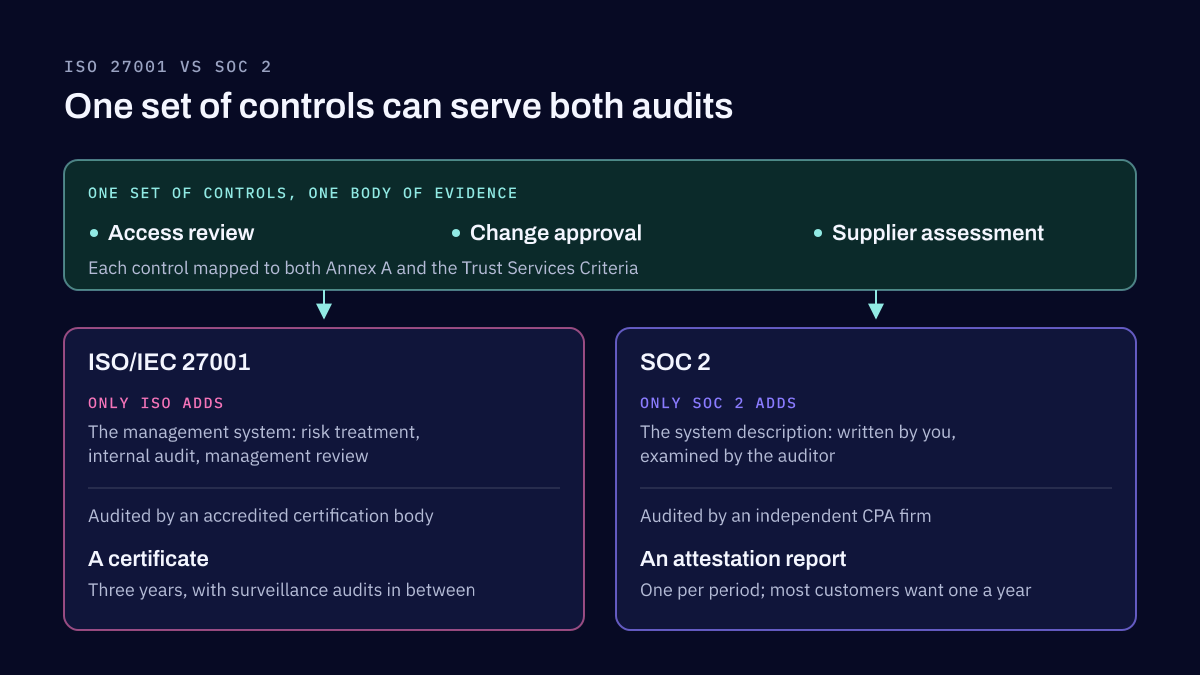
ISO/IEC 27001 is an international standard for running information security as a management system, and an accredited certification body certifies you against it. SOC 2 is a report on your controls, written by an independent CPA firm against the AICPA's Trust Services Criteria. Which one you need depends on who is asking, and most of the work counts for both.
Governance and Compliance
GCP Compliance: Governance and Cloud Legal Issues
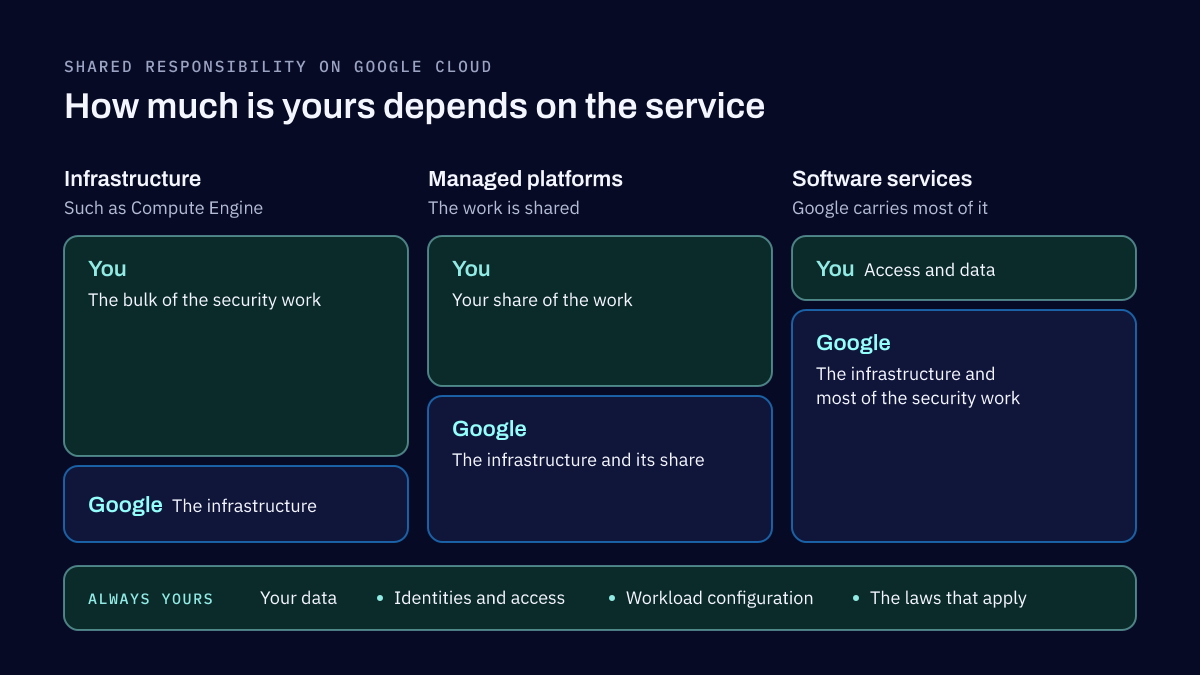
Compliance on Google Cloud is shared. Google secures the infrastructure and signs the contract terms; you decide where data lives, who can reach it and how you prove it. This guide covers the legal questions to settle first and the governance controls that answer them.
Tell us which standard you need and by when
Name the standard, who is asking for it and the date you are working to. We reply within two business days.