Governance and Compliance
ISO 27001 vs SOC 2: which one your customers need, and what each takes
ISO/IEC 27001 is an international standard for running information security as a management system, and an accredited certification body certifies you against it. SOC 2 is a report on your controls, written by an independent CPA firm against the AICPA's Trust Services Criteria. Which one you need depends on who is asking, and most of the work counts for both.

The short answer to ISO 27001 vs SOC 2 is that you need the one your customer asks for. A US customer will usually ask for a SOC 2 report; a European or international customer, or a tender, will usually ask for an ISO/IEC 27001 certificate. The two measure much the same security work in different ways. ISO 27001 certifies that you run security as a managed system. SOC 2 is an auditor's report on whether your controls are designed well and, in the fuller version, whether they worked over a period.
If nobody has asked yet, the next request decides. Look at the questionnaires you receive, the contracts you are negotiating and the markets you sell into, and start there.
The two side by side
| ISO/IEC 27001 | SOC 2 | |
|---|---|---|
| What it is | An international standard for an information security management system | An attestation engagement under AICPA standards, reported against the Trust Services Criteria |
| Who audits | An accredited certification body | An independent CPA firm |
| What you receive | A certificate | An attestation report |
| What it covers | The management system and the Annex A controls you choose for it | Security always; availability, processing integrity, confidentiality and privacy when you choose them |
| How long it lasts | Three years, with surveillance audits in between | One report per period; most customers ask for a new one every year |
| Who asks for it | International and European customers, tenders | US customers, especially for software and services |
What ISO 27001 asks of you
ISO/IEC 27001 is a requirements standard. You define the scope of your information security management system, assess the risks to the information in it, choose controls to treat those risks and record the choice in a Statement of Applicability, which goes through the 93 controls of Annex A. The standard also asks for an internal audit and a management review, so the system keeps checking itself.
Certification is a two-stage audit. The first stage reviews your documents and readiness; the second checks, through evidence and interviews, that the controls work in practice. The current edition is ISO/IEC 27001:2022, with an amendment on climate action published in 2024. Certificates to the 2013 edition expired or were withdrawn on 31 October 2025, at the end of the transition the International Accreditation Forum set, so any certificate a customer accepts today should name the 2022 edition.
What SOC 2 asks of you
SOC 2 is not a certificate. It is a report from a CPA firm on the controls of a company that provides a service to other businesses, measured against the Trust Services Criteria of the AICPA. Security is always in scope. Availability, processing integrity, confidentiality and privacy are added when they match what you promise your customers.
There are two types. A Type 1 report describes your system and the design of your controls at one date. A Type 2 report also tests whether the controls operated over a period, and it is the one most larger customers ask for. The report includes a description of your system, written by you, which the auditor then examines.
The criteria are changing. Reports today use the 2017 Trust Services Criteria with points of focus revised in 2022. On 26 October 2026 the AICPA published exposure drafts of proposed 2027 criteria, which combine and reword some criteria and add points of focus on artificial intelligence. If they are approved, they would apply to engagements beginning on or after 31 December 2027, with early adoption allowed. A company starting SOC 2 now prepares against the current criteria and should expect to review its mapping once the new ones are final.
Which one first
Start with the one that is being asked for. Customers name the evidence they will accept, and a different certificate or report may not be accepted in its place, however much of the same work sits behind it. Read the security clauses in your contracts and the questions in the questionnaires you receive; they tell you which one, and often which SOC 2 categories, your customers expect.
When both are being asked for, start with the one your largest or most urgent customer needs, and plan the second from the first day, as described below.
What companies get wrong the first time
Four mistakes come up again and again when a company prepares for its first certificate or report.
A scope that is too wide or too vague. Some companies try to put everything in scope. Others cannot say which systems, people and locations are in it. Both make the audit harder than it needs to be. Define the scope around the product or service your customers are buying, and write down what is in and what is out.
Policies without practice. A set of written or purchased policies passes no audit on its own. The auditor asks for evidence that people follow them: access reviews that were done, changes that were approved, suppliers that were assessed. A policy nobody follows becomes a finding.
Evidence left to the end. Collecting evidence a few weeks before the audit does not work, and for a SOC 2 Type 2 it cannot work, because the evidence has to cover the whole period under review. Start collecting it when the controls start.
Treating it as an IT project. Both frameworks reach well beyond IT. Management has to own the risk assessment, HR runs onboarding, training and leavers, and someone has to assess suppliers. When those people are left out, the controls that depend on them fail.
Doing both without doing it twice
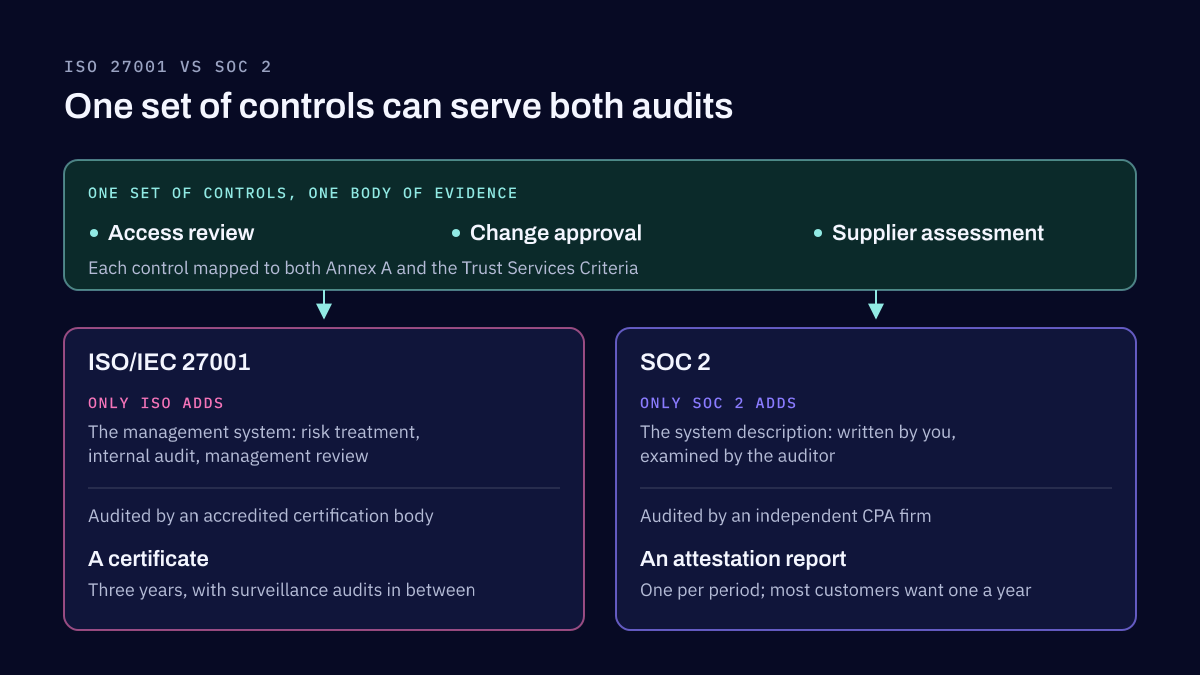
Most of the work counts for both. The way to avoid doing it twice is to build one set of controls and one body of evidence, and map each control to both the Annex A controls of ISO 27001 and the Trust Services Criteria of SOC 2. An access review, a change approval or a supplier assessment then serves both audits.
Two things do not carry over. ISO 27001's management system, with its risk treatment process, internal audit and management review, has no equivalent that SOC 2 requires. SOC 2's system description, the account of your system that the CPA firm examines, has no equivalent in ISO 27001. Plan for both from the start, and the second framework becomes an addition, not a second project.
The same thinking applies to other frameworks a customer may name. Our article on ISO 27001 vs NIST 800-53 shows how far a control mapping can be trusted, and where a match on paper still leaves a gap.
After the first audit
What surprises companies most comes after the first certificate or report. It never ends: ISO 27001 brings a surveillance audit every year and a recertification every three, and SOC 2 brings a new period and a new report every year. Compliance is a program, not a project.
The evidence keeps coming due, and collecting it month after month falls on people who have other jobs. Changes break controls: a new system, a new hire, a new supplier or a reorganisation can quietly take part of the company out of compliance between audits. And the auditor's fee recurs every year, on top of the work of staying ready, which few companies budget for the first time.
Where GUILDA can help
Our Compliance & Certification service prepares companies for ISO/IEC 27001 certification and SOC 2 reports: a gap assessment of 2 to 6 weeks, preparation of 2 to 4 months, and, if you want it, monthly upkeep between audits. We prepare; an accredited certification body or an independent CPA firm, which you choose, audits you. If the larger need is a security program to run these controls, Security Governance designs it, and software companies selling to larger customers will find the frameworks they are usually asked for on our Software & Hi-Tech page.
Sources
- ISO/IEC 27001:2022, Information security management systems, Requirements, International Organization for Standardization, 2022
- ISO/IEC 27001:2022/Amd 1:2024, Climate action changes, International Organization for Standardization, 2024
- IAF MD 26:2023, Transition Requirements for ISO/IEC 27001:2022, International Accreditation Forum, 2023
- 2017 Trust Services Criteria (With Revised Points of Focus, 2022), AICPA & CIMA, 2022
- Exposure Drafts: Proposed 2027 SOC 2 Trust Services Criteria and Description Criteria, AICPA & CIMA, 2026
- AICPA Proposes Update of SOC 2 Trust Services Criteria, CPA Practice Advisor, 2026
ISO 27001 consulting and SOC 2 readiness
We prepare your company for an ISO/IEC 27001 certificate or a SOC 2 report, from the first gap assessment to the day the auditor arrives, and can keep everything current afterwards. The certification body or the CPA firm audits you; our work is to make sure you are ready.
Related reading
Governance and Compliance
What Is FedRAMP and Why It Matters to Businesses
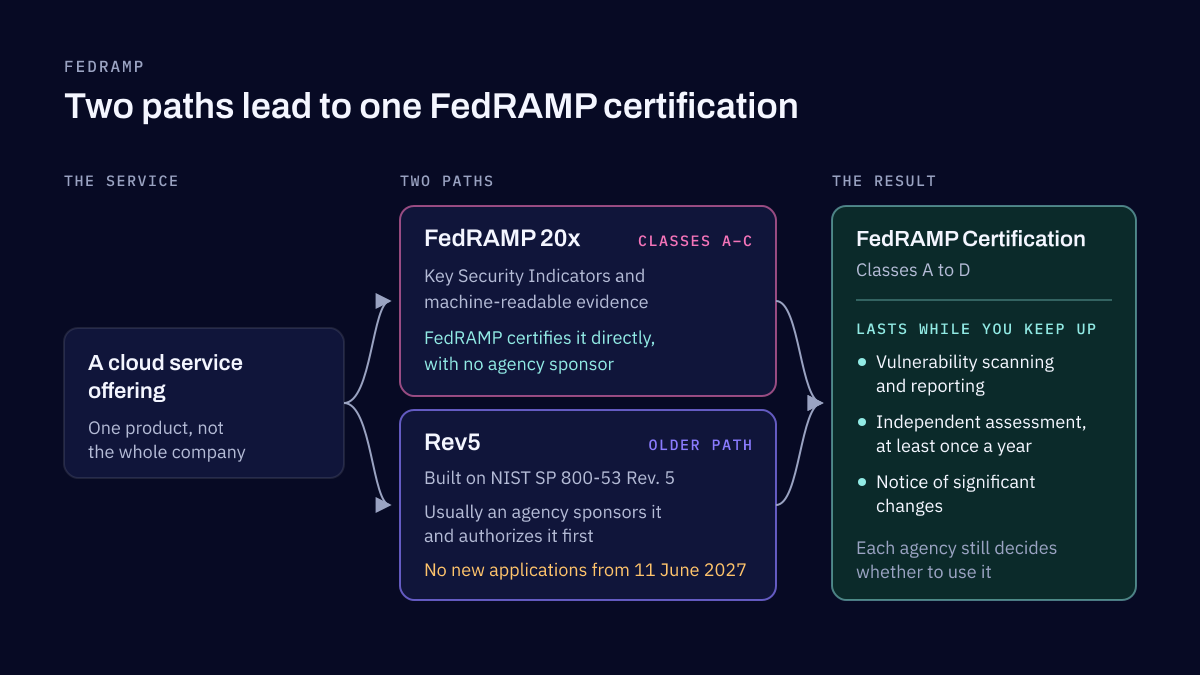
FedRAMP is the US government program that decides which cloud services federal agencies may use. It matters to companies that sell a cloud service to agencies and to contractors told to use FedRAMP cloud services. This guide explains how it works after the 2026 changes and when it is worth pursuing.
Governance and Compliance
GCP Compliance: Governance and Cloud Legal Issues
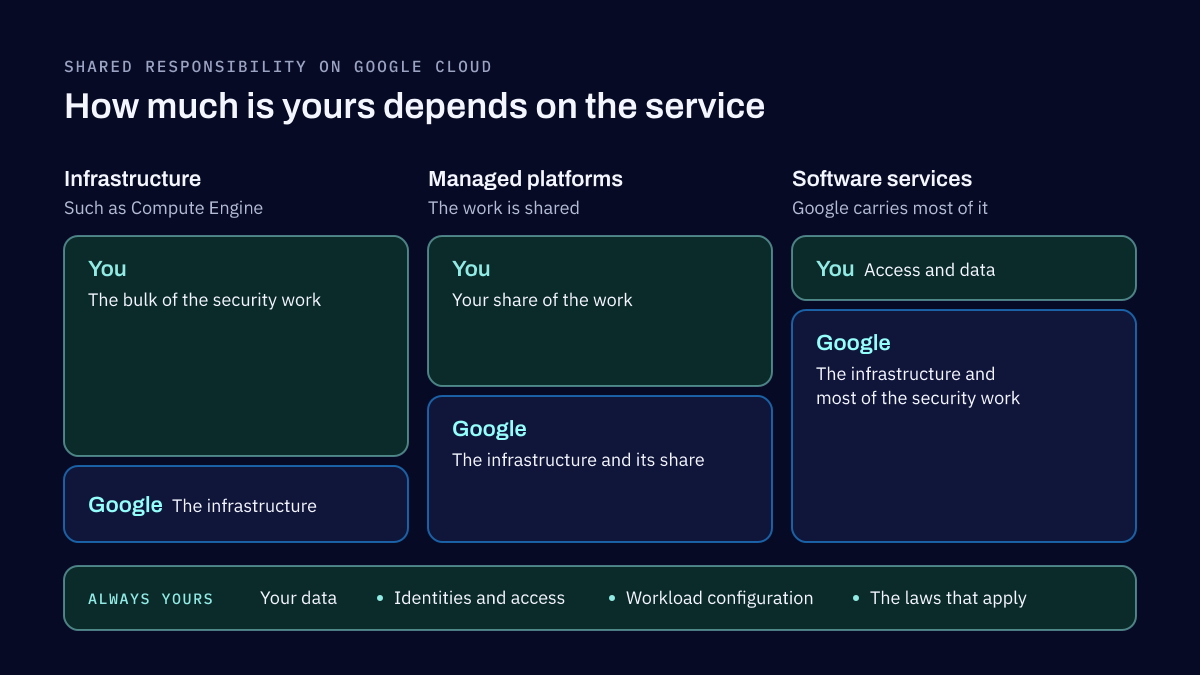
Compliance on Google Cloud is shared. Google secures the infrastructure and signs the contract terms; you decide where data lives, who can reach it and how you prove it. This guide covers the legal questions to settle first and the governance controls that answer them.
Tell us which standard you need and by when
Name the standard, who is asking for it and the date you are working to. We reply within two business days.