Governance and Compliance
GCP Compliance: Governance and Cloud Legal Issues
Compliance on Google Cloud is shared. Google secures the infrastructure and signs the contract terms; you decide where data lives, who can reach it and how you prove it. This guide covers the legal questions to settle first and the governance controls that answer them.

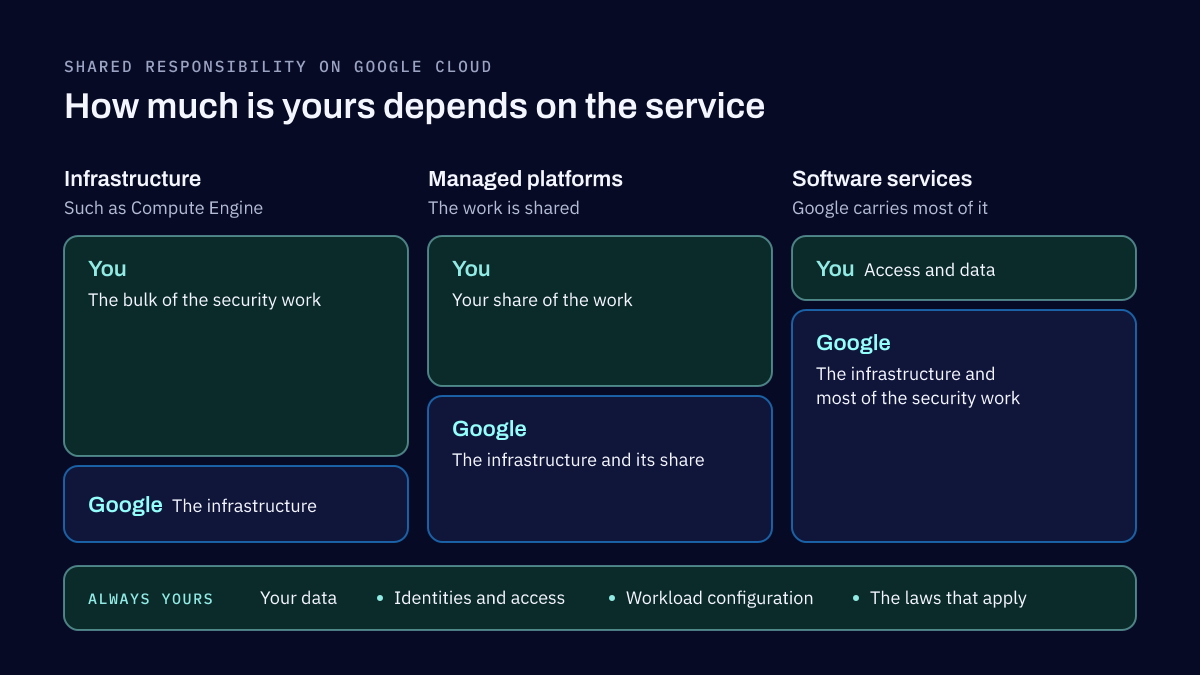
GCP compliance means meeting your legal and regulatory obligations for the systems and data you run on Google Cloud. Google is responsible for the security of its infrastructure, and it backs that with certifications and contract terms. You remain responsible for where your data is stored, who can reach it, how each workload is configured and which laws apply to your business. Compliance on Google Cloud comes down to two things: settling the legal questions before you move, and setting up governance controls that enforce and record the answers.
This article covers both, in the order we work through them with clients.
The legal questions to settle first
On cloud projects, the same questions come up first almost every time. Where will the data be stored? Will it cross a border? Which data protection laws apply, for example the GDPR or Mexico's LFPDPPP? Who else processes it? And what does the contract promise about security? You should be able to say where your data resides, who processes it and which legal requirements apply before the first workload moves.
Where the data is stored
Google Cloud lets you choose a region or multi-region for most resources. For the services listed in its data residency terms, Google commits in the Service Specific Terms to store customer data at rest only in the location you select, although it may replicate within the same country for backup and reliability. The commitment covers data at rest in listed services, so check every service your design uses.
For companies in Mexico, Google Cloud opened a region in Querétaro, northamerica-south1, announced in December 2024. Data that must stay in the country can now stay there.
Data protection law
The GDPR applies to companies established in the European Union, and to companies elsewhere that offer goods or services to people in the EU or monitor their behaviour there. Article 28 requires a written contract with every processor, and Article 32 requires security appropriate to the risk. Transfers out of the EU need a legal basis under Chapter V. For the United States, the EU-US Data Privacy Framework has been in force since July 2023. The EU General Court upheld it in September 2025, and an appeal is now before the Court of Justice. Google's data processing terms also provide the EU Standard Contractual Clauses for transfers that no other mechanism covers.
In Mexico, a new Ley Federal de Protección de Datos Personales en Posesión de los Particulares replaced the 2010 law. It was published in the Diario Oficial de la Federación on 20 March 2025 and took effect the next day, under the same name and abbreviation. Supervision moved from INAI to the Secretaría Anticorrupción y Buen Gobierno. The law still turns on the privacy notice: it must tell people what you collect, why, and whether you transfer their data. Sending data to a provider that processes it on your behalf, such as a cloud provider, is not a transfer under the law, so it does not need the consent a transfer may, but you remain responsible for that data and for the security measures the law requires. If your privacy notice and your contracts were written for the old law, review them against the new one with your lawyer.
Subprocessors and the contract
Google's Cloud Data Processing Addendum is the contract that covers personal data. It names Google as your processor, sets out its security commitments and lists how it handles subprocessors. Google publishes its subprocessor list and notifies customers at least 30 days before a new subprocessor starts work. Read the addendum alongside your own obligations: if your customers' contracts limit where their data may go or who may handle it, those limits have to hold through every subprocessor too.
The shared responsibility model, and what clients get wrong
The most common mistake we see is assuming Google Cloud handles all of security and compliance. It does not. Google secures the underlying infrastructure. Customers remain responsible for their data, identities, access controls, workload configurations and the compliance obligations that apply to them.
How much falls to you depends on the service. Google's own guidance puts it plainly: on infrastructure services such as Compute Engine, the bulk of the security work is yours; on managed platforms it is shared; on software services Google carries most of it, but access and data stay with you. Google also describes this as shared fate, offering secure landing zones and guidance to help customers get their part right. The help is real, and the responsibility is still yours.
The governance controls to put in place first
On Google Cloud, governance is set at the top of the resource hierarchy and inherited below it. That makes the first few decisions the most valuable ones. This is the order we follow.
- The resource hierarchy. One organization, folders for business units or environments, and projects inside them. Policies and permissions set on a folder apply to every project in it, so the structure decides how simply you can govern.
- Who can create projects. When an organization is created, every user in the domain can create projects and billing accounts by default. Name the people who should, then remove those roles from everyone else at the organization level.
- Organization policies. Restrict resource locations so data stays where your legal analysis says it must. Restrict sharing to your own domain, so nobody grants access to an outside account. Block the creation of service account keys, which are long-lived credentials that often leak. Google now offers newer managed versions of several of these constraints; use them where available.
- Least-privilege access. Grant roles to groups rather than individuals, avoid the broad basic roles, and use the role recommendations in Policy Intelligence to remove permissions people do not use.
- Central audit logging. Admin Activity and System Event audit logs are always on. Data Access logs are mostly off by default and should be turned on for services that hold sensitive data. Send all of them to one central project with an organization-level sink, and set retention to what your regulations require: Google keeps the required logs for 400 days and others for 30 days unless you change it.
Visibility and continuous compliance monitoring come next. Security Command Center finds misconfigurations and vulnerabilities across the organization, and its Premium tier adds compliance monitoring against common frameworks. Note that Google has deprecated the Enterprise tier, which shuts down on 21 May 2027. For regulated workloads that need stricter residency or support personnel controls, Assured Workloads applies control packages to a folder, for example for EU data boundaries or for FedRAMP High.
Proving it to an auditor
Controls only help an audit if you can show them working. Keep your organization policies and IAM changes in code, so each change has a review and a history. Keep the audit logs where the auditor can query them. For the parts Google runs, download its ISO/IEC certificates and SOC reports from Compliance Reports Manager. Together these let you answer the question every auditor asks: who could reach this data, and how do you know?
If your company is preparing for an ISO/IEC 27001 certificate or a SOC 2 report, our compliance and certification work covers the gap assessment and the evidence. For the Google Cloud side, a cloud security assessment reviews your organization against these controls and hardens what falls short. If you are still planning the move, our cloud transformation work builds the landing zone with them in place from the start, and our security governance work sets the policies the controls enforce. If you sell to US federal agencies, read our guide to what FedRAMP is and when it matters.
This article describes the law and Google's terms as they stood when it was last reviewed. It is not legal advice; confirm how they apply to your company with your lawyer.
Frequently asked questions
Does Google Cloud make my company compliant?
No. Google Cloud holds certifications and reports for its own infrastructure and services, and you can rely on them for the parts Google runs. Your data, your users and permissions, the way you configure each workload and the laws that apply to your business remain yours. An auditor will ask you for evidence of those, not for Google's certificates.
Can I keep my data in one country on Google Cloud?
For the services Google lists as covered, its Service Specific Terms commit it to store your data at rest only in the region or multi-region you choose. You then enforce the choice with the resource locations organization policy, so nobody creates a resource elsewhere. Check each service you use against Google's list, as not every service is covered.
What happens when Google adds a subprocessor?
Under the Cloud Data Processing Addendum, Google tells customers at least 30 days before a new subprocessor starts processing their data, with its name, location and activities. If you object, the addendum lets you terminate the agreement within 90 days of the notice. Someone in your company should receive and read these notices.
Which Google Cloud controls should come first?
The resource hierarchy, a short list of people who can create projects, organization policies for locations, sharing and service account keys, least-privilege access and audit logs collected in one place. Monitoring with Security Command Center comes next. All of these are set once at the organization level and inherited by every project after that.
Sources
- Cloud Data Processing Addendum (Customers), Google Cloud, 2026
- Google Cloud Platform Service Specific Terms, Data Location, Google Cloud, 2026
- Google Cloud Platform Subprocessors, Google Cloud, 2026
- Shared responsibilities and shared fate on Google Cloud, Google Cloud, 2026
- Resource hierarchy, Google Cloud, 2026
- Organization Policy constraints, Google Cloud, 2026
- Default access control for organizations, Google Cloud, 2026
- Cloud Audit Logs overview, Google Cloud, 2026
- Security Command Center service tiers, Google Cloud, 2026
- Assured Workloads overview, Google Cloud, 2026
- Regulation (EU) 2016/679, General Data Protection Regulation, European Union, 2016
- Data transfers between the EU and the United States, European Commission, 2025
- Ley Federal de Protección de Datos Personales en Posesión de los Particulares, Cámara de Diputados, 2025
ISO 27001 consulting and SOC 2 readiness
We prepare your company for an ISO/IEC 27001 certificate or a SOC 2 report, from the first gap assessment to the day the auditor arrives, and can keep everything current afterwards. The certification body or the CPA firm audits you; our work is to make sure you are ready.
Related reading
Governance and Compliance
ISO 27001 vs SOC 2: which one your customers need, and what each takes
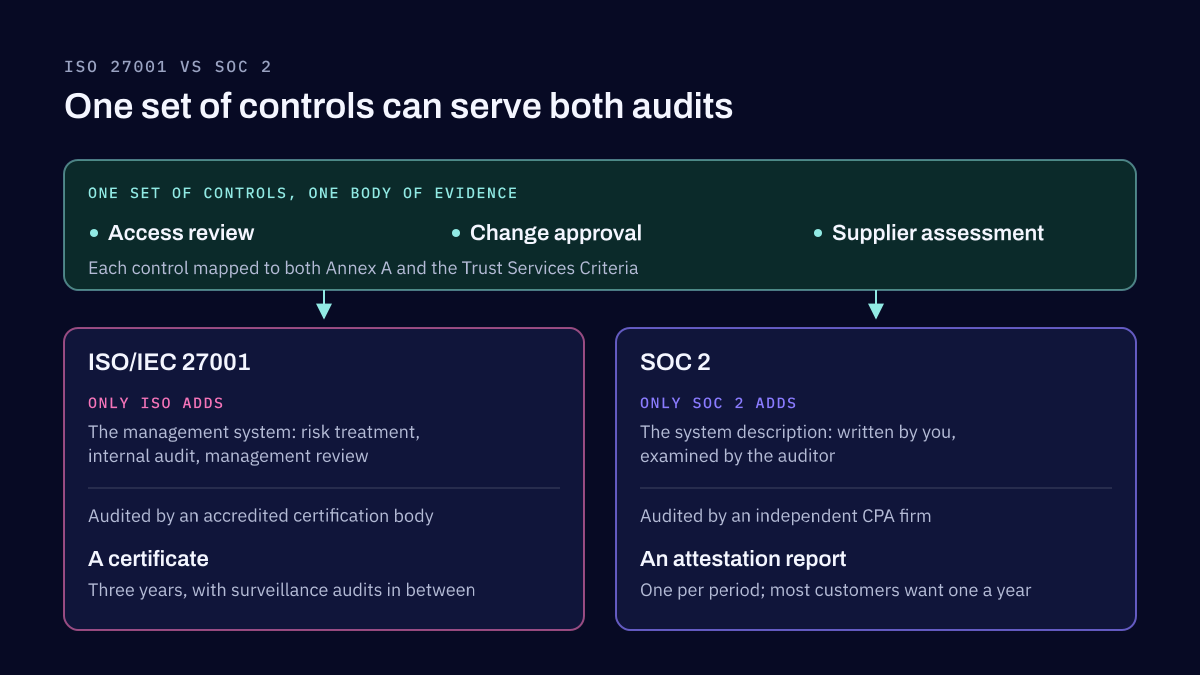
ISO/IEC 27001 is an international standard for running information security as a management system, and an accredited certification body certifies you against it. SOC 2 is a report on your controls, written by an independent CPA firm against the AICPA's Trust Services Criteria. Which one you need depends on who is asking, and most of the work counts for both.
Governance and Compliance
What Is FedRAMP and Why It Matters to Businesses
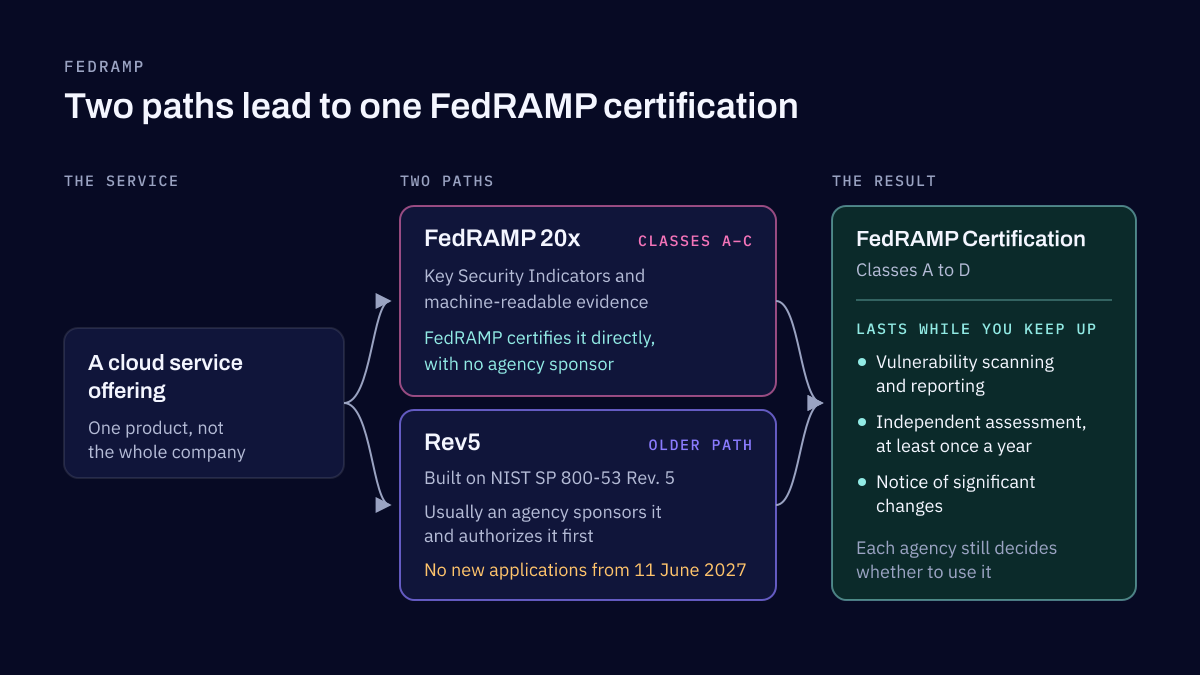
FedRAMP is the US government program that decides which cloud services federal agencies may use. It matters to companies that sell a cloud service to agencies and to contractors told to use FedRAMP cloud services. This guide explains how it works after the 2026 changes and when it is worth pursuing.
Tell us which standard you need and by when
Name the standard, who is asking for it and the date you are working to. We reply within two business days.