Governance and Compliance
ISO 27001 vs NIST 800-53: a control mapping and where it misleads
ISO/IEC 27001 and NIST SP 800-53 overlap, but they are not interchangeable. This article explains how they differ, maps all 93 Annex A controls to NIST controls from NIST's own crosswalk, with the full matrix to download, and shows where a match on paper still leaves a gap.

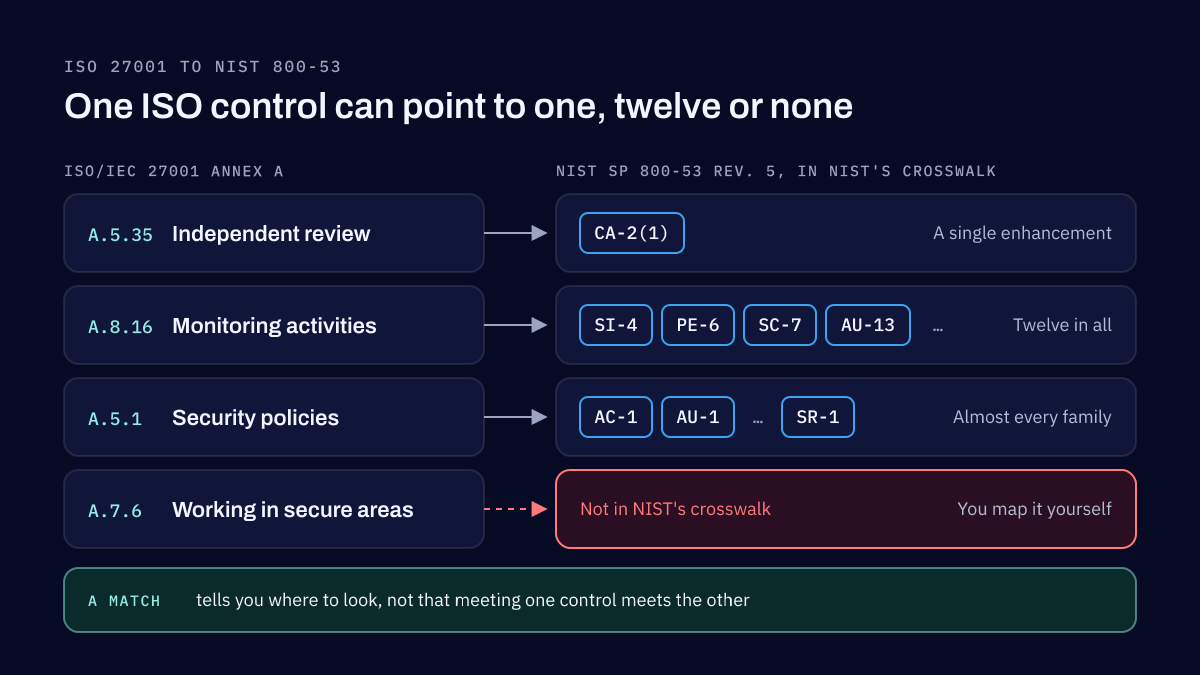
ISO/IEC 27001 and NIST SP 800-53 answer different questions. ISO/IEC 27001 is a standard for running an information security management system, with 93 reference controls in its Annex A, and an accredited body can certify you against it. NIST SP 800-53 is a catalog of detailed controls written for US federal systems, and no one issues a certificate for it. One ISO control usually maps to several NIST controls. NIST's own crosswalk maps 91 of the 93 Annex A controls, and a match tells you where to look, not that meeting one control meets the other.
The full mapping is below, theme by theme, and as a file you can open in a spreadsheet. First, how the two differ, why companies map them, and where the mapping misleads.
How ISO 27001 and NIST 800-53 differ
ISO/IEC 27001:2022, amended in 2024 for climate action, has two parts. Clauses 4 to 10 are the requirements of the management system: its scope, the risk assessment and risk treatment, objectives, internal audit, management review and corrective action. Annex A lists 93 controls in four themes: 37 organisational, 8 people, 14 physical and 34 technological. You apply the controls your risk assessment calls for and justify each choice in a Statement of Applicability. Certification bodies had to move every certified company to the 2022 edition by 31 October 2025, so documents that still use the 2013 numbering, such as A.12.6.1, are out of date.
NIST SP 800-53 Revision 5 is a catalog of controls in 20 families, from access control (AC) to supply chain risk management (SR). Many controls have enhancements, written in brackets as in AC-2(12), and many leave values open for the organisation to set: how often, by whom, within what time. A companion publication, SP 800-53B, groups the controls into low, moderate and high baselines for federal systems. NIST updates the catalog through minor releases; the latest, Release 5.2.0, came out in August 2025.
There is no NIST certificate. A federal agency authorises a system after its controls are assessed, and FedRAMP's Rev5 path uses SP 800-53 Rev. 5 as the baseline for cloud services. The practical difference is this: an ISO/IEC 27001 certificate tells a customer that you run a working management system, and an SP 800-53 assessment tells them which specific controls are in place and how each one is set.
Why companies map one to the other
The companies that need this mapping usually work across US and international markets, and each market asks for something different. Customers outside the United States, and many large ones inside it, ask for an ISO/IEC 27001 certificate. A US federal customer, a contract or a FedRAMP requirement names NIST SP 800-53. Running two separate control sets for the same systems doubles the policies, the evidence and the audit work.
Mapping the two lets you consolidate them into one set of controls, collect the evidence once and show each auditor or assessor the part they need. Where FedRAMP applies, the mapping is also the first measure of how much of your ISO work carries over; the article on what FedRAMP is explains when it applies.
Where the mapping misleads
Similar controls do not mean equivalent compliance. ISO/IEC 27001 is built around managing risk: you decide which controls you need and show that they work. NIST SP 800-53 is more granular: each control states what must be done, often with values that the customer or the program sets. The implementation, the way it is assessed, the scope and the evidence an auditor expects can all differ, and each difference can leave a gap. NIST's crosswalk itself shows where to look:
- Policies. Annex A 5.1 relates to the policy and procedures control of almost every NIST family, from AC-1 to SR-1. One well written ISO policy set can serve them, but an assessor will look for the access control policy, the audit policy, the media protection policy and the others, each reviewed at the frequency set for it.
- Independent review. Annex A 5.35 relates to a single enhancement, CA-2(1), which asks for independent assessors. The ISO control asks for the approach to security to be reviewed independently at planned intervals; a NIST assessment tests each control.
- Monitoring. Annex A 8.16 relates to twelve NIST controls and enhancements, from system monitoring (SI-4) to monitoring physical access (PE-6). A monitoring tool that meets the ISO control does not show that each of the twelve is in place.
- Gaps. Three requirements of the 2022 edition have no NIST control in the crosswalk: clause 6.3 on planning changes, 7.6 on working in secure areas and 8.34 on protecting systems during audit testing. The crosswalk also predates Release 5.2.0, so the controls added in 2025 are not in it.
NIST makes the same point about its own work: the relationships are not always one-to-one, every mapping involves some judgement, and equivalence should not be assumed from the tables alone.
How to use NIST's crosswalk
Start from NIST's official crosswalk of SP 800-53 Rev. 5 to ISO/IEC 27001:2022, published in its Online Informative References (OLIR) catalog, rather than a commercial one. Commercial crosswalks publish coverage percentages that contradict each other; NIST's states only which controls relate. Then work through it in order:
- Establish the relationships. For each control you run under ISO/IEC 27001, list the NIST controls the crosswalk relates to it.
- Check implementation and evidence. For each NIST control, read what it requires and the values your customer or program sets, and check whether your ISO implementation and its evidence meet them.
- Record the gaps. A NIST control your ISO work does not meet, in full or in part, goes on a gap list with an owner and a date.
- Build one control framework. Write each control once, with the ISO and NIST references it serves, so that one piece of evidence answers both.
- Monitor it continuously. Check the controls on a schedule, not only before an audit, and update the mapping when either framework changes.
The mapping, control by control
The tables below turn NIST's crosswalk round, from ISO/IEC 27001:2022 to NIST SP 800-53 Rev. 5, for all 93 Annex A controls. NIST controls are written as in NIST's catalog, with enhancements in brackets. The description of each ISO control is our own short wording, not ISO's title. Each row is a relationship NIST recorded, not a statement that the controls are equivalent. The crosswalk is version 1.0.0, dated October 2023, and was checked on 30 October 2026.
Download the full matrix as a CSV file. It also covers the management system clauses 4 to 10, most of which relate to NIST's program management (PM) family, and opens in any spreadsheet.
Organisational controls (A.5)
| ISO/IEC 27001:2022 | Control | NIST SP 800-53 Rev. 5 |
|---|---|---|
| A.5.1 | Security policies, approved and reviewed | AC-1, AT-1, AU-1, CA-1, CM-1, CP-1, IA-1, IR-1, MA-1, MP-1, PE-1, PL-1, PM-1, PS-1, RA-1, SA-1, SC-1, SI-1, SR-1 |
| A.5.2 | Security roles and responsibilities | AC-1, AT-1, AU-1, CA-1, CM-1, CM-9, CP-1, CP-2, IA-1, IR-1, MA-1, MP-1, PE-1, PL-1, PM-1, PM-2, PM-10, PM-29, PS-1, PS-7, PS-9, RA-1, SA-1, SA-3, SA-9, SC-1, SI-1, SR-1 |
| A.5.3 | Keeping conflicting duties apart | AC-5 |
| A.5.4 | Management requiring staff to follow the policies | AC-1, AT-1, AU-1, CA-1, CM-1, CP-1, IA-1, IR-1, MA-1, MP-1, PE-1, PL-1, PL-4, PM-1, PS-1, PS-6, PS-7, RA-1, SA-1, SA-9, SC-1, SI-1, SR-1 |
| A.5.5 | Contact with authorities | IR-6 |
| A.5.6 | Contact with special interest groups | PM-15, SI-5 |
| A.5.7 | Threat intelligence | PM-16, PM-16(1), RA-10 |
| A.5.8 | Security in project management | PL-2, PL-7, PL-8, SA-3, SA-4, SA-9, SA-15 |
| A.5.9 | Inventory of information and assets, with owners | CM-8 |
| A.5.10 | Acceptable use of information and assets | MP-2, MP-4, MP-5, MP-6, MP-7, PE-16, PE-18, PE-20, PL-4, SC-8, SC-28 |
| A.5.11 | Return of assets when people leave | PS-4, PS-5 |
| A.5.12 | Classifying information | RA-2 |
| A.5.13 | Labelling information | MP-3, PE-22 |
| A.5.14 | Transferring information | AC-4, AC-17, AC-18, AC-19, AC-20, CA-3, PE-17, PS-6, SA-9, SC-7, SC-8, SC-15 |
| A.5.15 | Access control rules | AC-1, AC-3, AC-6 |
| A.5.16 | Managing identities | AC-2, IA-2, IA-4, IA-5, IA-8 |
| A.5.17 | Managing passwords and other authentication information | IA-5 |
| A.5.18 | Granting, reviewing and removing access rights | AC-2 |
| A.5.19 | Security in supplier relationships | SR-1, SR-2 |
| A.5.20 | Security in supplier agreements | SA-4, SR-2, SR-3, SR-5 |
| A.5.21 | Security in the ICT supply chain | SR-2, SR-3, SR-4, SR-5 |
| A.5.22 | Monitoring supplier services and their changes | RA-9, SA-9, SR-6, SR-7 |
| A.5.23 | Security of cloud services | SA-1, SA-4, SA-9, SA-9(3), SR-5 |
| A.5.24 | Planning and preparing for incident management | IR-8 |
| A.5.25 | Assessing and deciding on security events | AU-6, IR-4 |
| A.5.26 | Responding to security incidents | IR-4 |
| A.5.27 | Learning from security incidents | IR-4 |
| A.5.28 | Collecting evidence | AU-3, AU-10(3), AU-11 |
| A.5.29 | Security during disruption | CP-2, CP-4, CP-6, CP-7, CP-8, CP-9, CP-10, CP-11, CP-13 |
| A.5.30 | ICT readiness for business continuity | CA-2, CP-2(1), CP-2(8), CP-4, CP-4(1) |
| A.5.31 | Legal, regulatory and contractual requirements | AC-1, AT-1, AU-1, CA-1, CM-1, CP-1, IA-1, IR-1, MP-1, PE-1, PL-1, PM-1, PS-1, RA-1, SA-1, SC-1, SI-1, SR-1 |
| A.5.32 | Intellectual property rights | CM-10 |
| A.5.33 | Protecting records | AC-3, AU-9, CP-9, SC-8, SC-28, SC-28(1) |
| A.5.34 | Privacy and protection of personal data | PL-2, PM-18, PT-1, PT-3, PT-7 |
| A.5.35 | Independent review of information security | CA-2(1) |
| A.5.36 | Compliance with security policies and standards | AC-1, AT-1, AU-1, CA-1, CA-2, CA-7, CM-1, CP-1, IA-1, IR-1, MP-1, PE-1, PL-1, PM-1, PS-1, RA-1, SA-1, SC-1, SI-1, SR-1 |
| A.5.37 | Documented operating procedures | AC-1, AT-1, AU-1, CA-1, CM-1, CP-1, IA-1, IR-1, MA-1, MP-1, PE-1, PL-1, PS-1, RA-1, SA-1, SA-5, SC-1, SI-1, SR-1 |
People controls (A.6)
| ISO/IEC 27001:2022 | Control | NIST SP 800-53 Rev. 5 |
|---|---|---|
| A.6.1 | Background screening | PS-3, SA-21 |
| A.6.2 | Security terms in employment contracts | PL-4, PS-6 |
| A.6.3 | Security awareness, education and training | AT-2, AT-3, CP-3, IR-2, PM-13 |
| A.6.4 | Disciplinary process | PS-8 |
| A.6.5 | Responsibilities after employment ends or changes | PS-4, PS-5 |
| A.6.6 | Confidentiality agreements | PS-6 |
| A.6.7 | Remote working | AC-17, PE-17 |
| A.6.8 | Reporting security events | AU-6, IR-6, SI-2 |
Physical controls (A.7)
| ISO/IEC 27001:2022 | Control | NIST SP 800-53 Rev. 5 |
|---|---|---|
| A.7.1 | Physical security perimeters | PE-3 |
| A.7.2 | Physical entry | PE-2, PE-3, PE-4, PE-5, PE-16 |
| A.7.3 | Securing offices, rooms and facilities | PE-3, PE-5 |
| A.7.4 | Monitoring physical security | AU-6(6), PE-3, PE-3(3), PE-6, PE-6(1), PE-6(4) |
| A.7.5 | Protection against physical and environmental threats | CP-6, CP-7, PE-9, PE-13, PE-14, PE-15, PE-18, PE-19, PE-23 |
| A.7.6 | Working in secure areas | Not in NIST's crosswalk |
| A.7.7 | Clear desk and clear screen | AC-11, MP-2, MP-4, PE-5 |
| A.7.8 | Placing and protecting equipment | PE-9, PE-13, PE-14, PE-15, PE-18, PE-19, PE-23 |
| A.7.9 | Security of assets off the premises | AC-19, AC-20, MP-5, PE-17 |
| A.7.10 | Storage media | MA-2, MP-2, MP-4, MP-5, MP-6, MP-7, PE-16 |
| A.7.11 | Supporting utilities | CP-8, PE-9, PE-10, PE-11, PE-12, PE-14, PE-15 |
| A.7.12 | Cabling security | PE-4, PE-9 |
| A.7.13 | Equipment maintenance | MA-2, MA-6 |
| A.7.14 | Secure disposal or reuse of equipment | MP-6 |
Technological controls (A.8)
| ISO/IEC 27001:2022 | Control | NIST SP 800-53 Rev. 5 |
|---|---|---|
| A.8.1 | User endpoint devices | AC-11, AC-19 |
| A.8.2 | Privileged access rights | AC-2, AC-6, CM-5 |
| A.8.3 | Restricting access to information | AC-3, AC-24 |
| A.8.4 | Access to source code | AC-3, AC-3(11), CM-5 |
| A.8.5 | Secure authentication | AC-7, AC-8, AC-9, IA-6 |
| A.8.6 | Capacity management | AU-4, CP-2(2), SC-5(2) |
| A.8.7 | Protection against malware | AT-2, SI-3 |
| A.8.8 | Managing technical vulnerabilities | RA-3, RA-5, SI-2, SI-5 |
| A.8.9 | Configuration management | CM-1, CM-2, CM-2(3), CM-3, CM-3(7), CM-3(8), CM-4, CM-5, CM-6, CM-8, CM-9, CM-9(1), SA-10 |
| A.8.10 | Deleting information | AC-4(25), AC-7(2), MA-2, MA-3(3), MA-4(3), MP-4, MP-6, MP-6(1), SI-21 |
| A.8.11 | Data masking | AC-4(23), SI-19(4) |
| A.8.12 | Preventing data leakage | AU-13, PE-3(2), PE-19, SC-7(10), SI-20 |
| A.8.13 | Backups | CP-9 |
| A.8.14 | Redundant processing facilities | CP-2, CP-6, CP-7 |
| A.8.15 | Logging | AU-2, AU-3, AU-6, AU-9, AU-11, AU-12, AU-14 |
| A.8.16 | Monitoring activities | AC-2(12), AC-17(1), AU-13, IR-4(13), MA-4(1), PE-6, PE-6(3), SC-7, SI-4, SI-4(4), SI-4(13), SI-4(16) |
| A.8.17 | Clock synchronisation | AU-8 |
| A.8.18 | Privileged utility programs | AC-3, AC-6 |
| A.8.19 | Installing software on operational systems | CM-5, CM-7, CM-7(4), CM-7(5), CM-11 |
| A.8.20 | Network security | AC-3, AC-18, AC-20, SC-7, SC-8, SC-10 |
| A.8.21 | Security of network services | CA-3, SA-9 |
| A.8.22 | Segregating networks | AC-4, SC-7 |
| A.8.23 | Web filtering | AC-4, SC-7, SC-7(8) |
| A.8.24 | Cryptography | SC-12, SC-13, SC-17 |
| A.8.25 | Secure development life cycle | SA-3, SA-15, SA-17 |
| A.8.26 | Application security requirements | AC-3, SC-8, SC-13 |
| A.8.27 | Secure architecture and engineering principles | SA-8, SA-17 |
| A.8.28 | Secure coding | SA-4(3), SA-8, SA-10, SA-11(1), SA-15(5) |
| A.8.29 | Security testing in development and acceptance | CA-2, SA-4, SA-11, SR-5(2) |
| A.8.30 | Outsourced development | SA-4, SA-10, SA-11, SA-15, SR-2, SR-4 |
| A.8.31 | Separating development, test and production | CM-4(1), CM-5, SA-3 |
| A.8.32 | Change management | CM-3, CM-5, SA-10, SI-2 |
| A.8.33 | Test data | SA-3(2) |
| A.8.34 | Protecting systems during audit testing | Not in NIST's crosswalk |
Where to start
If a customer or a contract has named NIST SP 800-53, the first step is a gap assessment against NIST SP 800-53 that starts from the controls you already run for ISO/IEC 27001 and the values your customer sets. There is no NIST certificate, so the result is a report and a plan, not an audit opinion.
If you are building the program in the first place, a security program built on ISO/IEC 27001 can carry the NIST references from the start, and one risk assessment can serve both clause 6.1.2 and RA-3. If your systems run on Google Cloud, the governance controls on Google Cloud are where both frameworks meet the platform. And if the customer asked for a SOC 2 report rather than a NIST assessment, ISO 27001 vs SOC 2 explains how far the same work carries over.
Frequently asked questions
What is the difference between ISO 27001 and NIST SP 800-53?
ISO/IEC 27001 is an international standard for an information security management system. It sets requirements for managing security risk, lists 93 reference controls in Annex A, and an accredited body can certify you against it. NIST SP 800-53 is a catalog of detailed security and privacy controls in 20 families, written for US federal systems, and no one issues a certificate for it. ISO says how to manage security; NIST says in detail which controls to run.
Does an ISO 27001 certificate satisfy NIST SP 800-53 or FedRAMP?
No. A certificate shows that your management system meets ISO/IEC 27001. It does not show that each NIST control is in place with the values your customer sets. FedRAMP's Rev5 path assesses a cloud service against its own baseline, built on SP 800-53 Rev. 5. Much of your ISO work carries over, and the mapping shows where to look for the rest.
Where can I find NIST's official mapping?
In NIST's Online Informative References (OLIR) catalog, as "800-53-Rev5-to-ISO 27001-2022", linked from the SP 800-53 Rev. 5 page. It is a spreadsheet with one sheet per NIST family, going from each NIST control to the ISO clauses and Annex A controls it relates to. The tables in this article turn it round, from ISO to NIST.
Why are some ISO 27001 controls missing from the mapping?
NIST's crosswalk is not comprehensive, and NIST says so. Annex A 7.6 (working in secure areas), 8.34 (protecting systems during audit testing) and clause 6.3 (planning changes) have no NIST control in it. That means NIST recorded no relationship for them, so you map them yourself and write down why you chose the controls you did.
Sources
- ISO/IEC 27001:2022, Information security management systems, Requirements, International Organization for Standardization, 2022
- ISO/IEC 27001:2022/Amd 1:2024, Climate action changes, International Organization for Standardization, 2024
- Transition Requirements for ISO/IEC 27001:2022 (NF38), Irish National Accreditation Board, 2023
- SP 800-53 Rev. 5, Security and Privacy Controls for Information Systems and Organizations, NIST, 2020
- 800-53 Rev. 5 to ISO/IEC 27001:2022 Informative Reference (OLIR), NIST, 2023
- FedRAMP certification, FedRAMP, US General Services Administration, 2026
ISO 27001 consulting and SOC 2 readiness
We prepare your company for an ISO/IEC 27001 certificate or a SOC 2 report, from the first gap assessment to the day the auditor arrives, and can keep everything current afterwards. The certification body or the CPA firm audits you; our work is to make sure you are ready.
Related reading
Governance and Compliance
ISO 27001 vs SOC 2: which one your customers need, and what each takes
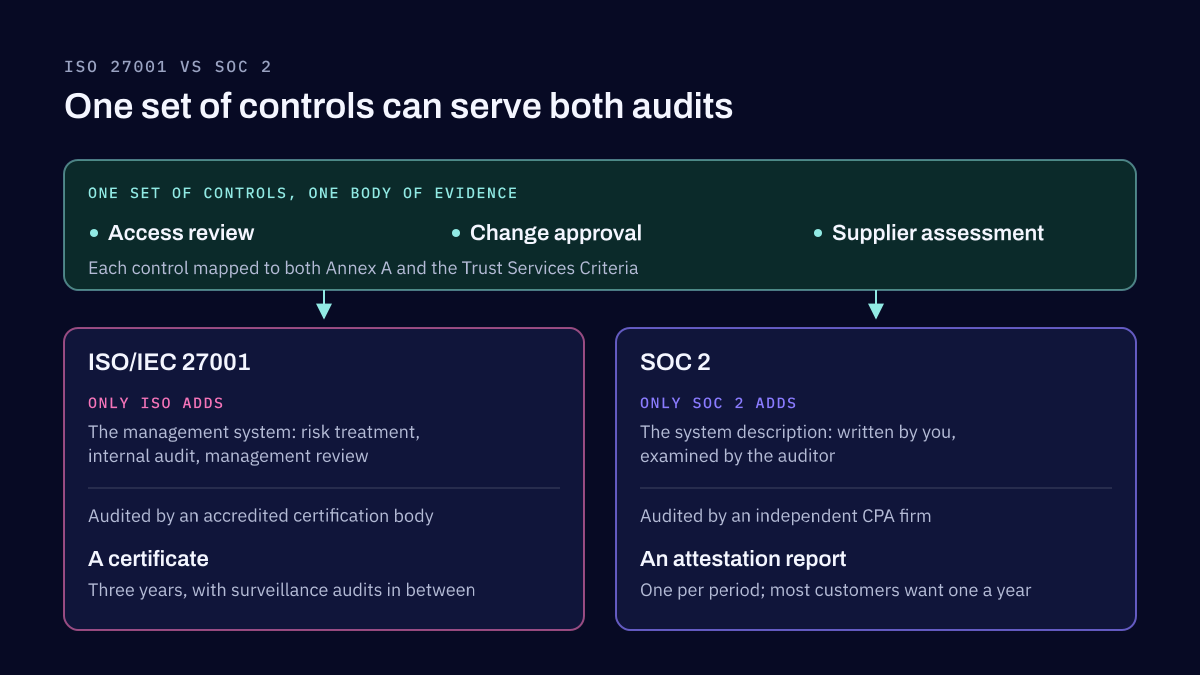
ISO/IEC 27001 is an international standard for running information security as a management system, and an accredited certification body certifies you against it. SOC 2 is a report on your controls, written by an independent CPA firm against the AICPA's Trust Services Criteria. Which one you need depends on who is asking, and most of the work counts for both.
Governance and Compliance
What Is FedRAMP and Why It Matters to Businesses
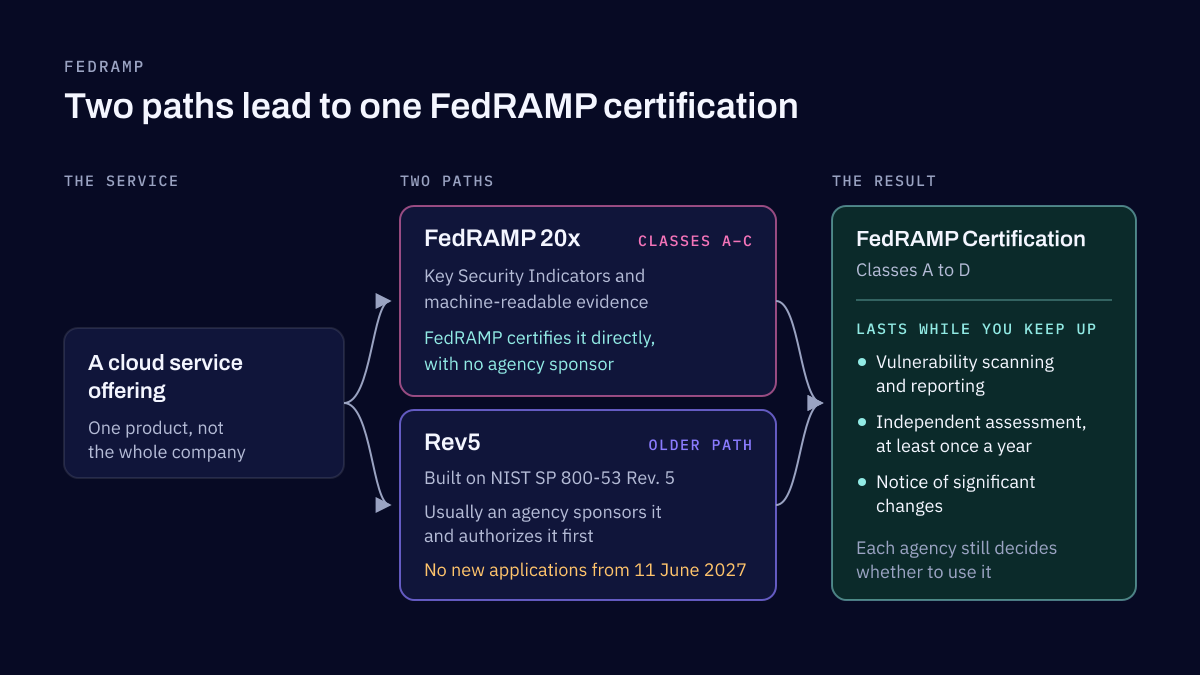
FedRAMP is the US government program that decides which cloud services federal agencies may use. It matters to companies that sell a cloud service to agencies and to contractors told to use FedRAMP cloud services. This guide explains how it works after the 2026 changes and when it is worth pursuing.
Tell us which standard you need and by when
Name the standard, who is asking for it and the date you are working to. We reply within two business days.