Threats and Breaches
The $6 billion Binance hack: how EIP-7702 turned a hot wallet against its owner
Attackers drained about $6.3 billion from Binance's hot wallets on 29 October 2026, using EIP-7702 to point a wallet at their own contract. The keys did not leak; a system that signs was used. The lesson for any company is to protect the signer and the approvals, not only the key.

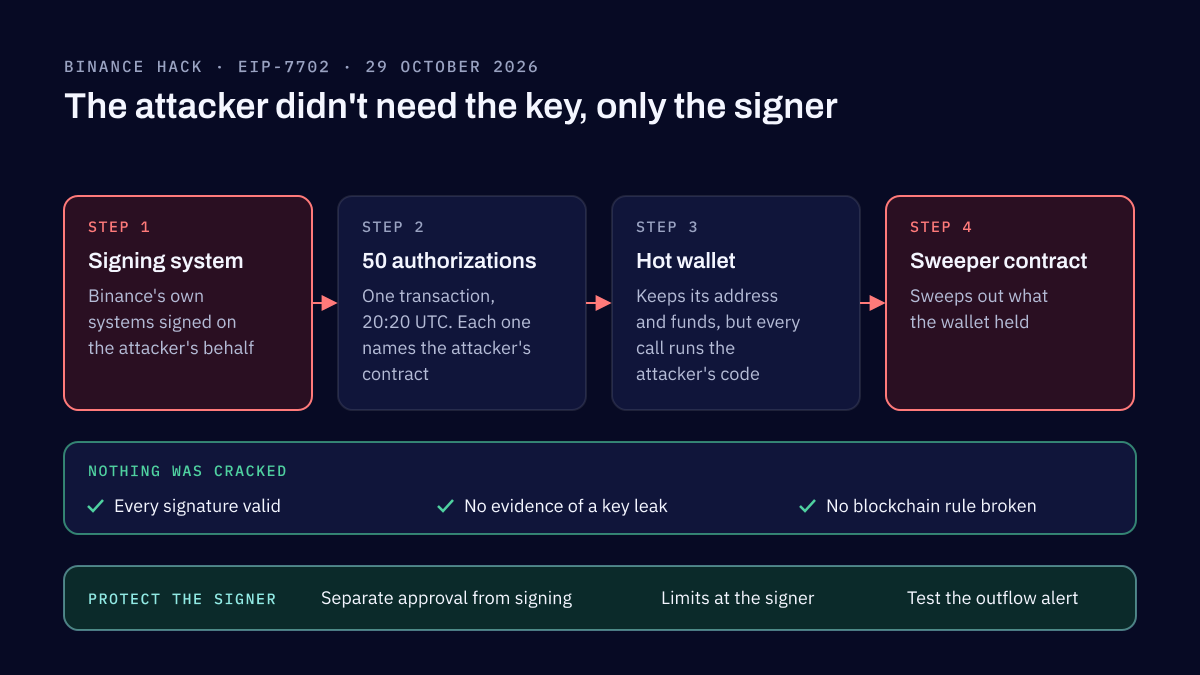
On 29 October 2026, attackers drained about $6.3 billion from Binance's hot wallets, the largest crypto theft on record. The Binance hack used EIP-7702, an Ethereum feature live since May 2025 that lets an ordinary account hand control to a smart contract with one signed authorization. Authorizations signed for a Binance hot wallet pointed it at the attacker's "sweeper" contract, which emptied it. Binance says it found no evidence that its private keys leaked. The attacker did not need them: it needed a system that signs. That is the lesson for every company, crypto or not.
What Binance has confirmed
Binance has published four updates. In its first, on 30 October, it put the impact at "around $6.3B", said it had temporarily suspended withdrawals and revoked "the affected address authorisation", and promised to cover all losses from its SAFU fund and its own funds. Its second dated the start of the attack to about 20:05 UTC on 29 October. By its fourth, on 1 November, it had covered about 95% of the amount and began reopening withdrawals in phases. Binance has not yet published its post-incident report, which it says will follow once the investigation is complete.
How much was taken, and how much is frozen
The sources agree on the order of magnitude, not on the exact figure. Each counts at a different moment and over different wallets.
| Source | Total stolen | Frozen |
|---|---|---|
| Binance | about $6.3 billion | about $3 billion |
| Chainalysis | about $6.4 billion | about $2.8 billion |
| TRM Labs | about $6.36 billion, across ten blockchains | about $2.7 billion |
| Elliptic | $6.43 billion, across 11 blockchains | $2.85 billion, 44% of the theft |
Elliptic says the frozen funds are almost all USDT and USDC, stablecoins whose issuers can block them. The FBI says the attackers have been converting stolen assets mainly into Ether and expects further laundering.
EIP-7702 in plain terms
Ethereum has two kinds of account. An ordinary account is controlled by a private key and holds funds. A smart contract is code that runs when called. EIP-7702, activated with the Pectra upgrade on 7 May 2025, joins the two. The account's key signs an authorization naming a contract, and from then on the account behaves as that contract. It keeps its address and its funds, but every call to it runs the contract's code. The delegation lasts until the key signs a new authorization that clears it.
It was built for useful things: paying several bills in one transaction, setting spending limits, letting someone else pay the network fees. The specification is also blunt about the risk: "The code specified by an authorization has unrestricted access to the account." Whoever can get an authorization signed decides what the account does.
How the attacker turned the hot wallet into a sweeper
A hot wallet is the online wallet an exchange uses to pay out withdrawals, so its keys are used by systems many times a day. According to TRM Labs, at 20:20 UTC the attacker submitted one transaction carrying 50 authorizations, each signed for a Binance Ethereum hot wallet and pointing it at a contract the attacker controlled. The 50 covered 50 consecutive transaction numbers, so that one would be valid whenever it ran. From that moment the wallet ran the attacker's code, which swept out what it held. Elliptic found the same contract had been rehearsed on another wallet about four hours earlier. Chainalysis reports that other Binance wallets were drained by ordinary signed transfers.
What matters for defenders is that every signature was valid. TRM Labs and Elliptic both assess that the attacker got Binance's own signing systems to sign on its behalf. Nothing was cracked, and no blockchain rule was broken.
What is not known yet
How the attacker reached the signing systems is not confirmed. Binance's first update said the incident "may involve a compromised DevOps engineer's laptop", which gave access to a service container from which withdrawal transactions were submitted. Its second said the investigation "has uncovered additional points of breach", without describing them. How the laptop was compromised, and what else was breached, has not been published. Claims of phishing, a supply-chain attack or an insider are speculation until Binance's report appears. We will review this article when it does.
The biggest crypto exchange hack, and who the FBI says did it
On 31 October the FBI said North Korea was responsible for the theft of more than $6 billion from Binance, naming the group it calls TraderTraitor, also tracked as the Lazarus Group. With the Secret Service and IRS Criminal Investigation, it asked exchanges and other services to block 628 addresses used to launder the funds, as BleepingComputer reported. TRM Labs, Chainalysis and Elliptic had already attributed the theft to TraderTraitor. Binance itself has named no attacker. The same group took about $1.5 billion from the exchange Bybit in February 2025, the previous record, so the record has grown fourfold in under two years.
The lesson for companies that hold no crypto
Most companies have a system that signs something valuable: a payment run sent to the bank, an API key that moves money, a key that signs software releases or certificates. The Binance hack shows that protecting the key is necessary but not enough. A key in a hardware security module cannot be copied, but it will still sign whatever the system in front of it asks. The question is who can make that system ask.
These are the weak points we find most often at clients:
- Keys sit where too many can read them: in configuration files, environment variables or pipeline settings, instead of a hardware security module or a cloud key management service that never lets them out. Our key management and secrets review starts there.
- The service that signs can do too much. Whoever compromises it inherits the signing authority, and nobody has listed what signs what or rotated the keys in years.
- Limits live only in the application. If the approval limit is checked by the same software that sends the request to the signer, controlling that software bypasses it.
- One person can approve. There is no independent second approval for large or unusual transfers.
- Nobody is alerted when money leaves faster than normal, and nobody has rehearsed pausing outflows or knows who may decide to. A detection rule for abnormal outflows is what turns hours into minutes.
The way in is often an ordinary one. A compromised laptop is where many breaches at financial companies begin, often through phishing aimed at staff, even though Binance has not said how its own engineer's laptop was compromised.
What to check first
In this order:
- List everything that can sign or approve a movement of money: every key, service account and API credential, and where each one lives.
- Find out who can change what a signer may do. Policies, delegations and administrator rights over the signer are as powerful as the key itself. In this hack, one delegation turned the wallet against its owner.
- Test the outflow alert. Simulate an abnormal transfer and time how long it takes for someone to be alerted and able to stop it.
- Separate approval from signing, so the system that approves a transfer is not the one that signs it, and enforce the limits at the signer, where the requesting software cannot change them.
Frequently asked questions
What is EIP-7702?
An Ethereum feature, live since the Pectra upgrade of May 2025, that lets an ordinary account, one controlled by a private key, point to a smart contract with a single signed authorization. From then on, calls to the account run that contract's code with full access to the account's funds, until the owner signs a new authorization that clears it. It was designed for features such as batched payments and spending limits.
Were Binance's private keys stolen?
Binance says it has found no evidence of a wallet private key leak. TRM Labs and Elliptic both assess that the attacker instead got Binance's own signing systems to sign transactions of the attacker's choosing. Binance's preliminary explanation is a compromised engineer's laptop that gave access to a service container; its full report has not been published yet.
Did Binance customers lose money?
Binance says it will cover all the stolen funds, from its SAFU fund and its own money, and that users will not bear the loss. By 1 November it said it had covered about 95% of the amount and began reopening withdrawals in phases, starting with major networks such as Bitcoin and Ethereum.
Does this matter if my company holds no crypto?
Yes. Any company has systems that sign or approve something valuable, such as payment runs, bank API calls, software releases or certificates. The pattern of this attack, getting the signer to sign rather than stealing the key, works against all of them, and the controls that stop it are the same ones.
Sources
- Security Incident Update (2026-10-30), Binance, 2026
- Security Incident Update #2 (2026-10-30), Binance, 2026
- Security Incident | Recovery Update #4: Withdrawals Resume in Phases (2026-11-01), Binance, 2026
- The $6.4 Billion Binance Hack: Tracing the North Korea Link, Chainalysis, 2026
- North Korea Steals USD 6.36 Billion From Binance in the Largest Hack in History, TRM Labs, 2026
- The largest theft in history: North Korea behind the $6.4 billion Binance hack, Elliptic, 2026
- North Korea Responsible for $6 Billion+ Binance Attack, FBI, 2026
- FBI links $6.3 billion Binance crypto heist to North Korean hackers, BleepingComputer, 2026
- North Korea Responsible for $1.5 Billion Bybit Hack, FBI Internet Crime Complaint Center, 2025
- EIP-7702: Set Code for EOAs, Ethereum Improvement Proposals, 2024
- Pectra Mainnet Announcement, Ethereum Foundation, 2025
Application security services and cloud security
We review the applications you build, assess and harden the AWS, Microsoft Azure or Google Cloud accounts they run in, and design how the data they hold is protected. Reviews follow OWASP, and cloud work follows the CIS Benchmarks.
Related reading
Threats and Breaches
Software supply chain risk: what SolarWinds and CrowdStrike teach
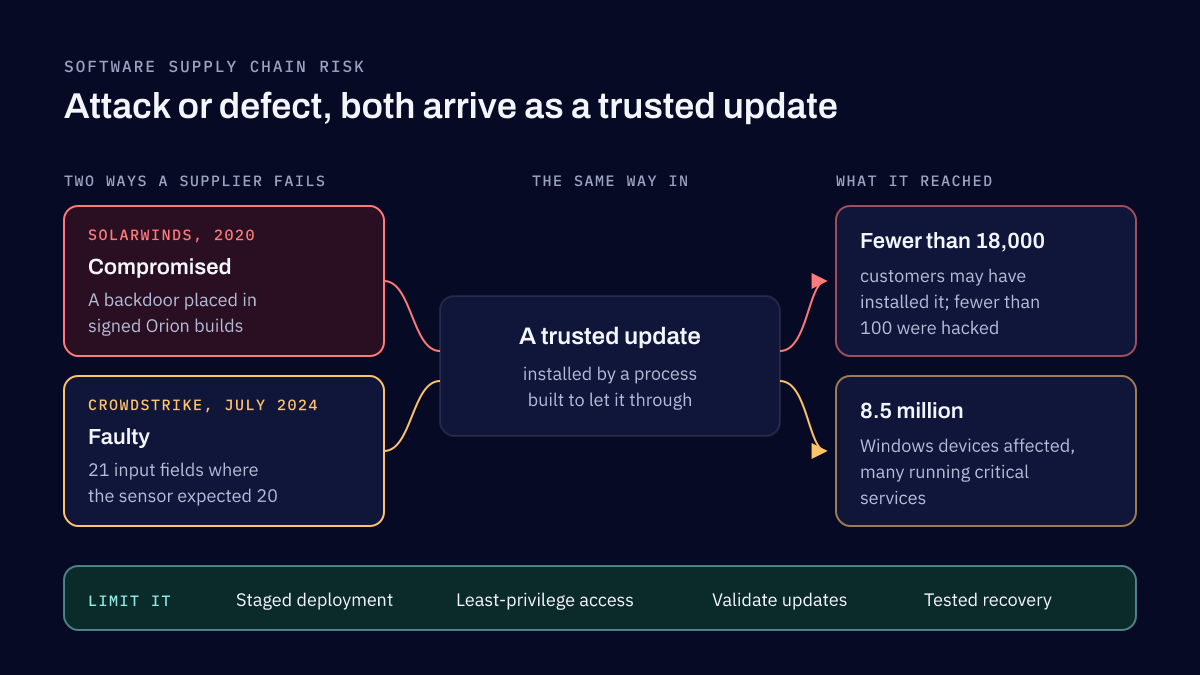
The SolarWinds attack and the CrowdStrike outage were different failures that arrived the same way, as a trusted update. What they show about software supply chain risk, and the contract terms and controls that limit it.
Threats and Breaches
Evolve Bank and Trust data breach: what it, Sony and Banorte teach
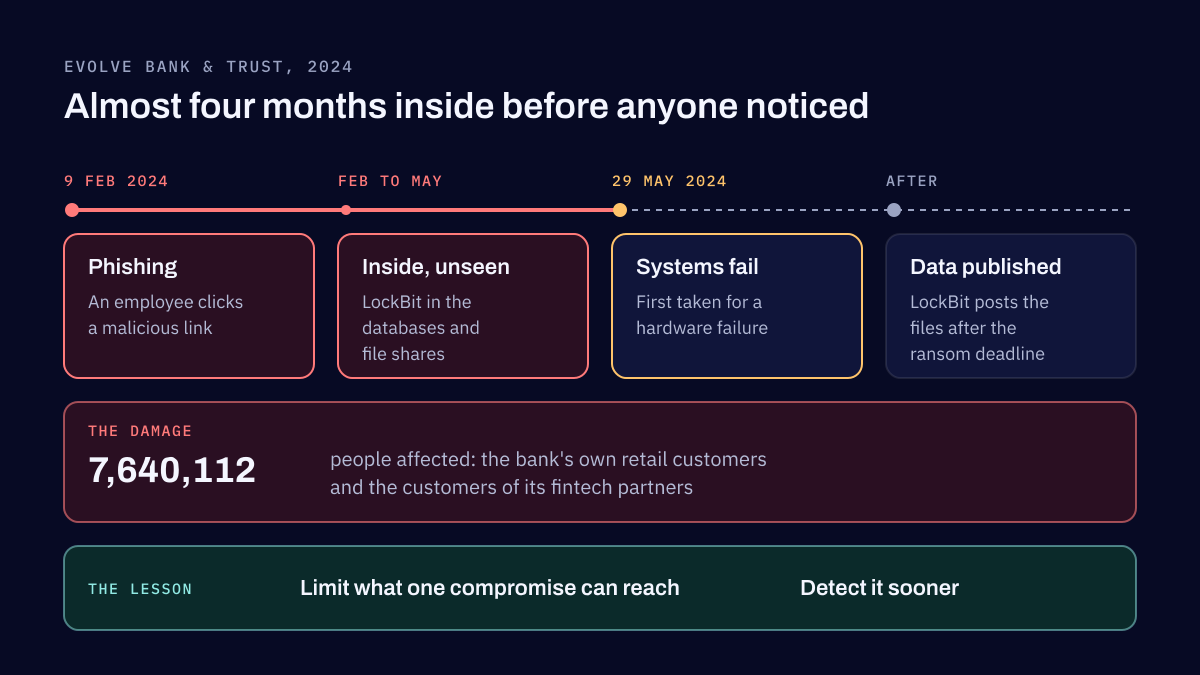
Three breaches of customer and financial data, at Evolve Bank & Trust, Sony and Banorte, began in different ways. What they share is the damage, and the lessons are about limiting what one compromise can reach and finding it sooner.
Tell us what you need reviewed
Name the applications, cloud accounts or data in question, and any deadline. We reply within two business days.