Threats and Breaches
Evolve Bank and Trust data breach: what it, Sony and Banorte teach
Three breaches of customer and financial data, at Evolve Bank & Trust, Sony and Banorte, began in different ways. What they share is the damage, and the lessons are about limiting what one compromise can reach and finding it sooner.

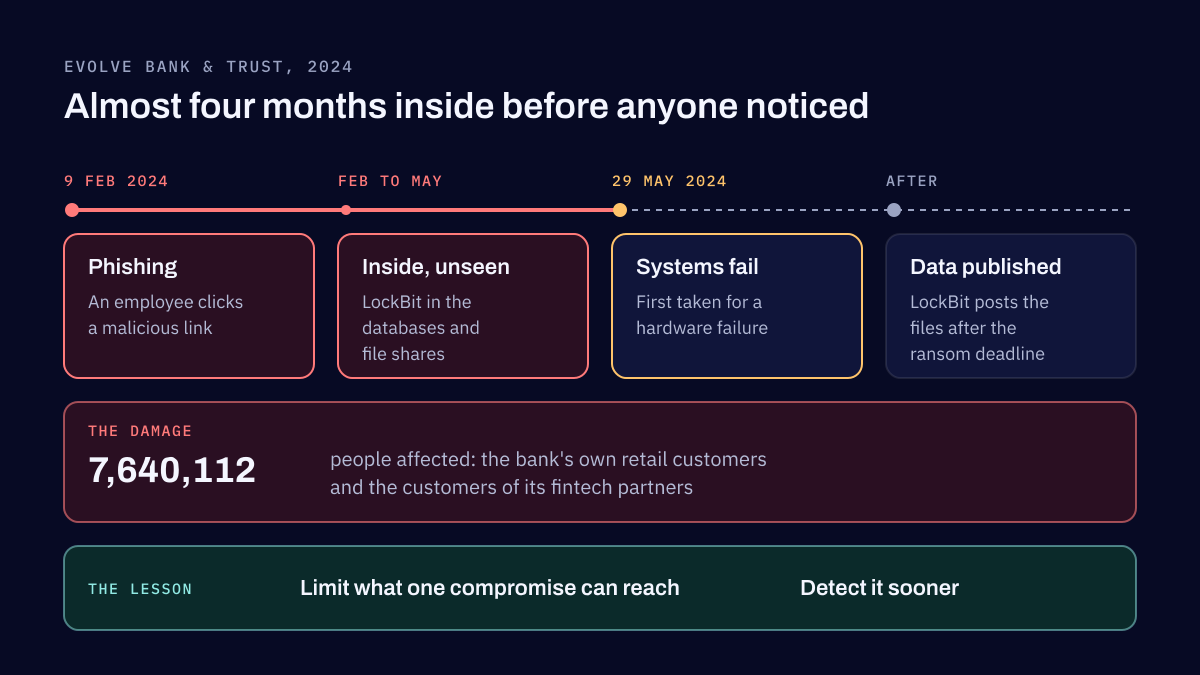
The Evolve Bank & Trust data breach began on 9 February 2024, when an employee clicked a malicious link. The LockBit ransomware group stayed inside the bank's systems until late May and took data on about 7.6 million people, many of them customers of fintech apps that bank with Evolve. Two earlier cases, at Sony and at the Mexican bank Banorte, began in different ways. What the three share is not the way in, but the damage: a lot of customer data within one attacker's reach, found late.
This article sets out what is known about each case, what the three have in common, and what I would check first at a bank or a fintech today.
What happened at Evolve Bank & Trust
Evolve is an Arkansas bank with a large role in financial technology: through its open banking division it provides banking services to fintech companies such as Affirm and Wise. According to its notice to the Maine Attorney General, the attacker got in on 9 February 2024 after an employee clicked a malicious link. The bank noticed on 29 May that some systems were not working properly and at first took it for a hardware failure.
By then the attacker had spent almost four months in its databases and file shares. LockBit first claimed it had stolen data from the US Federal Reserve. When the ransom deadline passed without the demand being met, it published the files, and researchers found they belonged to Evolve. The bank's filing counts 7,640,112 people affected, including its own retail customers and the customers of its fintech partners.
On 14 June 2024, shortly before the breach became public, the Federal Reserve announced an enforcement action against Evolve. Examinations in 2023 had found that the bank lacked an effective framework for managing the risk of its fintech partnerships. The order was about compliance rather than the breach, but it describes the same weakness from another side: a bank responsible for a great deal of other companies' customer data, without the controls that responsibility requires.
Sony: a file-transfer tool as the way in
In 2023 the Cl0p group exploited a flaw in MOVEit Transfer, a file-transfer product from Progress Software, before a fix existed. The flaw, CVE-2023-34362, let an attacker read the product's database without logging in. Sony's MOVEit server was accessed on 28 May 2023, and the company found the unauthorised downloads on 2 June.
Sony notified 6,791 people in the United States, mostly current and former employees and their families. The incident stayed within the MOVEit platform, which Sony took offline. The lesson is narrow but common: a tool that moves files between companies holds sensitive data by design, faces the internet by design, and is often patched last.
Banorte: a leak whose cause was never disclosed
In August 2022 a 1.4 GB file with data on Banorte customers appeared online: full names, tax IDs, addresses, phone numbers, email addresses and account balances. The Mexican digital rights group R3D confirmed that the records were real customer data. Banorte said its platforms had not been breached and that the information was inaccurate and out of date.
How the data left the bank has never been made public, and this article does not guess. The case still teaches something: data a company no longer uses, but still holds, can be leaked just like current data, and it carries the same harm for the people named in it.
What the three breaches share
The three breaches started differently: a phishing email at Evolve Bank, a flaw in the MOVEit file-transfer tool at Sony, and an undisclosed cause at Banorte. What they share is the damage: large amounts of customer data were reachable once an attacker was in, and the companies found out late. The lesson is to limit what one compromise can reach and to detect it sooner.
Neither half of that lesson depends on stopping every attack. Phishing will occasionally work, and a supplier's product will occasionally have a flaw nobody knew about. What a company controls is how far one compromised account or server can go, and how long it takes to notice.
Weak points we keep finding at financial companies
Recurring risks include phishing that leads to broad access, file-transfer platforms left unpatched, sensitive data held for partners or past customers with no clear owner, and detection gaps that delay spotting unauthorised access and data exfiltration.
Each is worth a sentence. Phishing does the most damage when the account that clicks can reach far more than its owner needs, which is a question of privileges, not of training alone. File-transfer servers sit at the edge of the network and are easy to forget once they work. Data held for a partner, or for customers who left years ago, often has no owner who would notice it being copied. And a monitoring setup that alerts on malware but not on a large, unusual transfer of data will miss exactly the stage at which an attacker turns access into harm.
What to check first at a bank or fintech
After reading these cases, these are the checks I would put first:
- Third-party access: which partners, suppliers and their tools can reach your systems or your data, and what each can see.
- IAM privileges: accounts, human or not, that hold more access than their work needs, starting with administrators and service accounts.
- Exposed applications: everything that faces the internet, file-transfer tools included, tested the way an attacker would. Penetration testing of exposed applications is the direct way to find out.
- Vulnerability management: how long a critical patch takes to reach production, and who decides when it cannot.
- Data exfiltration monitoring: whether a large or unusual transfer of customer data would raise an alert.
- SIEM detection coverage: which attacker techniques your SIEM detection rules would catch, and which they would not.
- Incident response readiness: whether your own plan has been tested, with names, decisions and the regulators you must notify.
- Controls protecting customer data: where it sits, who can read it, whether it is encrypted, and whether data you no longer need is deleted. Reviewing how customer data is protected in your applications and cloud accounts covers this.
Phishing will remain the most common way in, so phishing exercises for staff still matter; they work best alongside the privilege limits above, not instead of them. If your company depends on suppliers whose software runs inside it, the same reasoning applies to them, as the article on what happens when a supplier fails explains.
The most useful first step is usually a cybersecurity risk assessment that starts with third-party access, privileged accounts and where customer data sits. It shows which of these checks matter most for your company, and in which order to close the gaps.
Frequently asked questions
How did the Evolve Bank & Trust data breach happen?
An employee clicked a malicious link on 9 February 2024, which gave a member of the LockBit ransomware group access to the bank's databases and file shares. The bank found the intrusion on 29 May, after first taking the symptoms for a hardware fault. The ransom demand was not met, and the stolen data was published.
How many people were affected, and what data was taken?
Evolve's notice to the Maine Attorney General lists 7,640,112 people. According to the bank, the data varies from person to person and may include name, Social Security number, date of birth, account information and other personal details. Many of the people affected were customers of fintech companies that use Evolve as their bank.
Did the breach come through a fintech partner?
No. It started inside the bank, with a phishing link. The fintech partners' customers were affected because the bank held their data, so the partners and their customers paid for a weakness that was not theirs. That is the reason a fintech should know how its bank protects the data it holds on its behalf.
What should a bank or fintech check first after a breach like this?
Who outside the company can reach its systems, which accounts hold broad privileges, which applications face the internet, how quickly vulnerabilities are patched, and whether large data transfers would be noticed. Then whether the SIEM would detect the attack, whether the incident plan has been tested, and how customer data is protected where it sits.
Sources
- Evolve Bank & Trust notice of data breach, filed with the Maine Attorney General, Office of the Maine Attorney General, 2024
- Evolve Bank says data breach impacts 7.6 million Americans, BleepingComputer, 2024
- Evolve Bank confirms data stolen by ransomware gang, Finextra, 2024
- Federal Reserve Board announces enforcement action with Evolve Bancorp and Evolve Bank & Trust, Board of Governors of the Federal Reserve System, 2024
- Sony confirms data breach impacting thousands in the U.S., BleepingComputer, 2023
- Progress Software releases security advisory for MOVEit Transfer, CISA, 2023
- Denuncian presunta filtración de datos de clientes de Banorte; banco niega vulneración, El Financiero, 2022
Cybersecurity risk assessment and threat analysis
A cybersecurity risk assessment tells you which risks matter most and what to do first. We model the threats your company faces, check your systems for weaknesses, rate each risk and hand you a plan for treating them, in two to six weeks at a fixed price.
Related reading
Threats and Breaches
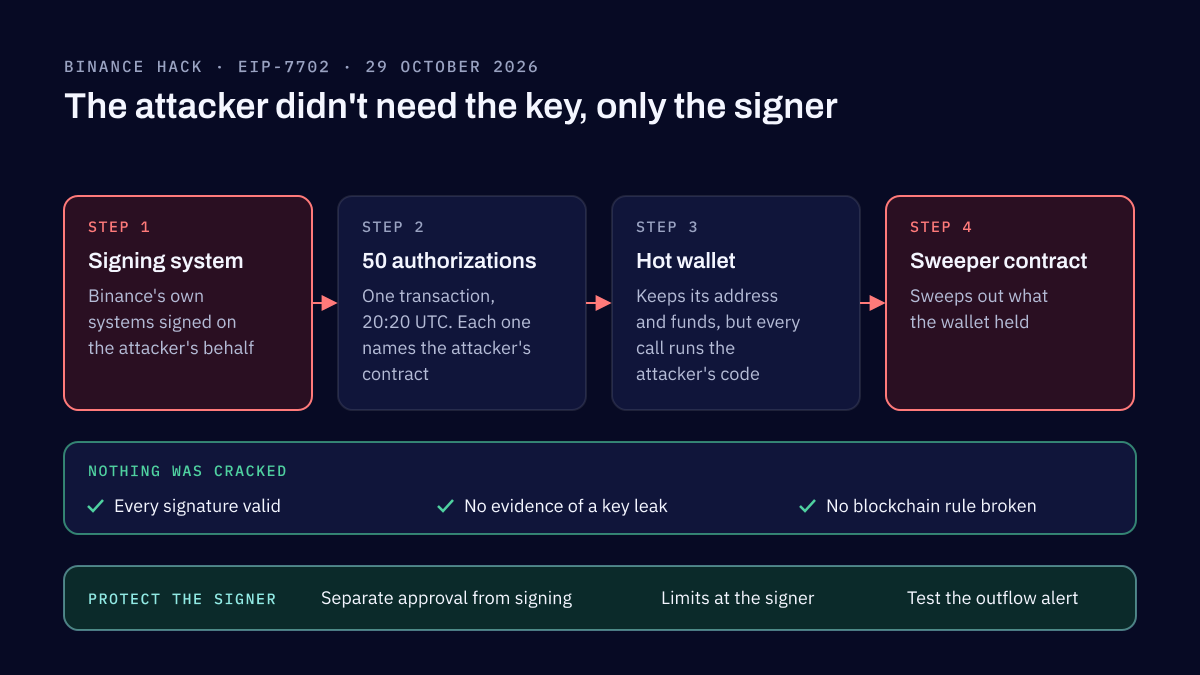
The $6 billion Binance hack: how EIP-7702 turned a hot wallet against its owner
Attackers drained about $6.3 billion from Binance's hot wallets on 29 October 2026, using EIP-7702 to point a wallet at their own contract. The keys did not leak; a system that signs was used. The lesson for any company is to protect the signer and the approvals, not only the key.
Threats and Breaches
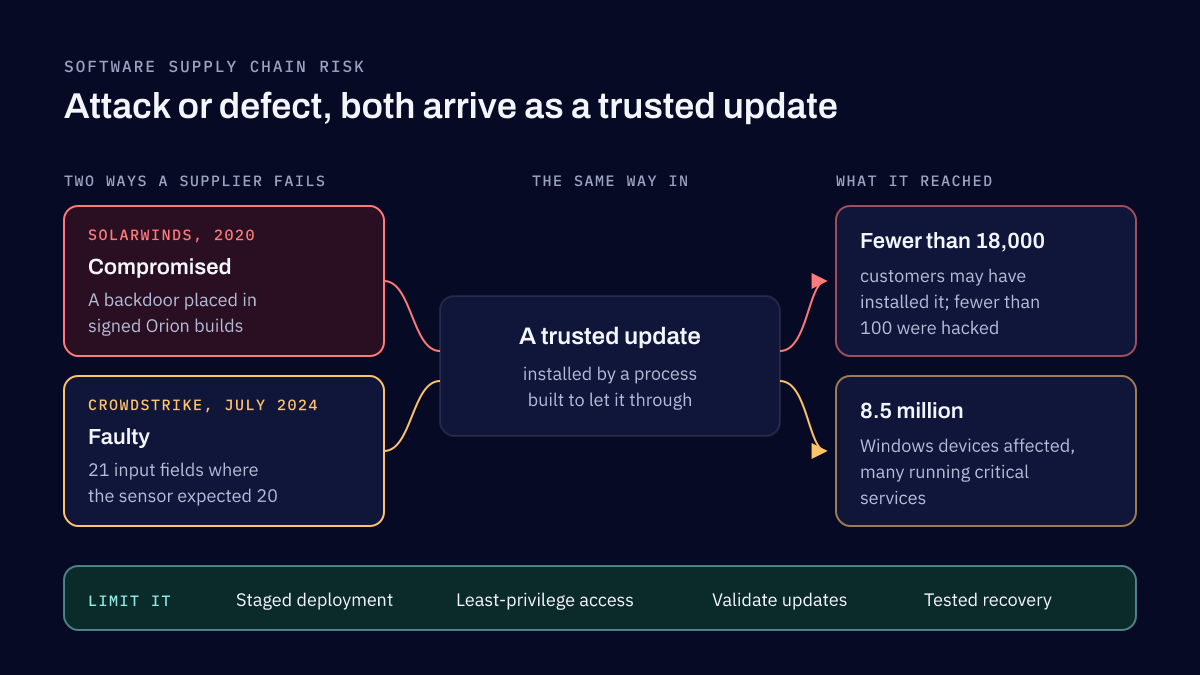
Software supply chain risk: what SolarWinds and CrowdStrike teach
The SolarWinds attack and the CrowdStrike outage were different failures that arrived the same way, as a trusted update. What they show about software supply chain risk, and the contract terms and controls that limit it.
Tell us what prompted the question
A few lines on what you need to understand, and who is asking, are enough. We reply within two business days.