Threats and Breaches
Software supply chain risk: what SolarWinds and CrowdStrike teach
The SolarWinds attack and the CrowdStrike outage were different failures that arrived the same way, as a trusted update. What they show about software supply chain risk, and the contract terms and controls that limit it.

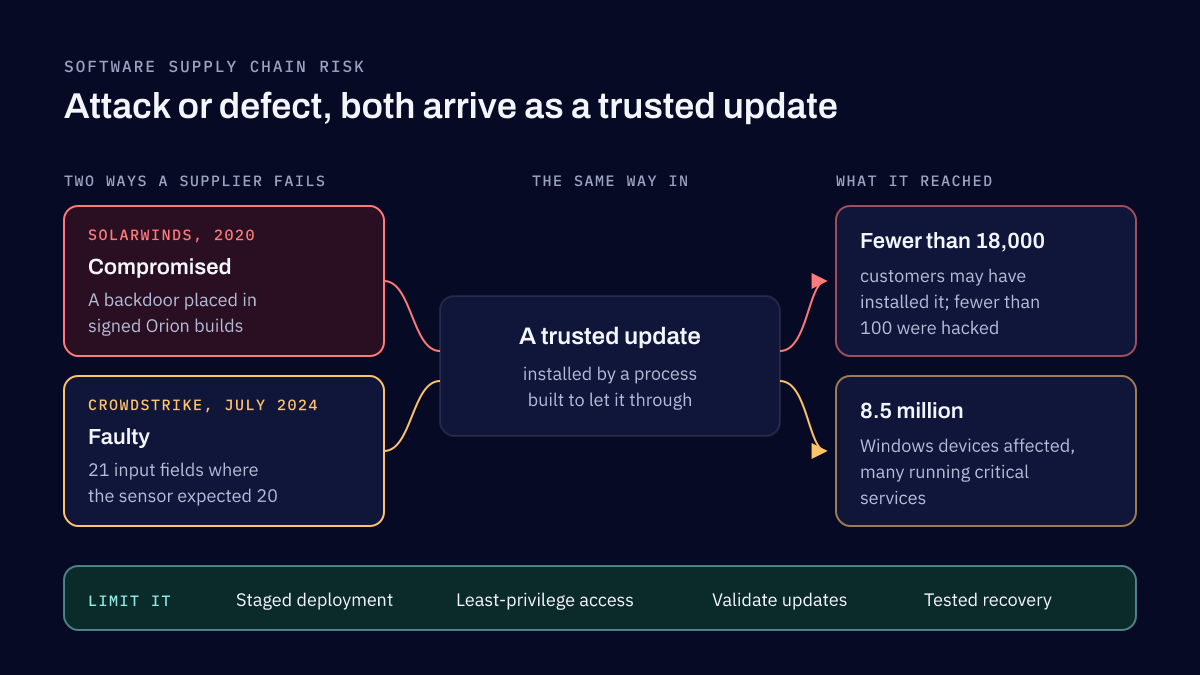
Software supply chain risk is the chance that software you trust, or an update to it, causes harm you did not create. The update can be compromised, as Orion's was in the SolarWinds attack of 2020, or simply faulty, as CrowdStrike's was in July 2024. You cannot remove the risk, but you can limit it: know which suppliers are critical, control how their updates reach production, limit what their access can reach, and plan for the day one fails.
This article compares the two incidents, then sets out how companies assess suppliers today, what is usually missing, and the contract terms and controls I recommend for a critical supplier.
Two ways a supplier fails you
A supplier can fail you in two ways. It can be compromised, so that an attacker uses its trusted position to reach you. Or it can make a mistake of its own, with no attacker involved. The two look different in the news, but they arrive the same way: as an update from a supplier you have already decided to trust, installed by a process built to let it through.
That is what makes them hard. Most security controls are designed to stop outsiders. A supplier's agent, management tool or update service is, by design, an insider with privileged access.
SolarWinds: a trusted update with a backdoor
In 2020 attackers got into SolarWinds' systems and placed a backdoor, later named SUNBURST, in builds of its Orion network management platform. The builds were signed and delivered through the normal update channel, so customers installed them as they would any other update. CISA's alert on the campaign says the activity began in at least March 2020, and the US government later attributed it to Russia's foreign intelligence service.
In December 2020 SolarWinds told about 33,000 Orion customers, and estimated that fewer than 18,000 might have installed an affected version. That figure is often quoted as the number of victims. It is not: in May 2021 the company estimated that fewer than 100 customers were actually hacked through SUNBURST. The attackers went further only at a small number of the companies that had installed it.
SolarWinds showed that an update can be authentic, signed and still hostile. Checking that an update really comes from the supplier is necessary, but it says nothing about whether the supplier itself was compromised.
CrowdStrike: an update that skipped staging
On 19 July 2024 CrowdStrike pushed a content update, Channel File 291, to its Falcon sensor on Windows. The update's new template expected 21 input fields, but the sensor supplied only 20. When the sensor tried to read the missing 21st value, it read memory out of bounds and crashed the machines it was protecting, and CrowdStrike's content validator did not catch it. Microsoft estimated that 8.5 million Windows devices were affected, under one percent of all Windows machines, but, as Microsoft noted, many of them ran critical services at large companies.
CrowdStrike's own root cause analysis names two gaps: the validator, and the absence of a staged rollout for that type of content, so the update went to every online Windows host running the sensor at once, until CrowdStrike reverted it. Its fixes include staged deployment for content updates. Customers can now set content update policies by category, with an early access or general release ring, a delay of up to 72 hours, or a pinned version that does not update until they choose.
How companies assess suppliers today, and what is missing
Companies typically assess suppliers through security questionnaires, compliance certifications and vendor risk assessments. Common gaps include continuous monitoring, software update validation, dependency visibility and independent verification of supplier security controls.
A questionnaire and a certificate describe the supplier on the day they were written. Neither tells you how the supplier tests an update before it reaches you, what open source components its software depends on, or whether the controls it describes are in place. That is the part of the assessment that would have mattered in both incidents.
What changed in our advice
SolarWinds demonstrated the risks of compromised software supply chains and trusted updates. CrowdStrike exposed the operational impact of insufficient update validation. Both reinforce the need for zero trust principles, staged deployments, rigorous testing and business continuity planning.
In practice, zero trust here means treating a supplier's software as something that can turn against you: its access is limited to what it needs and watched like any other privileged account. Staged deployment means a supplier's update reaches a small group of machines first, with time to see whether they survive, wherever the supplier lets you choose. Staged deployment in your own pipeline follows the same principle for the software you build.
Contract terms and controls for a critical supplier
For a supplier whose failure would stop the business, I recommend these terms in the contract:
- Security audit rights, so you can verify controls rather than rely on a questionnaire.
- Incident notification SLAs, with a deadline for telling you of an incident.
- Staged update controls, so you decide which machines receive an update first.
- Update deferral options, so you can delay an update without losing support.
- Tested continuity plans, on their side and yours, for the day the supplier is down.
And these controls on your side:
- Least-privilege access for the supplier's software and staff, designed with zero trust access for suppliers in mind.
- Monitoring of supplier activity, as for any privileged account.
- Validation of deployments before an update reaches every machine.
- Recovery procedures that have been tested, not only written.
The contract terms should be agreed with your counsel; the list is what to ask for, not legal wording.
Frameworks that already ask for this
None of this is new to the standards. NIST SP 800-161 Revision 1, updated in November 2024, sets out cybersecurity supply chain risk management practices; it was written for US federal agencies, and any organisation can apply it. In the United States, banks follow the 2023 interagency guidance on third-party relationships, which says that using a third party does not reduce the bank's own responsibility. In the European Union, the Digital Operational Resilience Act has applied to financial firms since 17 January 2025, and requires a register of every ICT supplier arrangement.
Supplier failure also reaches customer data: the Evolve Bank breach shows the other side, where fintech companies' customers were exposed by their bank.
The way to start is to know which suppliers are critical and what each can reach. A risk assessment answers that, and a process for assessing suppliers keeps the answer current as part of your security program.
Frequently asked questions
What is software supply chain risk?
It is the chance that software you trust, or an update to it, causes harm you did not create. The harm can come from an attacker who compromises the supplier and uses its update channel, or from the supplier's own mistake. Either way it arrives through a channel your defences are built to trust.
What is the difference between the SolarWinds attack and the CrowdStrike outage?
SolarWinds was an attack. Intruders placed a backdoor in builds of the Orion platform, and signed updates carried it to customers. CrowdStrike was a defect. A content update that expected one more input than the sensor supplied crashed Windows hosts, and no staged rollout limited how many received it. One tests whether you can trust an update, the other whether you can survive a bad one.
How do you assess a software supplier's risk?
Most companies use security questionnaires, compliance certifications and vendor risk assessments before signing. Those are a start. What they usually miss is continuous monitoring after signing, validation of the supplier's updates before they reach production, visibility of the components the software depends on, and independent checks of the controls the supplier says it has.
What should a contract with a critical software supplier include?
Security audit rights, a deadline for notifying you of an incident, control over when updates are deployed, the option to defer an update, and a continuity plan that has been tested. Agree the exact wording with your counsel. The contract matters most on the day something goes wrong, so write it for that day.
Sources
- Channel File 291 incident: root cause analysis, CrowdStrike, 2024
- Content update policy, Falcon Terraform provider, CrowdStrike, 2026
- Helping our customers through the CrowdStrike outage, Microsoft, 2024
- SolarWinds Corporation, Form 8-K of 14 December 2020, SolarWinds, via the SEC, 2020
- SolarWinds Corporation, Form 8-K of 7 May 2021, SolarWinds, via the SEC, 2021
- Advanced persistent threat compromise of government agencies, critical infrastructure, and private sector organizations (AA20-352A), CISA, 2020
- Cybersecurity Supply Chain Risk Management Practices for Systems and Organizations (SP 800-161 Rev. 1, Update 1), NIST, 2024
- Interagency Guidance on Third-Party Relationships: Risk Management (SR 23-4), Board of Governors of the Federal Reserve System, 2023
- Preparation for the application of DORA, European Banking Authority, 2025
Information security program development and governance
Security governance turns good intentions into a program that runs. We design the program, write the policy framework, set up the risk and metrics reporting your leadership reads, and build the process for assessing suppliers, on ISO/IEC 27001 and NIST CSF.
Related reading
Threats and Breaches
The $6 billion Binance hack: how EIP-7702 turned a hot wallet against its owner
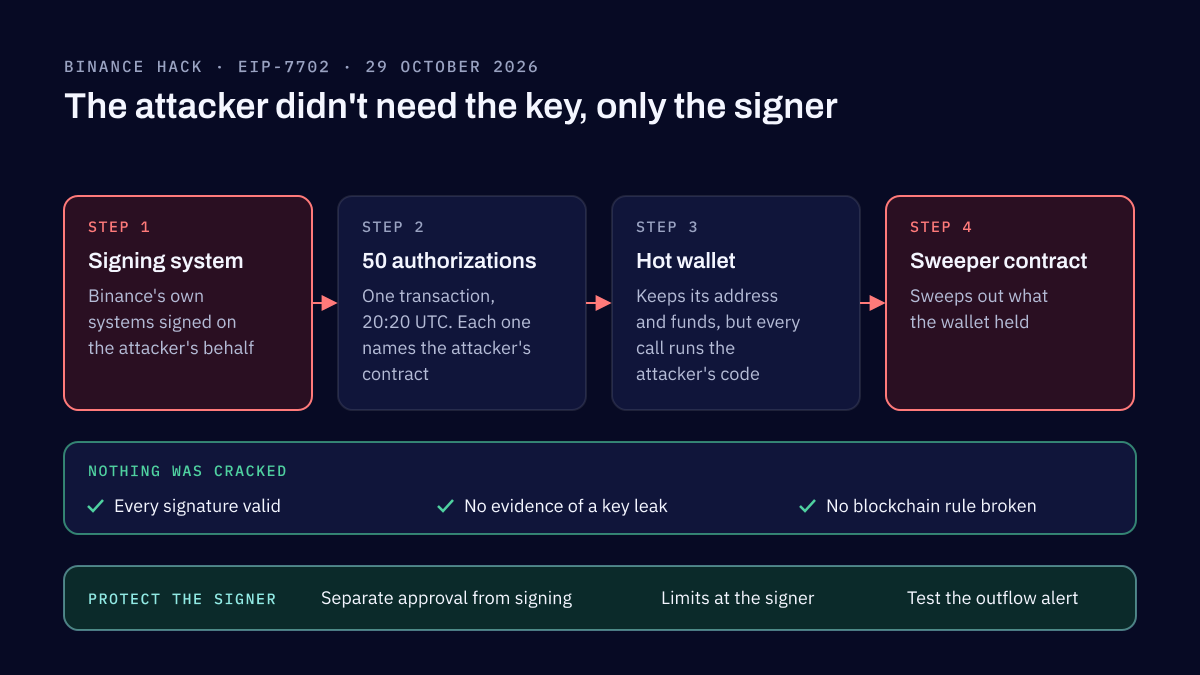
Attackers drained about $6.3 billion from Binance's hot wallets on 29 October 2026, using EIP-7702 to point a wallet at their own contract. The keys did not leak; a system that signs was used. The lesson for any company is to protect the signer and the approvals, not only the key.
Threats and Breaches
Evolve Bank and Trust data breach: what it, Sony and Banorte teach
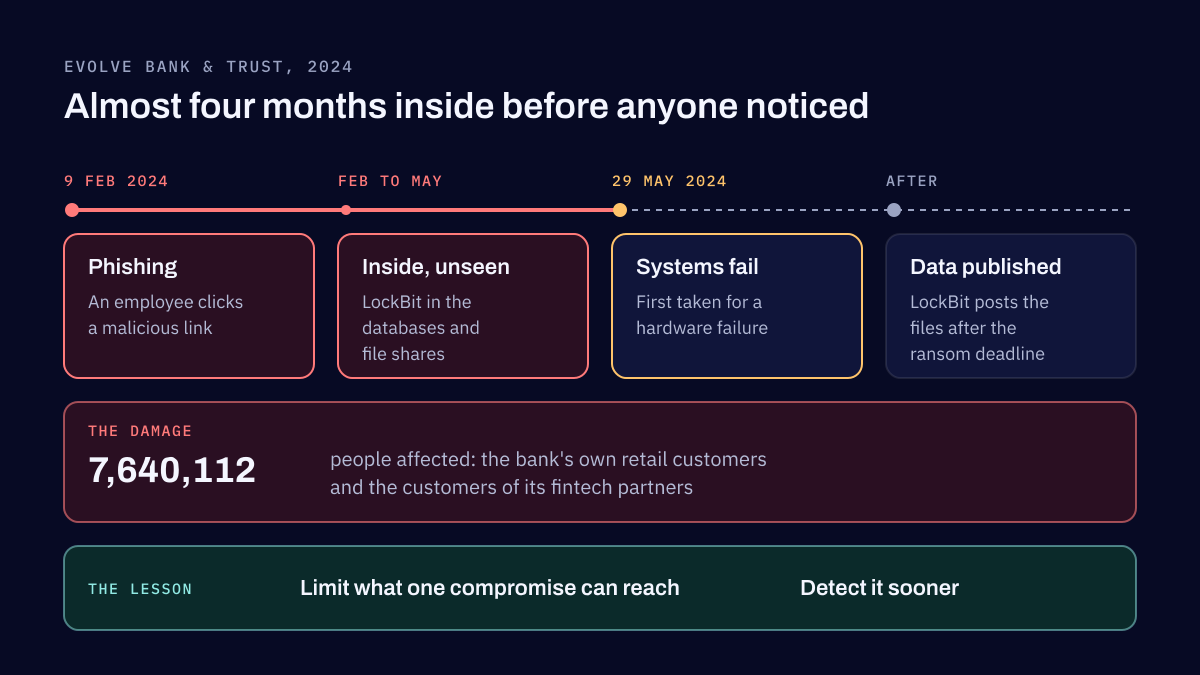
Three breaches of customer and financial data, at Evolve Bank & Trust, Sony and Banorte, began in different ways. What they share is the damage, and the lessons are about limiting what one compromise can reach and finding it sooner.
Tell us where your security program stands
A few lines on what exists today and what prompted the question are enough. We reply within two business days.