Kubernetes and Containers
Shielded GKE Nodes: what they protect and what they do not
Shielded GKE Nodes prove to the control plane that each node is a genuine VM of your cluster, so an attacker who steals a node's bootstrap credentials cannot impersonate it. Secure Boot and integrity monitoring add checks on how the node started. They protect the node, not the workloads running on it.

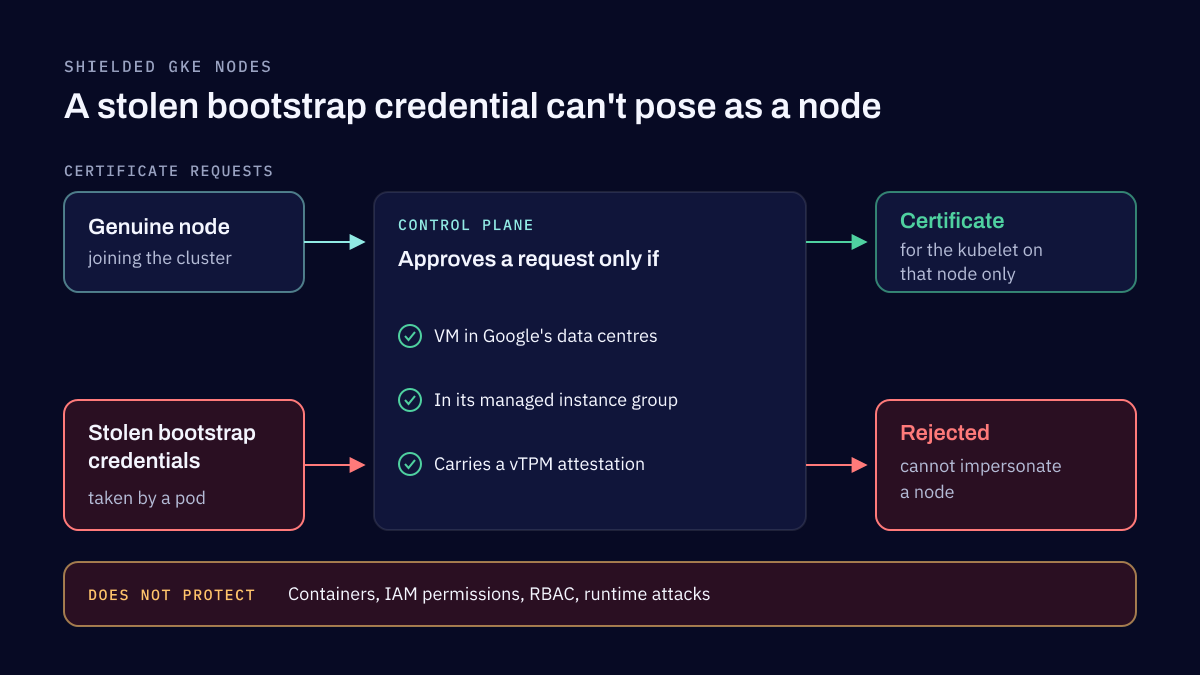
Shielded GKE Nodes protect a cluster against node impersonation. Without them, an attacker who exploits a vulnerability in a pod can steal the node's bootstrap credentials and pose as a node, which can expose the cluster's secrets. With them, the control plane gives a node its credentials only after verifying that it is a genuine VM of the cluster. Secure Boot and integrity monitoring add checks on how each node booted. None of these protect the containers themselves.
This article is part of our Google Cloud and Kubernetes series. The overview of container security best practices covers the workload controls that sit above the node.
What they protect against
A new GKE node starts with bootstrap credentials in its metadata, which it uses to obtain the certificate the kubelet needs to join the cluster. The risk is that a pod which escapes to the node, or reads the node's metadata, takes those credentials and uses them to request certificates of its own.
Shielded GKE Nodes close that path. The bootstrap credentials can only create certificate signing requests, and the control plane approves a request only when the node passes its checks: it is a VM in Google's data centres, it belongs to the cluster's managed instance group, and the request carries an attestation from the node's virtual Trusted Platform Module (vTPM). The certificate it issues is valid only for the kubelet on that node. A stolen bootstrap credential is therefore not enough to impersonate a node.
In our experience, Shielded Nodes matter most in security audits and compliance reviews, as evidence that node identity and boot integrity are verified, and in detecting unexpected changes to how a node boots.
Secure Boot and integrity monitoring
The same Shielded VM technology offers two further settings on each node pool.
Integrity monitoring compares each boot of the node against a known good baseline and reports when the boot sequence changes. It is on by default for GKE node pools.
Secure Boot checks that the node's boot components are signed, and refuses to start what is not. It is off by default on node pools, and you turn it on with --shielded-secure-boot when creating a cluster or node pool. Its effect depends on the node image. On Ubuntu nodes, Secure Boot blocks unsigned third-party kernel modules from loading. On Container-Optimized OS it does not affect module loading, which that image controls separately.
What they do not protect against
The most common misunderstanding we meet is that Shielded Nodes protect the workloads. They do not. They do not prevent a container from being exploited, they do not limit what an over-privileged IAM account can do, they do not fix Kubernetes RBAC that grants too much, and they do not detect a runtime attack inside a container. Their focus is node identity and boot integrity, and nothing more.
That makes them one layer among several. The controls for the workloads above the node are different ones:
- Who can call Google Cloud APIs, and with which permissions: Workload Identity Federation for GKE.
- Which images are allowed to run at all: Binary Authorization.
- What a container can do once it runs: the Pod Security Standards, RBAC and network policies in the overview.
Defaults on Autopilot and Standard
On Autopilot clusters, Shielded GKE Nodes are always on and cannot be turned off. Google's hardening guide lists Shielded Nodes, Secure Boot and integrity monitoring as always enabled in Autopilot.
On Standard clusters, Shielded GKE Nodes are on by default but can be turned off. Integrity monitoring is on by default, and Secure Boot is off unless you enable it. The control plane always uses Shielded Nodes, whatever the setting.
The feature carries no extra charge. Google notes that a shielded node writes about 0.5 KB more logs at startup than a standard one.
The order we turn them on
On a new Standard cluster, we enable Shielded GKE Nodes, integrity monitoring and a hardened node image, Container-Optimized OS, from the start. We enable Secure Boot after compatibility testing, particularly on Ubuntu nodes that need unsigned third-party kernel modules or custom drivers. A security control that stops nodes from running the workloads they exist for has failed at its job, so availability is part of the test.
In practice that means a test node pool with Secure Boot on, running the same workloads and agents as production, before the setting reaches production node pools.
Turning them on for existing clusters
On an existing Standard cluster you can enable or disable Shielded GKE Nodes with gcloud container clusters update. Plan it as a change, not a toggle. GKE recreates the control plane immediately and the worker nodes through surge upgrades, and this happens even if node auto-upgrades are turned off. If the control plane changes before the nodes do, node registration can fail, so check the cluster's maintenance settings before you start.
Google documents Secure Boot and integrity monitoring as settings chosen when a node pool is created. The documented route for an existing cluster is therefore a new node pool with the settings you want, then moving workloads to it and removing the old pool.
Where GUILDA can help
Our Engineering Security service hardens GKE clusters against the CIS Benchmarks for Kubernetes, including node configuration, and documents each change for your team. For the Google Cloud projects around the cluster, Data, Application & Cloud Security assesses and hardens the accounts, IAM and logging. If node integrity comes up in an ISO/IEC 27001 or SOC 2 audit, Compliance & Certification prepares the controls and evidence the auditor asks for.
Sources
- Use Shielded GKE Nodes, Google Cloud, 2026
- Best practices for hardening your cluster's security, Google Cloud, 2026
DevSecOps consulting and engineering security
We build security into how your software is designed, built and run, from the checks in your pipeline to the configuration of your Kubernetes clusters and the coding standards your developers follow. Everything we set up is handed to your team to own.
Related reading
Kubernetes and Containers
Binary Authorization on GKE: a rollout that does not block deployments
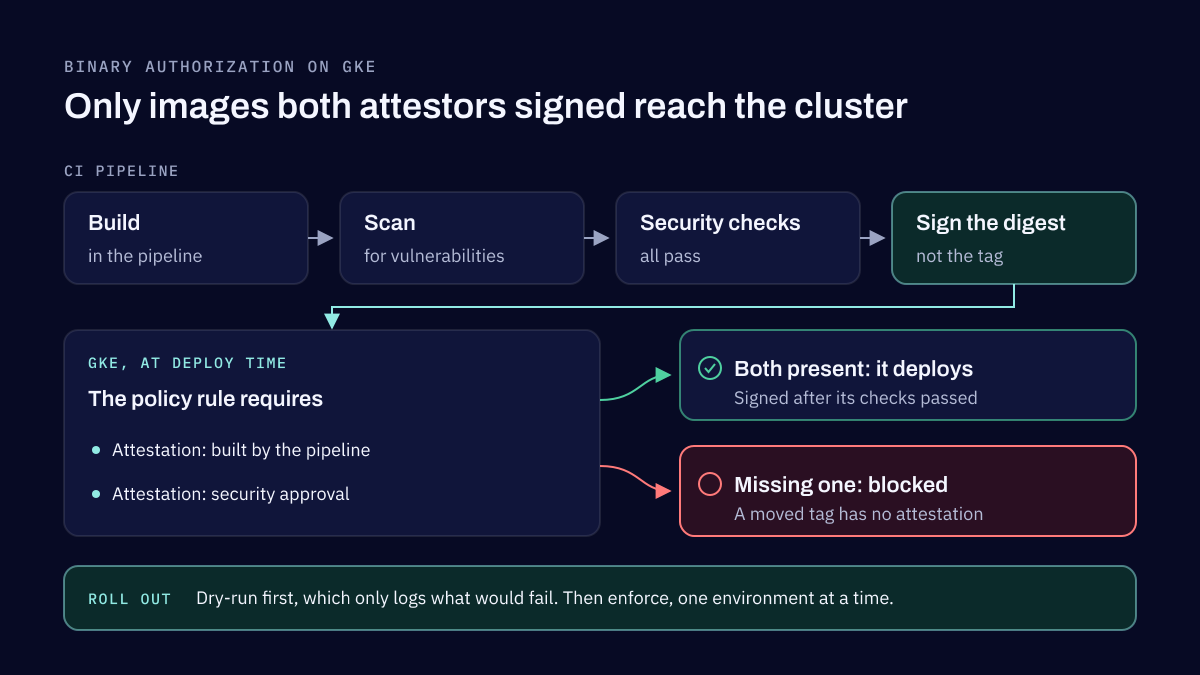
Binary Authorization makes GKE check every container image against a policy before it deploys, and lets only images signed by the attestors you trust run. Roll it out in dry-run mode first, sign image digests in CI after the build and the scan pass, and keep exemptions and break-glass for real emergencies.
Kubernetes and Containers
Workload Identity Federation for GKE: access without keys
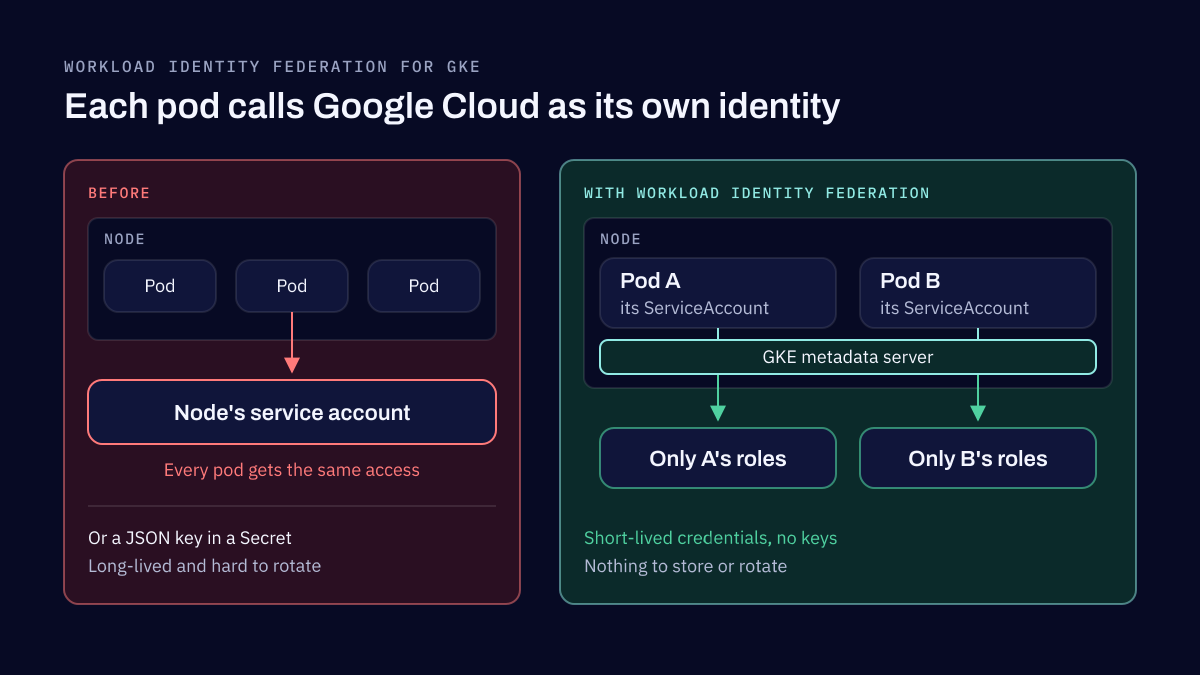
Workload Identity Federation for GKE lets a Kubernetes workload call Google Cloud APIs as its own identity, with short-lived credentials and no service account key to store or rotate. It removes a whole class of leaked credentials, but only if each workload gets its own identity and only the access it needs.
Tell us how your software is built and shipped
Name the languages, the pipeline and where it runs. We reply within two business days.